
Is Synopsys, Inc.'s (NASDAQ:SNPS) Latest Stock Performance A Reflection Of Its Financial Health?
Synopsys' (NASDAQ:SNPS) stock is up by a considerable 6.7% over the past month. Given that the market rewards strong financials in the long-term, we wonder if that is the case in this instance. In this article, we decided to focus on Synopsys' ROE.
Return on Equity or ROE is a test of how effectively a company is growing its value and managing investors’ money. Simply put, it is used to assess the profitability of a company in relation to its equity capital.
Check out our latest analysis for Synopsys
How Do You Calculate Return On Equity?
ROE can be calculated by using the formula:
Return on Equity = Net Profit (from continuing operations) ÷ Shareholders' Equity
So, based on the above formula, the ROE for Synopsys is:
21% = US$1.4b ÷ US$6.7b (Based on the trailing twelve months to January 2024).
The 'return' refers to a company's earnings over the last year. One way to conceptualize this is that for each $1 of shareholders' capital it has, the company made $0.21 in profit.
What Has ROE Got To Do With Earnings Growth?
We have already established that ROE serves as an efficient profit-generating gauge for a company's future earnings. Depending on how much of these profits the company reinvests or "retains", and how effectively it does so, we are then able to assess a company’s earnings growth potential. Assuming everything else remains unchanged, the higher the ROE and profit retention, the higher the growth rate of a company compared to companies that don't necessarily bear these characteristics.
Synopsys' Earnings Growth And 21% ROE
To start with, Synopsys' ROE looks acceptable. Further, the company's ROE compares quite favorably to the industry average of 12%. This probably laid the ground for Synopsys' moderate 18% net income growth seen over the past five years.
As a next step, we compared Synopsys' net income growth with the industry and found that the company has a similar growth figure when compared with the industry average growth rate of 16% in the same period.
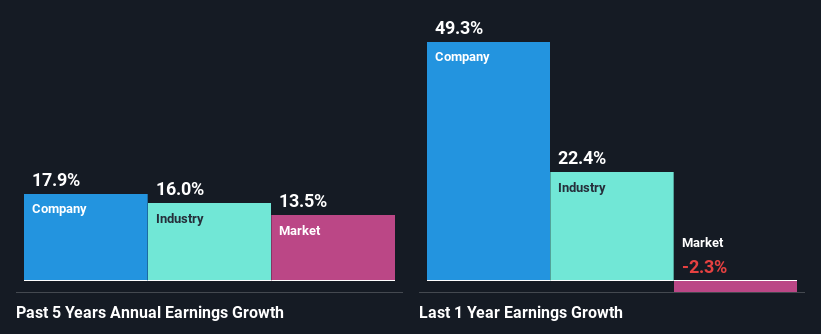
Earnings growth is a huge factor in stock valuation. The investor should try to establish if the expected growth or decline in earnings, whichever the case may be, is priced in. This then helps them determine if the stock is placed for a bright or bleak future. If you're wondering about Synopsys''s valuation, check out this gauge of its price-to-earnings ratio, as compared to its industry.
Is Synopsys Efficiently Re-investing Its Profits?
Given that Synopsys doesn't pay any dividend to its shareholders, we infer that the company has been reinvesting all of its profits to grow its business.