
Anton Petrus/Moment via Getty Images
Anton Petrus/Moment via Getty Images
China, to put it lightly, has been a disaster, and there are multiple reasons for why. First, regulatory crackdowns across various sectors, including technology, education, and property, have introduced significant uncertainty and risk, potentially stifling innovation and growth. Second, the ongoing tensions between China and the United States, encompassing trade disputes and sanctions, pose a substantial threat to market stability and international investment flows. Additionally, China's economic growth, although still robust, shows signs of slowing down, exacerbated by an aging population and rising debt levels. These factors, combined with potential property market vulnerabilities and global economic pressures, create a complex environment where investors might see heightened risks, making it easy to want to short China's equity markets, which have been in a downtrend for some time.
But there is a price for everything. I know a lot of people remain bearish on China's equity markets, but shorting is something I'm against (it's almost impossible to do well over time), and especially after a large decline has already taken place. That's why the Direxion Daily FTSE China Bear 3X Shares ETF (NYSEARCA:YANG) is a fund to avoid in my opinion. But if your opinion differs from mine, just know the risks involved in trading it. YANG is an exchange-traded fund that aims to replicate, before fees and expenses, 3x the inverse daily performance of the FTSE China 50 Index. This index is comprised of the 50 largest and most liquid public Chinese companies currently trading on the Hong Kong Stock Exchange. The unique feature of YANG is that it has leverage of -300%, which allows it to amplify negative returns of the benchmark index.
YANG, managed by Rafferty Asset Management, LLC, operates with a net expense ratio of 1.08%. This includes management fees, other operating expenses, and acquired fund fees and expenses. The holdings for YANG are essentially swaps that achieve the leverage and daily inverse movement. Swaps are financial derivatives where two parties agree to exchange financial instruments or cash flows for a certain period of time. These instruments are used to manage risk or to gain exposure to various financial assets and markets. In essence, swaps enable parties to tailor their risk exposure according to their investment strategies or risk management needs, without necessarily having to own the underlying asset.
In the context of Exchange-Traded Funds, swaps are often used to achieve inverse or leveraged exposure. An inverse ETF like YANG aims to provide returns that are opposite to the performance of its benchmark index, effectively allowing investors to profit from declines in the market or a specific sector. Leveraged ETFs, on the other hand, seek to provide returns that are multiples of the daily performance of their benchmark index. Both types of ETFs often use swap agreements with financial institutions to achieve their objectives. By entering into a swap, the ETF can gain exposure to the performance of an index without directly holding the assets in the index. This method allows for the creation of complex financial products that can cater to sophisticated investment strategies, providing tools for both hedging and speculative opportunities.
direxion.com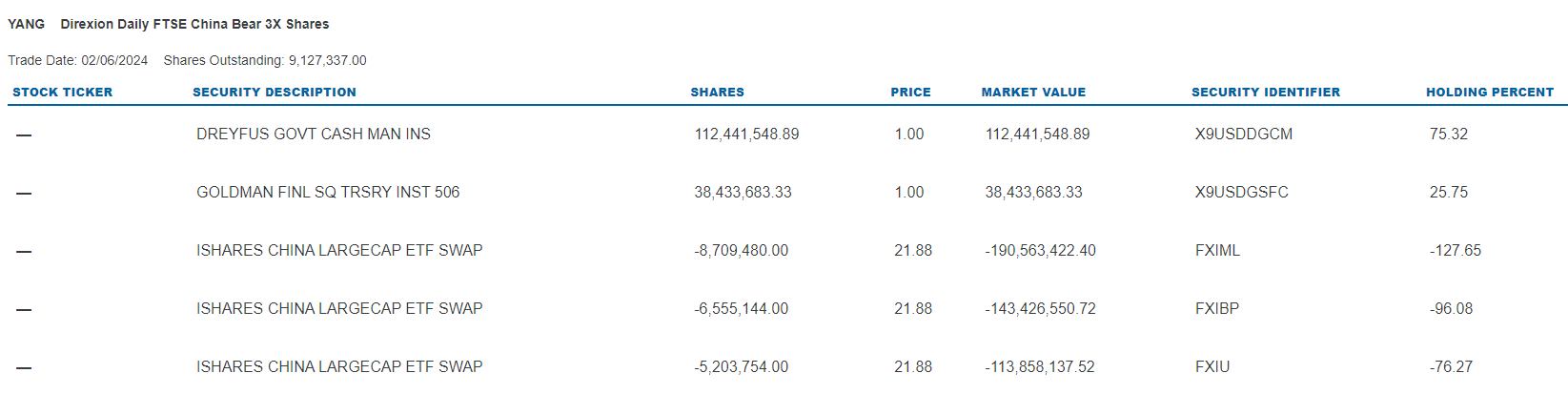
Investing in YANG offers the opportunity to profit from potential downturns in the Chinese market. However, it also comes with its own set of risks. The fund uses leverage, which can magnify both gains and losses. The daily inverse behavior also can result in some nasty compounding sequences, which is why inverse funds are so risky if held over any kind of a prolonged time period. China has also already gone down a lot, which makes the potential for betting against those equities far less appealing.
Trading YANG can be a strategic move to bet on further downturns in the Chinese market. But this is extremely risky. China's markets could easily rebound, and leveraging that just seems incredibly challenging here. I just don't think it makes sense unless you really want to speculate on a very short-term basis.