
Galeanu Mihai
Galeanu Mihai
Software is eating the world. Unfortunately, it's not making new highs. Still - it's a good area to look at for potential outperformance in the future. A good proxy for this is the SPDR® S&P Software & Services ETF (NYSEARCA:XSW), a passively managed exchange-traded fund that seeks to provide returns, before fees and expenses, that correspond to the overall performance of the industry. This ETF offers a unique opportunity to invest in a high-growth industry harnessing the power of technology trends like cloud computing, artificial intelligence, and blockchain.
XSW was launched by State Street Global Advisors in 2011. The fund aims to track the performance of the S&P Software & Services Select Industry Index, using a representative sampling technique. This index represents the software and services segment of the S&P Total Market Index, which comprises a variety of sub-sectors covering information technology, IT services, IT consulting, application software, and systems software.
The ETF is designed to provide a comprehensive selection of software and services stocks, with its holdings spanning across large, mid, and small-cap companies. This diversified approach, paired with its equal weighting methodology, ensures investors gain a broad exposure to the software and services sector without the risk of overconcentration in a few large companies.
The ETF's portfolio consists of a diverse mix of software and services stocks, with a focus on small to mid-cap growth-oriented companies. The fund has 137 holdings, and no position makes up more than 1.06% of the portfolio.
ssga.com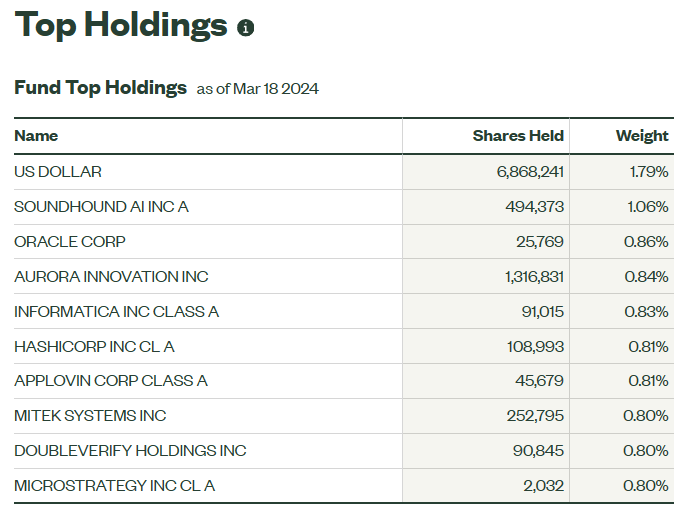
It's worth noting that the ETF also features mega-cap names and more high-profile software leaders such as Salesforce, Oracle Corporation, and Adobe Inc., but at a much smaller position than market-cap weighted averages.
XSW invests across several sub-sectors within the technology sector, with a strong focus on software and services. The majority of stocks are in the Application Software sub-group, with a 70% weighting.
ssga.com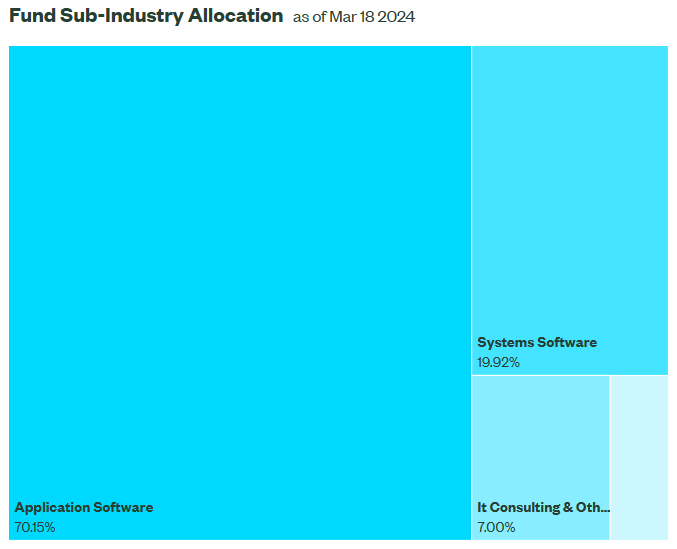
When compared to its peer ETFs, XSW stands out due to its unique equal-weighted methodology. This approach differentiates XSW from its peers, which typically use a market-capitalization-weighted methodology. XSW's equal-weighting method ensures that smaller companies gain more importance within the index and the fund's portfolio compared to market-cap-weighted alternatives. This shift in focus towards smaller, growth-oriented companies makes XSW a unique offering within the ETF market. It also admittedly hasn't helped given broader weakness in small-caps relative to large-caps. We can see this when looking at the price ratio of XSW to the iShares Expanded Tech-Software Sector ETF (IGV) which is market-cap weighted. XSW relative to IGV has underperformed meaningfully. It's also worth noting that the ratio may have bottomed, meaning XSW outperforms going forward.
stockcharts.com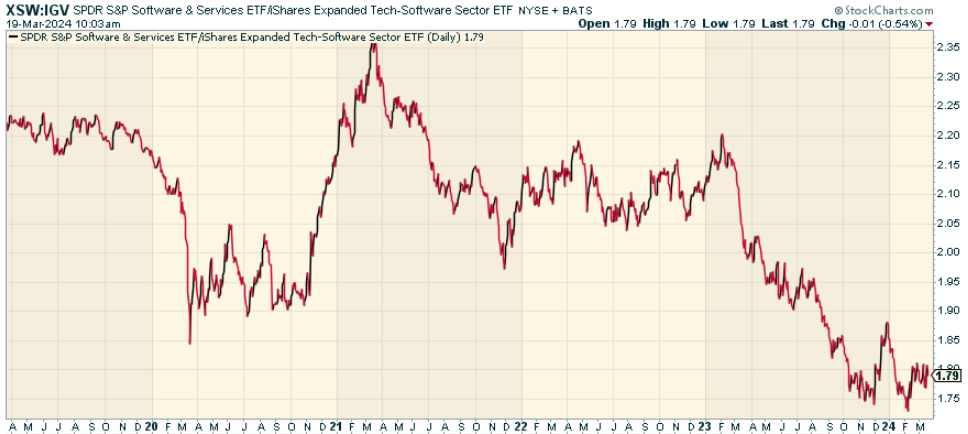
Exposure to High-Growth Industry: The software and services industry is projected to grow nearly 12% each year from 2023 to 2030. Companies operating in this sector are capturing high growth opportunities in areas like cloud computing, digital transformation, artificial intelligence, and even the blockchain.
Diversified Portfolio: XSW's portfolio consists of a diverse mix of software and services stocks, ensuring that investors gain broad exposure to this high-growth sector.
Equal-Weighting Methodology: The fund's equal-weighting methodology delivers a unique profile with a tilt toward high-growth, mid, and small-cap companies. This is a significant advantage over market-cap-weighted ETFs, which tend to be dominated by mega-cap tech stocks.
Sector-Specific Focus: XSW provides targeted exposure to U.S. companies in the software and services sector, which may not appeal to investors seeking broader diversification across various sectors.
Economic Sensitivity: The software and services sector can be especially sensitive to economic conditions. As consumers may reduce spending within this sector in uncertain economic times, this can contribute to higher volatility and potential losses during economic downturns.
Cybersecurity Threats: With the increasing popularity of cloud-service platforms, there are new opportunities for hackers to attack cloud services that haven't fully protected their platforms with their new developments. This factor can pose a potential risk to companies within XSW's portfolio.
Investing in the SPDR® S&P Software & Services ETF is an interesting idea to gain exposure to the rapidly growing software and services sector. With its equal-weighted methodology and a diversified portfolio of holdings, XSW can be a good option for those looking to tap into the high-growth potential of the technology sector. I'd personally just like to see more momentum first.