
shapecharge
shapecharge
This monthly article series shows a dashboard with aggregate industry metrics in healthcare. It is also a review of healthcare ETFs whose largest holdings have been used to calculate these metrics, like the Health Care Select Sector SPDR ETF (XLV) and iShares Global Healthcare ETF (NYSEARCA:IXJ).
The next two paragraphs in italic describe the dashboard methodology. They are necessary for new readers to understand the metrics. If you are used to this series or if you are short of time, you can skip them and go to the charts.
I calculate the median value of five fundamental ratios for each industry: Earnings Yield ("EY"), Sales Yield ("SY"), Free Cash Flow Yield ("FY"), Return on Equity ("ROE"), Gross Margin ("GM"). The reference universe includes large companies in the U.S. stock market. The five base metrics are calculated on trailing 12 months. For all of them, higher is better. EY, SY and FY are medians of the inverse of Price/Earnings, Price/Sales and Price/Free Cash Flow. They are better for statistical studies than price-to-something ratios, which are unusable or non available when the "something" is close to zero or negative (for example, companies with negative earnings). I also look at two momentum metrics for each group: the median monthly return (RetM) and the median annual return (RetY).
I prefer medians to averages because a median splits a set in a good half and a bad half. A capital-weighted average is skewed by extreme values and the largest companies. My metrics are designed for stock-picking rather than index investing.
I calculate historical baselines for all metrics. They are noted respectively EYh, SYh, FYh, ROEh, GMh, and they are calculated as the averages on a look-back period of 11 years. For example, the value of EYh for healthcare providers in the table below is the 11-year average of the median Earnings Yield in this industry.
The Value Score ("VS") is defined as the average difference in % between the three valuation ratios ((EY, SY, FY)) and their baselines (EYh, SYh, FYh). The same way, the Quality Score ("QS") is the average difference between the two quality ratios ((ROE, GM)) and their baselines (ROEh, GMh).
The scores are in percentage points. VS may be interpreted as the percentage of undervaluation or overvaluation relative to the baseline (positive is good, negative is bad). This interpretation must be taken with caution: the baseline is an arbitrary reference, not a supposed fair value. The formula assumes that the three valuation metrics are of equal importance.
The next table shows the metrics and scores as of writing. Columns stand for all the data defined above.
VS | QS | EY | SY | FY | ROE | GM | EYh | SYh | FYh | ROEh | GMh | RetM | RetY | |
HC Equipment | -32.39 | -12.39 | 0.0203 | 0.1968 | 0.0151 | 9.54 | 64.62 | 0.0289 | 0.2521 | 0.0277 | 12.86 | 63.98 | 0.02 | -1.94% |
HC Providers | -7.69 | -11.33 | 0.0500 | 1.4447 | 0.0456 | 14.85 | 19.55 | 0.0513 | 1.3735 | 0.0614 | 15.65 | 23.71 | 0.03 | 20.08% |
Pharma/Biotech | -24.86 | -4.83 | 0.0307 | 0.1904 | 0.0178 | 20.78 | 77.49 | 0.0356 | 0.2265 | 0.0323 | 22.01 | 80.79 | 0.01 | 7.26% |
Life Science Tools | -21.08 | -3.64 | 0.0259 | 0.1461 | 0.0262 | 13.83 | 58.49 | 0.0283 | 0.2661 | 0.0290 | 16.19 | 54.51 | 0.10 | 10.21% |
The next chart plots the Value and Quality Scores by industry (higher is better).
Value and quality in healthcare (Chart: author; data: Portfolio123)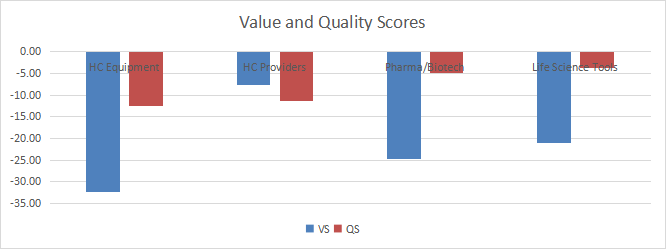
The value score has notably deteriorated in the pharmaceuticals/biotechnology and healthcare providers industries.
Value and quality variations (Chart: author; data: Portfolio123)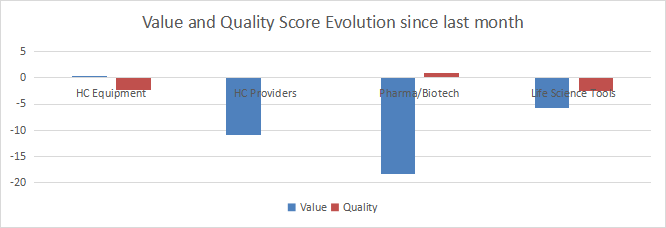
The next chart plots median returns by subsector.
Momentum in healthcare (Chart: author; data: Portfolio123)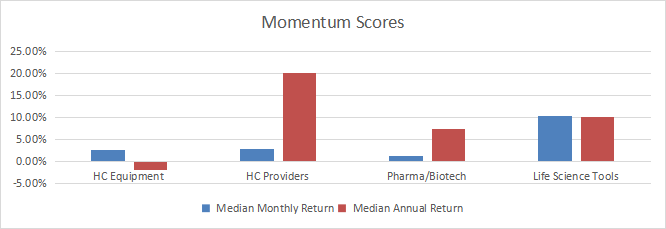
The healthcare sector as a whole is overvalued by about 13% relative to 11-year averages, according to my S&P 500 monthly dashboard. Nevertheless, overvaluation varies across subsectors: about 8% for healthcare providers, between 21% and 32% in other industries. Healthcare equipment has the worst value and quality scores.
iShares Global Healthcare ETF started investing operations on 11/13/2001 and tracks the S&P Global 1200 Health Care Index. It has a portfolio of 114 stocks and an expense ratio of 0.42%, whereas capital-weighted healthcare ETFs focused on US equities have much lower fees (0.09% for XLV). The underlying index selects international healthcare companies weighted based on float-adjusted market capitalization. About 71% of asset value is in U.S. companies. The next chart lists the top countries in the portfolio, excluding the U.S.
Geographical allocation in % of assets, ex-US (chart: author, data: iShares)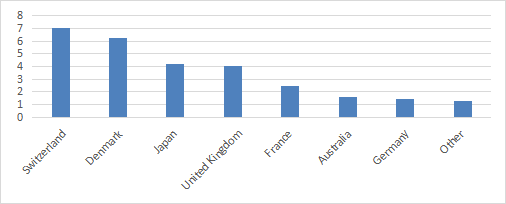
The portfolio is quite concentrated: the top 10 holdings, listed in the next table, represent 44% of asset value.
Name | Weight (%) | Exchange | Ticker |
ELI LILLY | 8.01 | NYSE | |
UNITEDHEALTH GROUP INC | 5.98 | NYSE | |
NOVO NORDISK CLASS B | 5.75 | Omx N.E. Copenhagen | NOVO B |
JOHNSON & JOHNSON | 4.8 | NYSE | |
ABBVIE INC | 4.25 | NYSE | |
MERCK & CO INC | 4.09 | NYSE | |
THERMO FISHER SCIENTIFIC INC | 2.98 | NYSE | |
ABBOTT LABORATORIES | 2.73 | NYSE | |
NOVARTIS AG | 2.72 | SIX Swiss Exchange | NOVN |
ASTRAZENECA PLC | 2.71 | LSE | AZN |
Nevertheless, IXJ is more diversified than XLV, which has about 55% of asset value in the top 10 holdings.
In the last 10 years, IXJ has underperformed XLV by 53% in total return:
IXJ vs XLV (Seeking Alpha)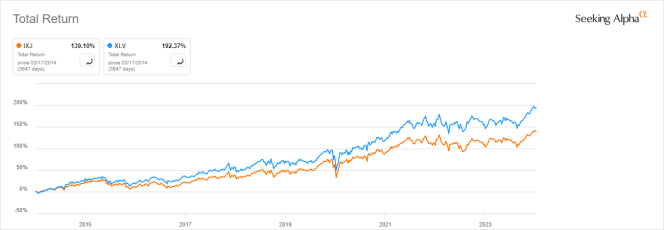
IXJ may be an alternative to XLV for investors seeking an international exposure and a slightly lower concentration in top holdings. Investors who seek a more balanced portfolio, and don’t need international exposure, may prefer Invesco S&P 500 Equal Weight Health Care ETF (RSPH).
I use the first table to calculate value and quality scores. It may also be used in a stock-picking process to check how companies stand among their peers. For example, the EY column tells us that a large pharma/biotech company with an Earnings Yield above 0.0307 (or price/earnings below 32.57) is in the better half of the industry regarding this metric. A Dashboard List is sent every month to Quantitative Risk & Value subscribers with the most profitable companies standing in the better half among their peers regarding the three valuation metrics at the same time. The stocks below are part of the list sent to subscribers a few weeks ago based on data available at this time.
Collegium Pharmaceutical, Inc. | |
Harmony Biosciences Holdings, Inc. | |
Alkermes Plc | |
Cencora, Inc. | |
AMN Healthcare Services, Inc. | |
Molina Healthcare, Inc. | |
Tenet Healthcare Corp. | |
DaVita, Inc. | |
Select Medical Holdings Corp. | |
CVS Health Corp. |
It is a rotational model with a statistical bias toward excess returns on the long-term, not the result of an analysis of each stock.