
cokada
cokada
Co-authored by Treading Softly.
There's a growing trend toward wanting to live more simply, especially among the middle-aged generation that is currently steeped in the workforce and trying to figure out retirement, families, and income.
In prior generations, people flocked away from farmland in the rural communities to cities, which helped spawn innovation as well as an industrial revolution. Yet there has always been periods where the flocking goes the other direction. People decide that cities are too busy, too noisy, too unsafe, and then decide that they want to live a simpler lifestyle. Right now, the Millennial generation is being marked as a generation where there is an overwhelming number of people who want to run homesteads and live as simply as possible. Sourdough starters, chickens, and large gardens are becoming the hallmarks of a large number of people from that generation, and it makes sense; understanding what you can live on or live off of, allows you to be able to disengage from a culture that many find to be unapproachable.
When it comes to the market, many people are approaching the market with the sole goal of eventually using it as a tool for retirement. They want to be able to retire safely and securely using a portfolio that enables them to do so. Yet many of them are doing so as passively as possible and missing out on massive opportunities to allow them to live off of dividends. The market can be volatile, it can be up one year and it can be down the next, and withdrawing money out of your portfolio regularly can cause what's known as the sequence of return risk – we'll discuss this deeper in a future article.
The big benefit of holding dividend-producing investments is that you can avoid part of this risk by having a portfolio that provides you with an abundance of income month after month. No dividend is ever guaranteed – this is why we recommend having a large number of dividend-paying investments. So that way if one holding decides to do the unexpected, you're not out to sea.
Today I want to look at two investments that can provide you with strong and stable income now and into the future, allowing you to live off of dividends just like so many are trying to live off the land again.
Let's dive in.
XAI Octagon Floating Rate & Alternative Income Trust (XFLT) is a CEF (Closed-End Fund) that takes a diversified approach to investing in leveraged loans. XFLT invests directly in loans, and indirectly through collateralized loan obligation, or CLO, debt and CLO equity. Source.
XFLT Q4 2023 Investor Presentation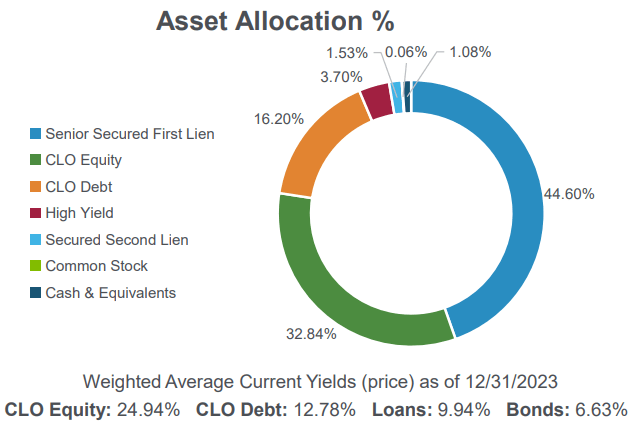
We cover other funds that have mostly CLO equity positions, which pay a higher yield but are also taking on higher risk. XFLT takes a diversified approach, which results in a lower overall yield for investors but reduces overall risk. The benefits of being a bit more conservative were demonstrated during COVID. Like many other CEFs in the sector, XFLT did have to reduce its distribution, but in 2021, it paid out a higher distribution than it was paying pre-COVID. The income disruption was brief, and today, XFLT is paying out more than it ever has, with $0.972 paid in 2023.
XFLT Q4 2023 Investor Presentation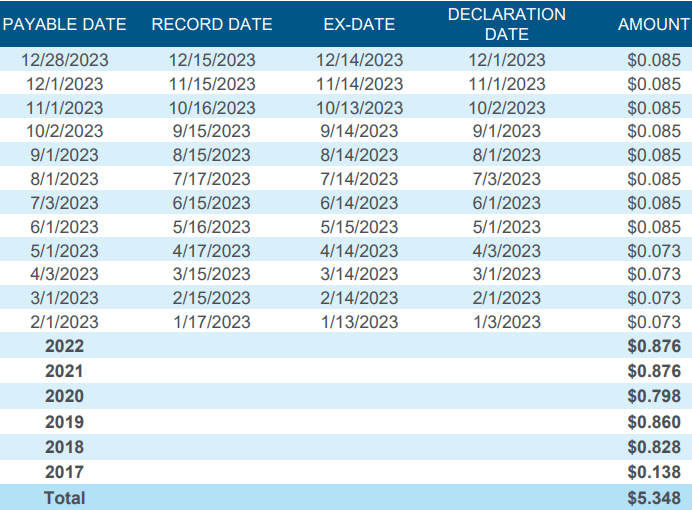
XFLT has taken advantage of more attractive loan pricing to grow its fund. It had a growth spurt in 2020 through 2021 and is in the midst of a second major growth spurt right now.
XFLT Q4 2023 Investor Presentation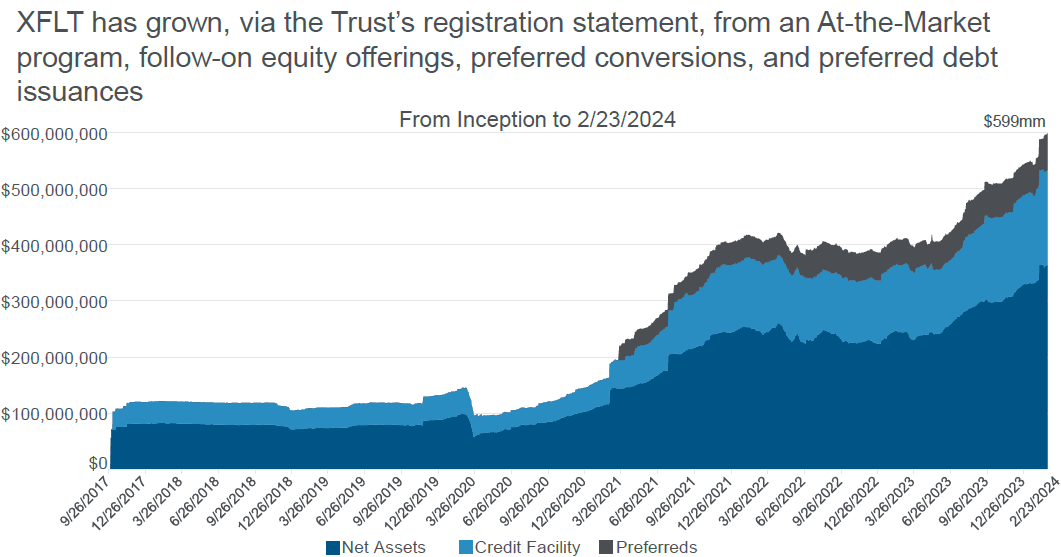
XFLT crossed over $500 million in assets in Q4, and today is very close to $600 million. Growth provides better returns thanks to economies of scale, and is also taking advantage of what management sees as favorable pricing among leveraged loans.
Loan yields are as high as they spiked up during March 2020, when the market feared mass defaults. Yet what makes this different is that yields are staying high for an extended period of time, while defaults remain below average. It is clear that the primary negative impact on loan prices is higher interest rates.
XFLT Q4 2023 Investor Presentation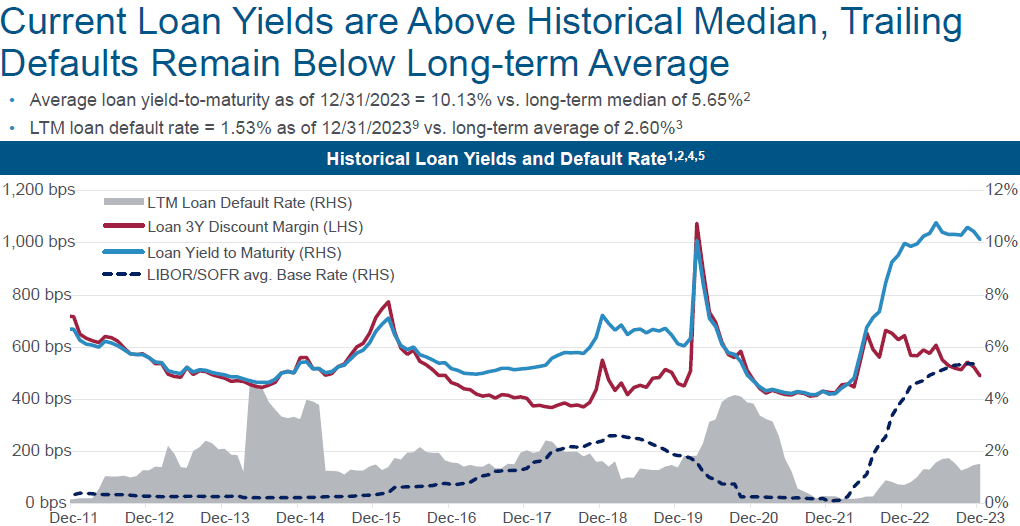
Management expects that default rates will continue to trend up towards average but will remain manageable. We agree and believe that it is a great time to be investing in corporate debt. XFLT is a great vehicle for us to do that.
To a great extent, real estate investment trusts, or REITs, and bonds share similar characteristics in terms of long duration and predictable cash flows. Due to this, the performance of bonds and REITs have been somewhat correlated amidst elevated interest rates.
Reviewing past rate cycles shows that REITs outperform equities after rate hikes. After the 1973 bear market and a pivot from the Fed in December 1974, listed REITS returned 59% in the following 12 months compared to 36% for the broader equity market. Similarly, in the 12 months after the GFC, REITS soared 74%, compared with 49% for equities. Current market conditions indicate similar, if not better, returns for the REIT sector due to their better positioning regarding balance sheet quality, FFO growth, and dividend coverage. Source.
abrdn website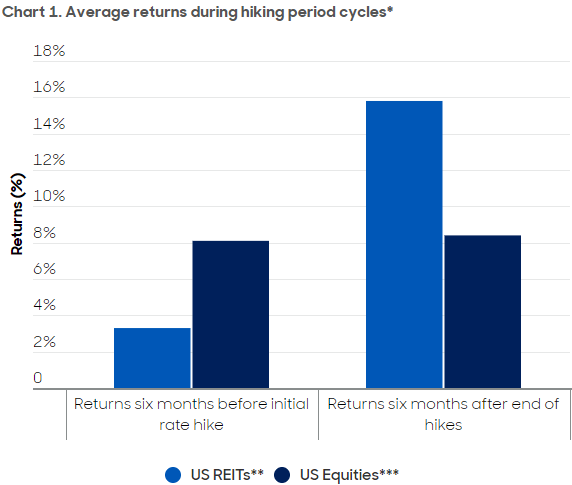
“It’s the interest rate stabilization piece, it is the attractive valuation piece and it’s the fact that we will see growth in this sector, especially in those sectors that are more defensively postured or have strong secular growth underpinning their demand,” - Laurel Durkay, MD and head of global listed real estate assets at Morgan Stanley Investment Management.
abrdn Global Premier Property (AWP) is a CEF, diversified across U.S. and international REITs, with its top 10 holdings being some of the industry-leading REITs in their respective domains, representing ~40% of the fund’s assets. Source.
AWP Fact Sheet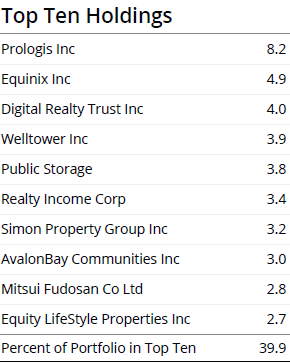
AWP provides global exposure to REITs, with ~60% of the portfolio comprising US-listed REITs and Japan, Singapore, U.K., and Mexico-based REITs constituting the majority of non-US holdings. AWP operates with a leveraged portfolio at ~24% of the fund’s assets, and this leverage carries a modest borrowing cost of 4.1%.
Notably, AWP was not originally an abrdn CEF. It was acquired in May 2018 as part of the reorganization of assets from Alpine Woods Capital Investors into Aberdeen funds. $10,000 invested in AWP in 2018 would have produced $4,600 in distributions to date, and the fund notably had strong price performance from the time of Abrdn’s acquisition until the pandemic in early 2020. AWP also rebounded strongly amidst the Fed’s QE to stimulate the economy and promote recovery following the COVID-19 crash. AWP currently pays $0.04/share per month, a 12.7% annualized yield, and the CEF trades at a 7% discount to NAV.
With an actively managed portfolio of quality global REITs, AWP is well-positioned to rebound as rates head downward. We sit back and collect our massive distributions while awaiting the upside.
Owning real estate has been one of the oldest ways to generate long-term wealth. It dates back to before the market when there were landowners and workers. The landowners were the ones who had the multi-generational wealth because that land would be passed down to their children. It wasn't until there was a more consolidated economy that we started seeing lending and loans becoming another avenue for generating wealth. Very wealthy families would start providing loans to others who would then repay them, and they would receive the principal plus interest. This allowed them to then turn and lend again. Today, you have the opportunity to invest in opportunities that not only own real estate, but also opportunities that provide lending or liquidity to the general economy, enabling you to generate wealth or income from both sources readily in your portfolio.
This is why I think that owning AWP and XFLT makes a lot of sense if you want to live off of dividends. You're tapping into two different distinct ways to generate wealth over the long run.
When it comes to retirement, you're going to need income to meet your expenses. Some choose to not generate income and instead, they sell off chunks of their assets over time in a periodic nature. Anyone who needs to sell shares to fund their retirement is doing this. Whereas a professional income investor uses the dividends that arrive in their portfolio to pay for their expenses. It allows them to live off of dividends. This provides you with a new way to be able to pass your wealth forward if you choose to do so or to donate your wealth to your chosen cause or belief. When you have a lack of restrictions and an abundance of opportunities, then you have the existence of freedom. Our unique Income Method can help you discover financial freedom and open up more doors of opportunity.
That's the beauty of my Income Method. That's the beauty of income investing.