gipi23/E+ via Getty Images
gipi23/E+ via Getty Images
Lumber is a critical industrial commodity, an infrastructure building block, and the most significant ingredient in new home building. The path of interest rates over the coming months is an essential factor driving lumber prices.
The Chicago Mercantile Exchange attempted to increase liquidity in the lumber futures arena by replacing the random-length lumber contract with a physical contract. The new lumber futures offer smaller contracts with more flexible delivery specifications. However, volume and open interest have not increased significantly. Open interest is the total number of open long and short positions in a futures market. Lumber futures’ low liquidity does not support hedging and speculative activity and causes high price volatility. During rallies, low participation causes offers to sell to disappear, and when the price moves lower, bids to purchase lumber tend to evaporate. Therefore, lumber futures can rise or fall to prices that defy logical, reasonable, and rational levels.
The iShares Global Timber & Forestry ETF (NASDAQ:WOOD) tends to follow lumber futures prices. However, it offers far more liquidity than the futures. In a June 2023 Seeking Alpha article on lumber and the WOOD ETF, I wrote:
iShares Global Timber & Forestry ETF thus is a liquid ETF that investors and traders can use to position for a recovery in the lumber futures market in 2024.
Nearby physical lumber futures prices were at the $484.50 level on June 2, 2023, with the WOOD ETF at $71.61 per share. On February 27, physical lumber for March 2024 delivery was over $565 per 1,000 board feet, and the WOOD ETF was at $76.62 per share. As we head into the spring, bullish and bearish factors pull lumber and WOOD in opposite directions.
The U.S. Federal Reserve told markets it needed more proof that inflation was heading for its 2% target at the late January FOMC meeting. The January consumer and producer price index data validated the central bank’s concerns, as the inflation came in hotter than expected.
While the markets had hoped the Fed would cut rates sooner in 2024 than later, the CPI and PPI dashed many hopes. Rates are not likely to increase, but the market will need to wait for rate cuts as inflation remains a nagging problem. Higher rates for longer are not bullish for new homes and lumber demand. In late February, 30-year conventional fixed-rate mortgages popped back above the 7% level.
While the monetary policy path since March 2022 tightened credit and slowed the ascent of housing prices, higher mortgage and consumer interest rates did not cause home prices to cascade lower.
New and existing home buyers face the worst of two possible worlds: the highest mortgage rates in years and home values that have not experienced the traditional decline. Many younger potential first-time buyers complain the double whammy has made home ownership an impossible dream in 2024.
The primary reason for high home prices is the extremely tight market for existing homes. Owners who financed or refinanced when rates were below 3% in 2020 and 2022 are not parting with their homes or loans. Upsizing with rates above 7% has become prohibitive, and downsizing in the current environment is only appropriate for cash buyers.
The bottom line is the low inventories of existing homes are leading to new construction to make up for the decline in supplies. Moreover, new home construction in low-tax states remains robust as migration from high-tax states continues. Therefore, lumber prices have remained stable as the demand for new construction is surprisingly high.
Meanwhile, pent-up demand for home buying is growing, and the overall market is adapting to and digesting the new interest rate environment. I purchased my first home in the early 1980s when mortgage rates were over 14%. I envied my parents, who held a 4.25% veteran mortgage at that time. I refinanced my current home in 2021 at 2.90%, and like many others who took advantage of the free money era, I have no interest in selling despite the higher property value.
Younger new buyers needing to set up a home for families will eventually bite the bullet and purchase. Still, the low existing inventories will likely push them into new construction, increasing lumber demand.
Lumber prices tend to peak in spring and summer.
Long-Term Random-Length and Physical Lumber Futures Chart (CQG)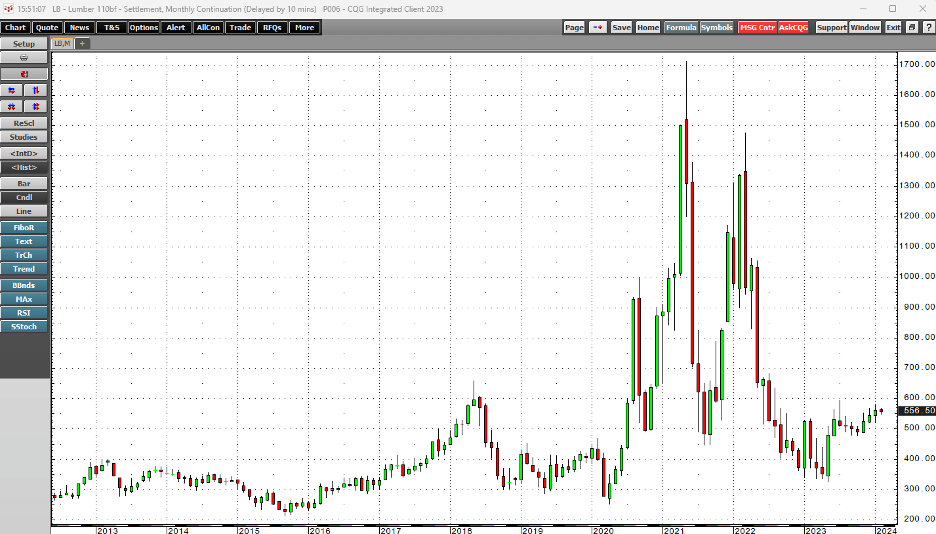
The monthly chart that combines the delisted random-length and new physical lumber futures highlights lumber prices tend to peak during spring and early summer. Price weakness during winter and strength in spring and summer is because of increased construction activity when the weather conditions are favorable. In May 2018, the lumber price peaked. In 2021, the record peak occurred in May, while the 2022 lower high was in March.
The monthly chart shows a gradual trend of higher lows and higher highs since October 2023. Lumber’s low liquidity could cause the price to surge over the coming months if the demand increases.
Lumber futures prices fell 77.9% from $1,477.40 in March 2022 to $326.60 in May 2023. The price recovered 81.6% to a $593 high in July 2023.
Five-Year Chart of the WOOD ETF Product (Barchart)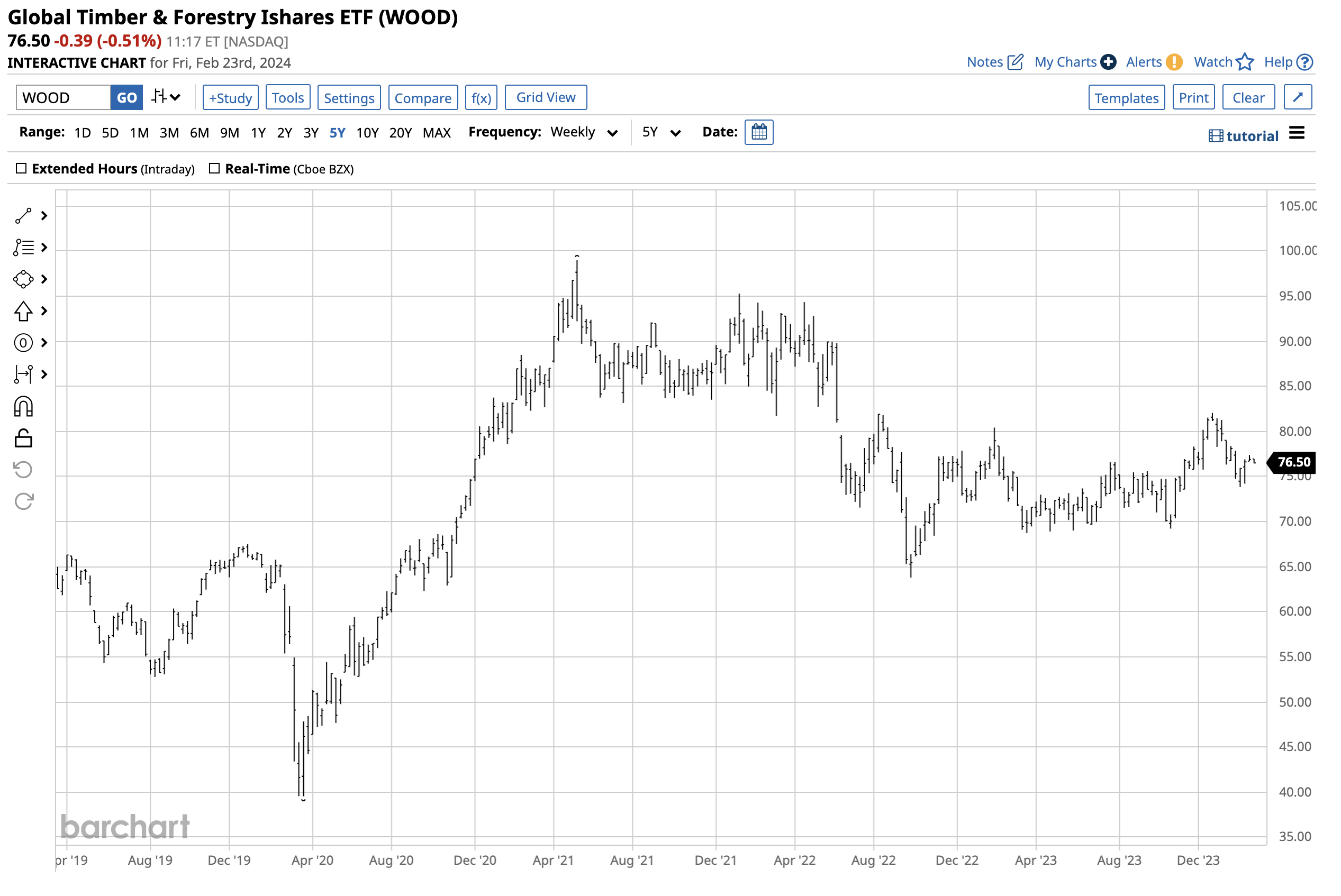
The chart shows the price action in the WOOD WTF product that reached a $95.27 high in January 2022 before declining 33% to $63.78 in September 2022. WOOD peaked before lumber future reached their 2022 high and fell to lows before the wood futures reached their May 2023 bottom. By July 2023, when the futures reached their most recent peak, WOOD rallied 20.1% from the low to $76.60. WOOD was virtually unchanged at $76.50 on February 26, while lumber futures were 4.6% lower than the 2023 high at the $565.50 level. WOOD is in a sideways consolidation pattern in late February 2024, with a slightly bullish bias. Seasonality could mean higher prices are on the horizon over the coming weeks and months.
At $76.50 per share, WOOD had around $190 million in assets under management. WOOD trades an average of 9,622 shares daily and charges a 0.42% management fee.
WOODS top holdings include:
Top Holdings of the WOOD ETF Product (Seeking Alpha)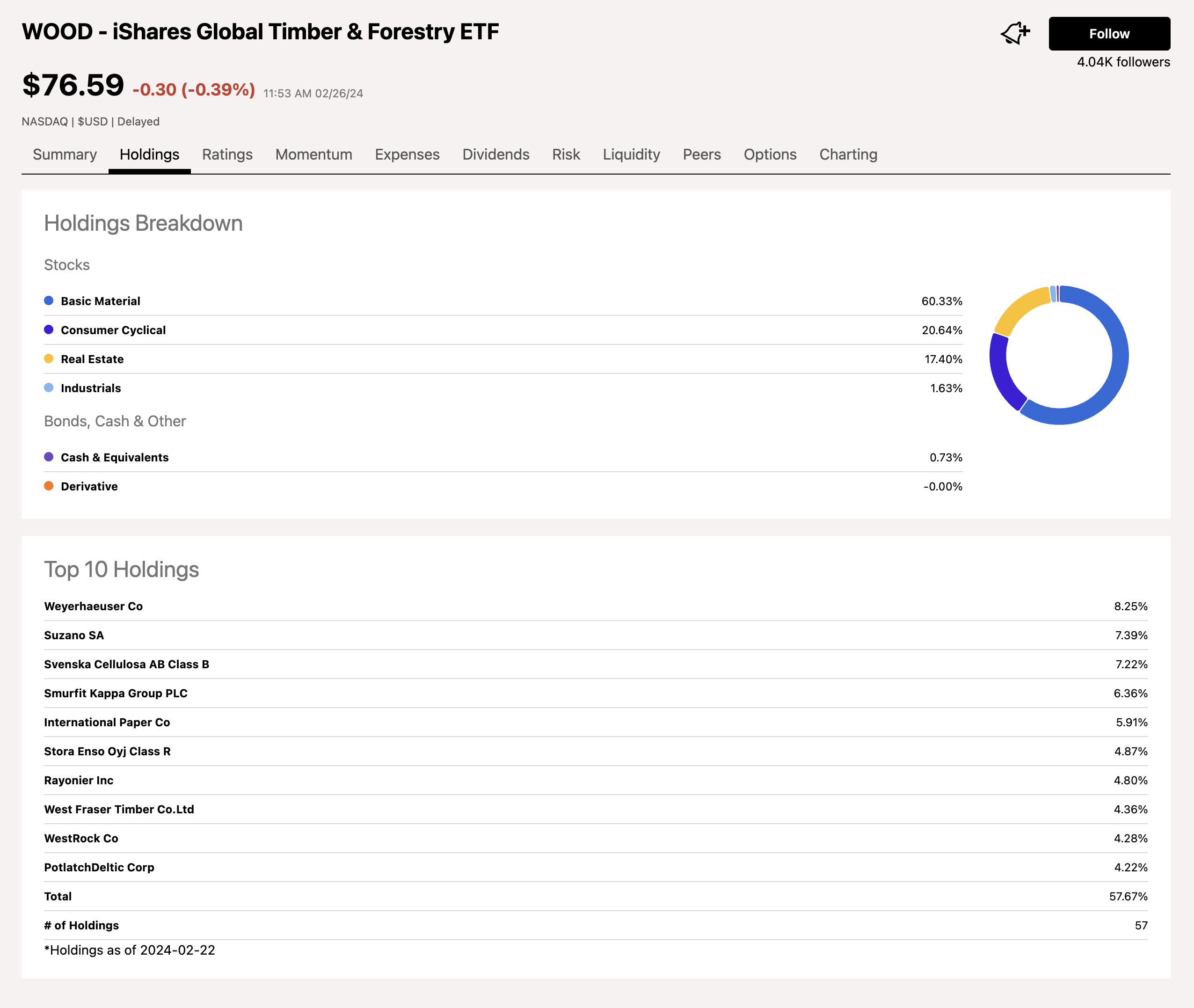
As the chart shows, WOOD’s top holding is Weyerhaeuser Company (WY), a company operating as a REIT in the lumber industry.
Lumber is an illiquid commodity with an untradeable futures market. WOOD provides exposure to lumber prices, which are highly interest rate sensitive. Tight existing home supplies in a market where owners are not likely to exchange low rates for high ones favor new construction as the pent-up demand for home ownership grows. As rates stabilize and eventually move lower, the demand for lumber will likely increase, pushing lumber-related assets like the iShares Global Timber & Forestry ETF higher.
The cons for a lumber investment in early 2024 are high rates and high property prices, while the pros are the increasing potential for stable to marginally lower rates, pent-up housing demand, and the tightest existing home supplies in many years.