
Neilson Barnard/Getty Images Entertainment
Neilson Barnard/Getty Images Entertainment
Whirlpool (NYSE:WHR) is a leading maker of appliances, and it sells under a number of other brand names including: KitchenAid, Maytag, Consul, Amana, JennAir, Indesit, InSinkErator and more. It has roughly $20 billion in annual revenues and around 61,000 employees. According to Whirlpool, about 58% of its revenues are generated from North America, 20% is from Europe/Middle East/Africa, 16% is from Latin America, and about 6% is from Asia. In 2021 and 2022, this stock was trading at around $250 per share, but it has since plunged and currently trades near 52-week lows. It looks like this has created a buying opportunity in which investors can lock in a generous and seemingly safe dividend yield of 6.5%, plus have the potential for significant capital gains when the share price rebounds.
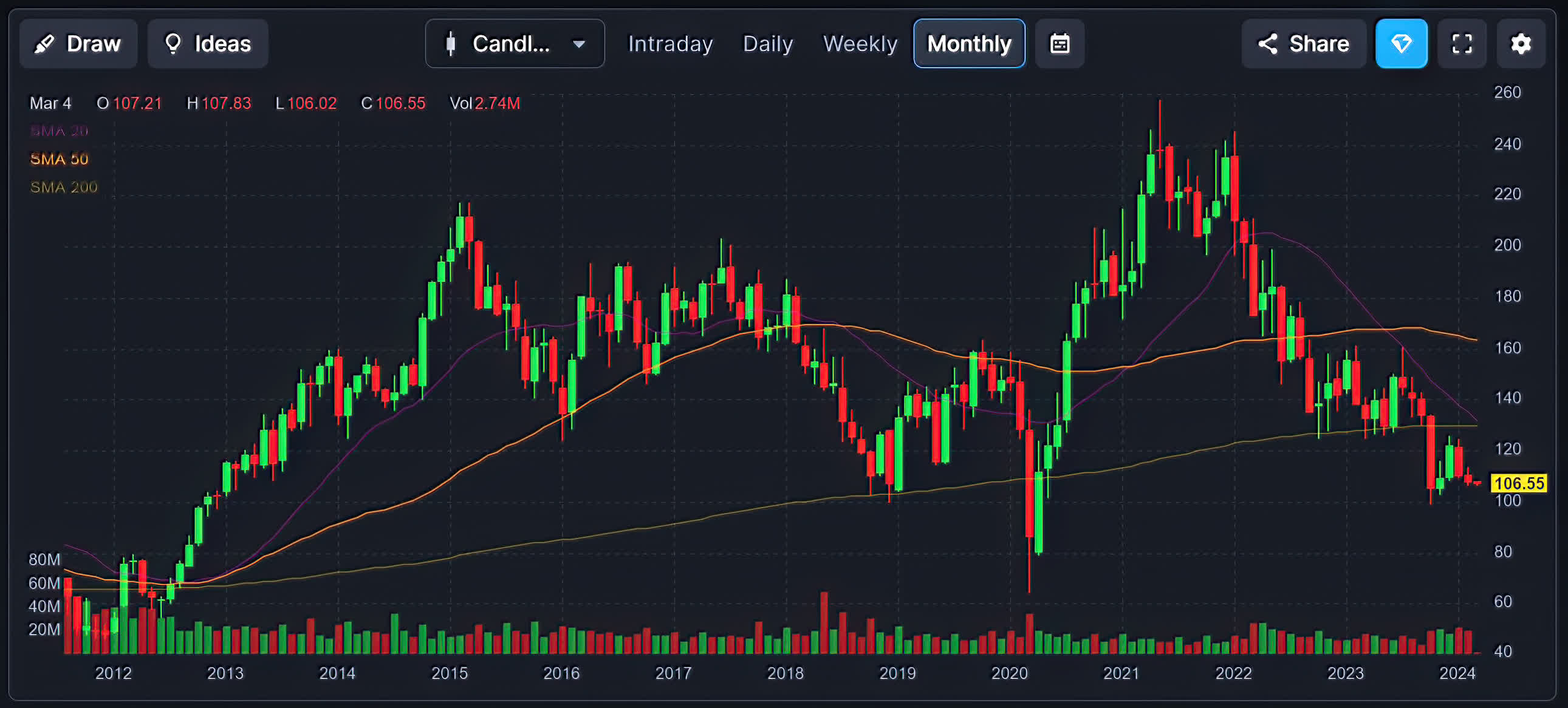
The chart below shows a longer-term view of Whirlpool. The light brown trendline represents the 200-week simple moving average and since 2012, Whirlpool shares have rarely dipped below this level. It touched this key support level in 2018, and it only went below this level during the Covid market correction in 2020, and once again in late 2023 (and it remains at this level now). Historically, it has been a great buying opportunity to purchase shares below this 200-week level, and it also has never taken too long for the shares to rebound and therefore reward dip buyers. We will see how it plays out this time, but to me this historical pattern on the chart is just another signal that this stock is a compelling buy.
finviz.com
Analysts expect Whirlpool to earn $13.48 per share in 2024, $14.91 per share in 2025, and $16.41 per share in 2026. All these figures show that this company is trading at a single digit price to earnings ratio which is typically considered bargain basement. The price to earnings ratio is currently around 7.0, based on 2024 estimates, and even less going forward. I think this company deserves a higher multiple, especially considering its dominant brand names and market share in many categories.
Whirlpool released an Investor Day presentation in February 2024, and it set a goal for 10% margins in 2026. This would be an improvement over projected margins of 6.8% for 2024 and actual margins of 6.1% in 2023. This 10% level of profit margin could lead to $20 per share in earnings in 2026, which would be similar to the nearly $20 per share that Whirlpool earned in 2022. If Whirlpool gets back to earning around $20 per share, I believe it could also get back to the $250 per share level it held a couple of years ago.
In terms of the balance sheet, Whirlpool has about $1.57 billion in cash and around $8 billion in debt. I would prefer to see a stronger balance sheet, but I am glad to see the company is working on paying down debt. Some of this debt was incurred when the company acquired InSinkErator which came with $2.5 billion in term loans. Whirlpool is stepping up its goals of paying down debt by $1 billion in 2024, instead of the previous goal of $500 million.
I don't think the market is giving Whirlpool enough credit in terms of the dividend because it has been consistently rising, and the yield is very generous. In 2014, the quarterly dividend was 75 cents per share, but thanks to steady increases, this company now pays $1.75 per share every quarter. This is equivalent to $7 per share on an annual basis, and the current yield is 6.55%. Whirlpool has been paying a dividend for 70 years. Even with earnings being less than in prior years, with an earnings estimate of $13.48 per share for 2024, this is more than enough to cover the $7 dividend payment. Because of this, I view the dividend as being safe; in fact, much safer than many dividend stocks, especially since earnings are expected to rise from this level going forward.
Whirlpool also has an impressive track record in terms of share buybacks. In the past five years, it has repurchased about $2.2 billion worth of shares, and over the past 10 years, share buybacks have reduced the share count by around 30%. About $2.6 billion is remaining on the current share repurchase authorization.
Interest rates are likely to decline this year and next year. This should create a surge in pent up demand for real estate deals, which could lead to appliance upgrades, and lower rates will also help boost demand for higher ticket items like major appliances. Lower rates will boost the overall economy, which will be another plus for Whirlpool.
Lower interest rates will help boost revenues for Whirlpool, but lower rates will also increase investor interest in high yielding stocks. If money market fund rates drop by 2026, investors are probably going to be willing to pay more for Whirlpool shares. Whirlpool's goal of expanding profit margins is a major upside catalyst. Whirlpool hopes to achieve this by reducing costs and by focusing on higher margin products. In addition, if Whirlpool is successful with its goals to deliver higher profit margins and potentially $20 per share in earnings (as it did in 2022), this will be a major upside catalyst. If we see lower interest rates converging with $20 per share in earnings in 2026, it would not be surprising to see Whirlpool shares eclipse the highs of 2022, which was over $250 per share.
Whirlpool is making some strategic moves to increase revenues and to make the business less dependent on the housing market by renewing its focus on smaller kitchen appliances and gadgets. This includes items like mixers, food processors and espresso makers. These items tend to be high margin items for the company, so this move could boost earnings over time.
Whirlpool has experienced a revenue slowdown for the past year or so, but this appears to be normal after consumers (who were flush with cash from stimulus checks) spent money on their homes during the Covid shutdowns. Whirlpool is also clearly being impacted by the currently "frozen" housing market. Homeowners who have locked in mortgage rates of about 3% or even less, don't want to sell their homes and then be forced to pay current rates of about 7% on a new home purchase. The purchase of a home often results in the upgrade of washers and dryers as well as other major kitchen appliances. When interest rates decline, real estate activity is expected to increase significantly, especially because the current frozen state of the housing market is probably creating pent up demand which could eventually create a sudden surge in real estate activity and appliance upgrades.
David Tepper is a well-known hedge fund billionaire, and it was just reported in early February 2024, that he had started a new position in Whirlpool, buying roughly 90,000 shares. Of course this could just be for a trade, but it could also be that he is seeing long term value in the stock as well as the generous dividend yield. It will be interesting to see if additional share purchases are made in future quarters.
Everyone needs to wash clothes and refrigerate food, so while upgrade purchases can be put off for a while, these are basic needs and new appliances will eventually be purchased. So while everyone is fretting about lower sales now and a potential recession, I am thinking about the amount of pent up demand that is being created by the frozen housing market and by high interest rates.
I don't like the additional debt incurred when Whirlpool acquired InSinkErator, but the fact that management has plans to reduce debt rapidly mitigates this concern. If rates stay higher for longer, that could keep the housing market in a frozen state. If the Federal Reserve creates a hard landing, or if we experience a recession for some other reason, it won't be good for the stock market, nor will it be good for revenues at companies like Whirlpool.
Whirlpool is a cyclical company, but it is working towards minimizing cycle lows by expanding into higher profit margin small appliances. As history shows, it pays to buy this stock after a down cycle and then ride it back up, and this appears to be an ideal time to buy low and get paid a generous yield while waiting for a higher share price. When rates drop, this stock could move much higher, not only because investors will covet high yield stocks more, but also because lower rates will boost consumer spending and revive the currently frozen housing market. This could lead to a surge in major appliance upgrades. The current valuation in terms of price to earnings ratio and the historical 200-week simple moving average suggests this stock is deeply undervalued and possibly at rock-bottom levels.
No guarantees or representations are made. Hawkinvest is not a registered investment advisor and does not provide specific investment advice. The information is for informational purposes only. You should always consult a financial advisor.