
Eleganza
Eleganza
I introduced the Simple Retirement Portfolios more than three years ago. Portfolios are meant to provide retirees with a simple, yet effective way to invest their retirement savings, with varying levels of risk, yield, and passive / active exposure. Portfolios hold a diversified set of equity and fixed income funds, with diversified exposure to most relevant asset classes. Portfolios are as follows:
Seeking Alpha - Table by Author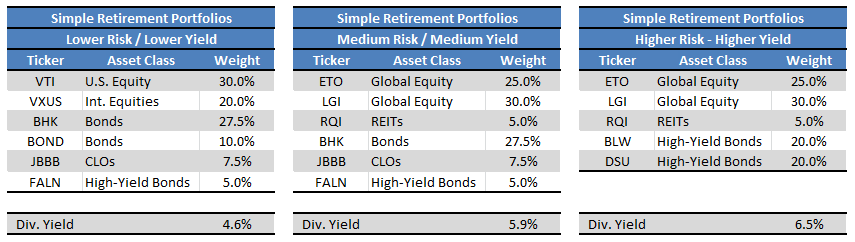
I'm doing semi-regular updates on these portfolios and their performance. The following article focuses on portfolio and fund performance for 2023.
Equities had an outstanding year last year, with the S&P 500 climbing 26.2%, the tech-heavy Nasdaq-100 soaring 55.0%. The Simple Retirement Portfolios benefitted too, with these seeing strong double-digit total returns during the year. Gains were slightly below-average, however, due to widening discounts to NAV. These do present a compelling entry point for new investors, with the Lazard Global Total Return and Income Fund (LGI) trading with a particularly large 12.4% discount.
Bonds were a mixed bag, with most sub-asset classes seeing declining prices during most of the year, due to Federal Reserve hikes, but rebounding near the end, due to dovish Fed guidance. On net, returns were generally positive, but weak. Most of the Simple Retirement Portfolio bond holdings performed much better than average, due to above-average yields, lower rate risk, and savvy fund selection.
Overall, the portfolios saw strong returns, and outperformed their benchmark, the Vanguard Target Retirement 2020 Fund Inv (VTWNX), during 2023, and since inception. Price returns for the medium-risk portfolio were the weakest, as its CEFs saw the largest increase in discounts.
Seeking Alpha - Table by Author
Quite proud of these results and expecting similar this year. That is the goal at least.
I'll start with a brief overview of the construction and rationale behind the portfolios. Feel free to skip this section if you've read my previous articles on the subject.
The Simple Retirement Portfolios are based on the Vanguard Target Retirement 2020 Fund (VTWNX). VTWNX invests in a diversified portfolio of low-cost fixed income and equity index funds and is aimed towards recent retirees. Asset allocations change every quarter to reduce risk as retirees age.
Balanced funds, including VTWNX, generally provide retirees with superior returns than equity index funds. This includes those indexed to the S&P 500, as the said index is simply too volatile to fund the monthly income needs of the average retiree. I've done the math on this here.
VTWNX seemed like a perfect low-risk fund for retirees, so I used it as the basis for my model portfolios. The portfolios used VTWNX's holdings in May 2020 as a starting point. Current holdings are only marginally different. These were as follows:
Vanguard Corporate Website - Chart by Author To construct the portfolios, I simply swapped some of VTWNX's holdings for stronger, higher-yielding alternatives with the potential for market-beating returns.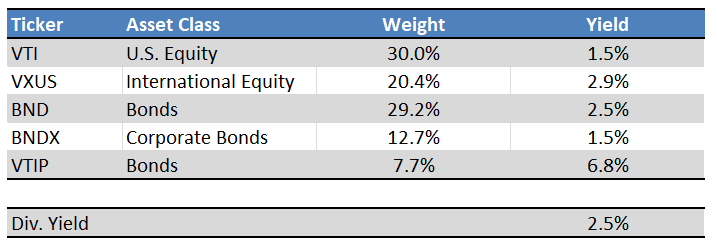
I created three portfolios, some more closely tracking their benchmark than others.
A lower-risk portfolio with few changes meant to closely track VTWNX, but with the possibility of some excess returns and income.
A medium-risk portfolio with some more changes, somewhat tracking VTWNX, and with the possibility of excess returns and income.
A higher-risk portfolio with significant changes, less concerned with tracking VTWNX, and with the possibility of substantial excess returns and income.
The resultant portfolios were as follows.
Seeking Alpha - Chart by Author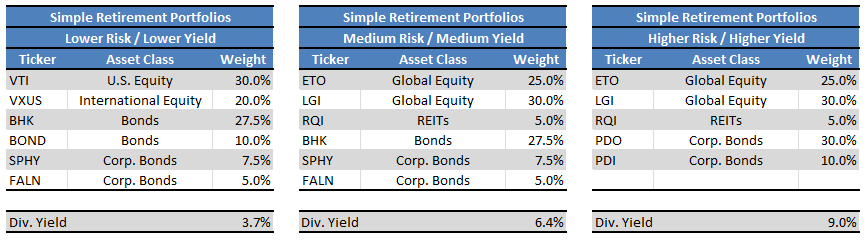
I did some changes to the portfolios in mid-2023, but their goals and overall exposures remain similar to the above.
The lower risk / yield portfolio outperformed its benchmark during 2023 with total returns of 17.4% versus 12.6%
Gains were mostly driven by strong equity returns, with the fund's equity investments seeing double-digit returns. Both of these are index funds, so returns were in-line with those of their index.
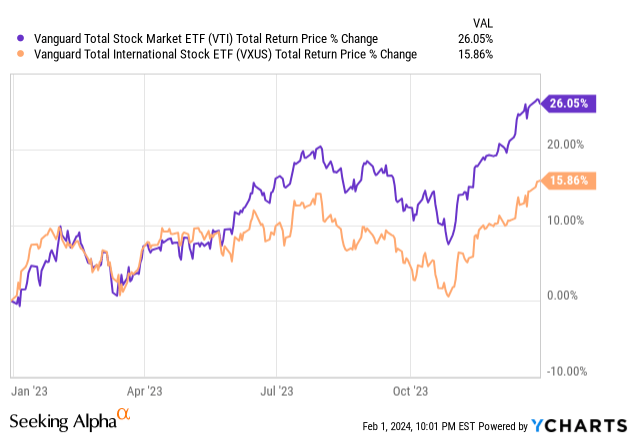
Outperformance was almost entirely due to above-average bond returns, with the portfolio's bond funds all outperforming the Vanguard Total Bond Market Index Fund ETF Shares (NASDAQ: BND), the industry benchmark.
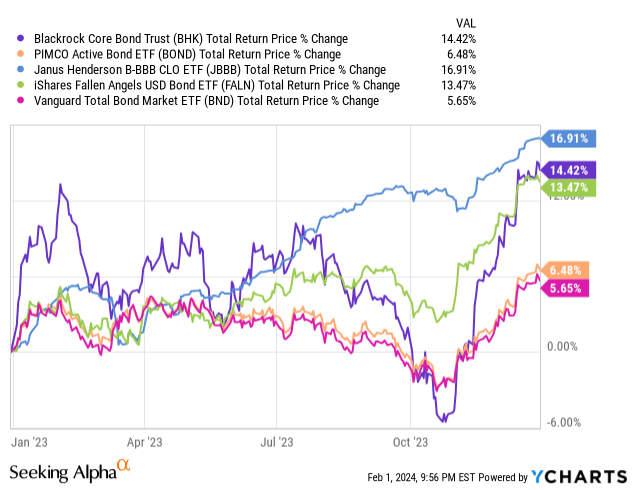
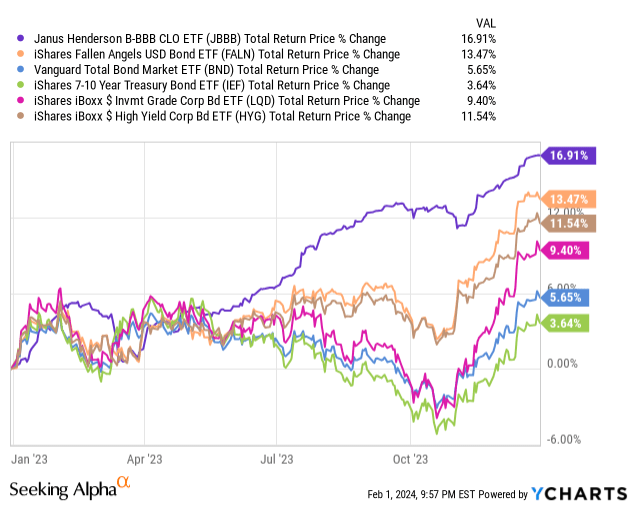
Some of the fund's above are materially riskier than BND, with more volatility. These also outperformed most other bond sub-asset classes, including high-yield corporate bonds. Performance was overwhelmingly strong, relative to the bond market at least.
The medium risk / yield portfolio outperformed its benchmark during 2023 with total returns of 16.1% versus 12.6%.
Gains were driven by strong equity returns, with the portfolio's global equity and REIT investments seeing double-digit returns.
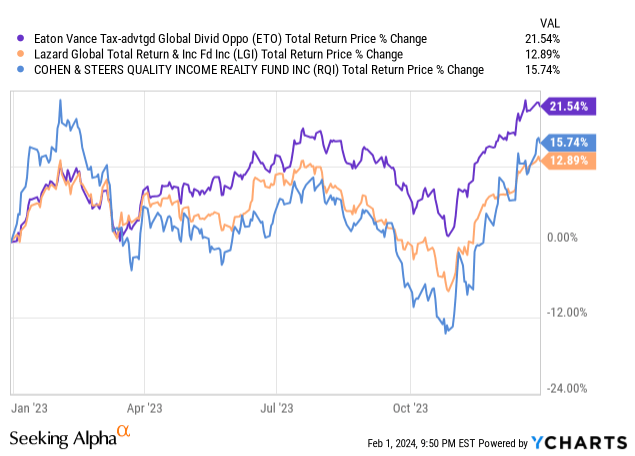
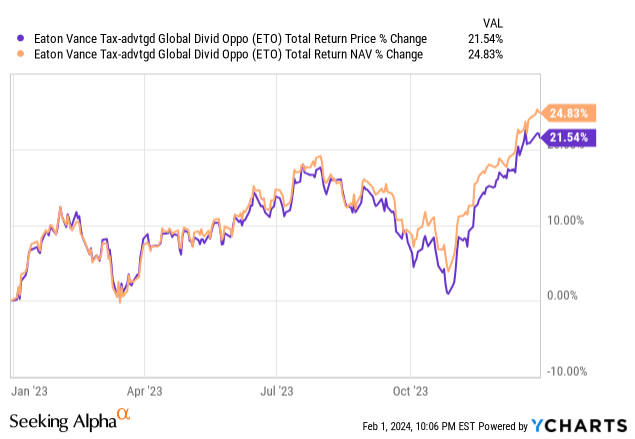
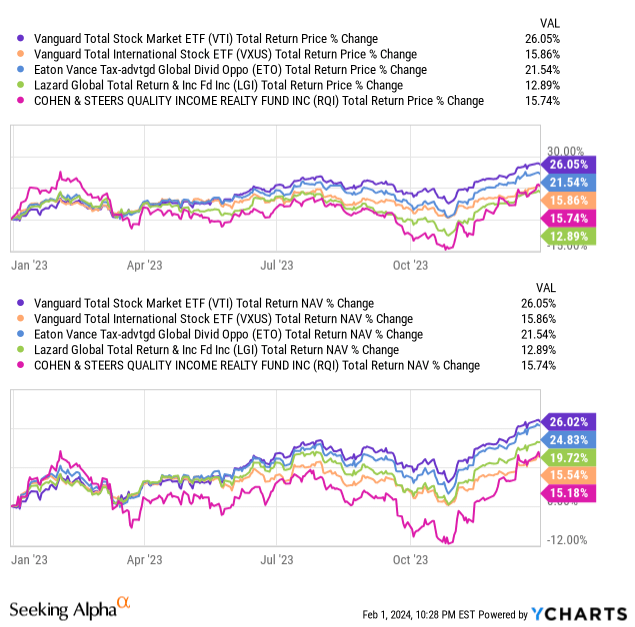
The Eaton Vance Tax-Advantaged Global Dividend Opportunities Fund (ETO) saw particularly strong price gains, backed by even stronger NAV gains, and boosted by the fund's leverage.
LGI's returns were much weaker than average, mostly due to a wider discount.
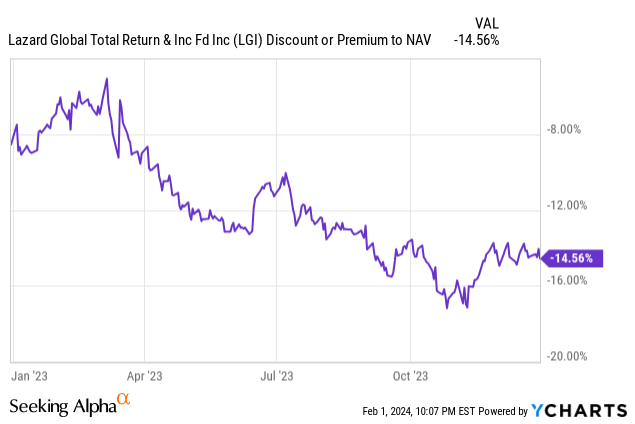
Wider discounts were a negative for investors in the past, but something of a benefit for prospective investors, which can invest in LGI at a compelling price and discount.
The Cohen & Steers Quality Income Realty Fund (RQI) managed to post strong returns during a tough year for real estate and REITs, due to a narrower discount, leverage, and, perhaps, some alpha.
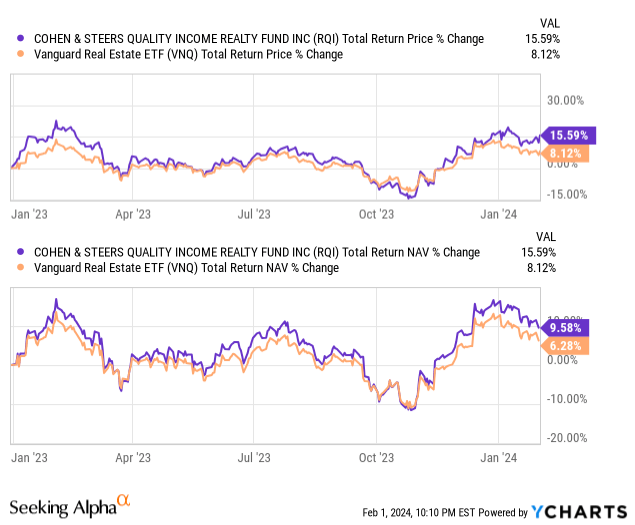
Outperformance was entirely due to above-average returns, same as with the lower risk portfolio.
Finally, the medium risk portfolio underperformed the lower risk portfolio due to somewhat lower equity fund returns. In general terms, LGI and RQI underperformed broader equity indexes, with ETO mostly matching these. Underperformance was mostly due to wider discounts to NAV for ETO and LGI, weak real estate performance for RQI.
The medium risk portfolio has outperformed the lower risk one since inception, just not last year.
The higher risk / yield portfolio outperformed its benchmark during 2023 with total returns of 20.2% versus 12.6%.
Gains were driven by strong equity and bond returns.
Equity positions and returns are the same as the medium risk portfolio, meaning ETO, LGI, and RQI.
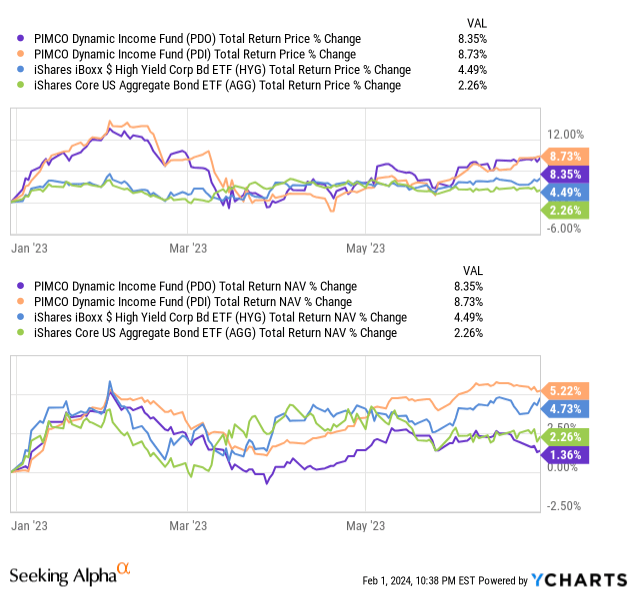
Bond positions changed during the middle of the year. During the first half, the portfolio was invested in two high-yield PIMCO CEFs. Both saw strong, market-beating returns during the first half of the year, mostly due to narrower discounts to NAV.
During the second half of the year, the portfolio shifted to two high-yield BlackRock CEFs, with higher distribution coverage ratios, lower duration, and a more favorable asset mix (to me at least). Both saw strong, market-beating returns during the second half of the year, mostly due to narrower discounts.
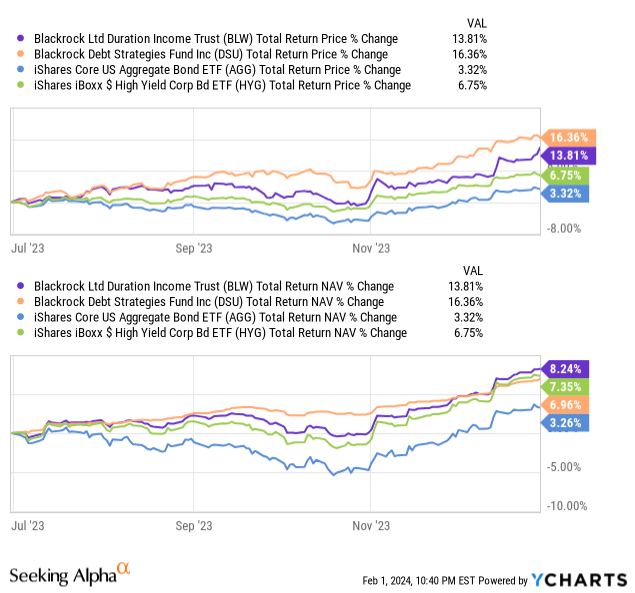
Although I do take into consideration discounts when selecting funds for these portfolios, these are long-term considerations, and these are intended to be long-term holdings. I do not intend to make short-term profits from swapping discounted CEFs constantly, notwithstanding the above.
I plan a closer look at these swaps at a later date but suffice to say that these have led to increased gains and outperformance these past few months (see above).
Both of the portfolio's actively-managed equity funds had matched the performance of the S&P 500 until 2023. Both funds underperformed during said year, leading to underperformance since their inclusion in these portfolios.
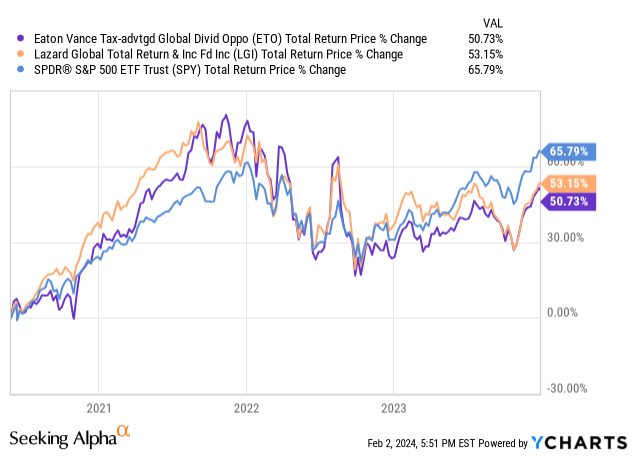
Both of the funds above are global equity funds, so the S&P 500 is not an ideal benchmark. Nevertheless, their underperformance relative to said index is an important negative, and an important consideration for investors. I certainly expected / hoped that these funds would outperform the S&P 500, in addition to the other goals of the portfolios (outperformance to their benchmark, higher yields).
A recurring theme in these articles is that outperformance is almost always due to bonds, with the portfolio's equity investments generally performing in-line with their benchmark (not the S&P 500, but a global equity index).
Results are consistent with those of the broader market, with active bond funds have much higher success rates than active equity funds. Specifics vary, but over 2/3rds of active bond funds have outperformed their benchmark during the past three years, compared to 1/3rd of active equity funds.
Morningstar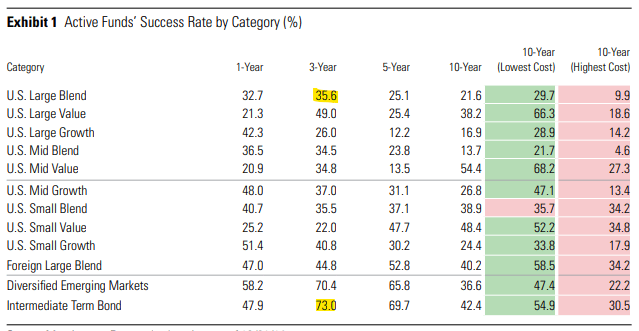
In my opinion, success rates for bond funds can be increased through proper selection and timing. Picking cheap ETFs almost always works. Picking heavily discounted CEFs should work too, although that requires a bit more care. Leveraged bond funds should outperform those without leverage, at some extra risk. Some specific strategies are very reliable, especially investing in fallen angels.
Considering the above, I believe that investors should strongly consider focusing on equity index funds and actively-managed bond funds.
Going for equity index funds ensures matching the returns of the equity market, which is about as best as most investors can manage. Seems less stressful too, less prone to FOMO.
Going for actively-managed bond funds could lead to higher yields and returns, as is the case for most funds, many investors, and these portfolios themselves.
This is what the lower risk portfolio is meant to do, although investors can construct similar portfolios using higher-yield bond funds too. Something like this could easily work, tailoring the weights for the desired yield.
Seeking Alpha - Chart by Author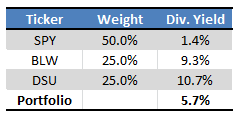
Finally, I'm incredibly bullish on CLO ETFs, with these performing exceedingly well since inception, and since I started covering them. I've considered having these play a greater role on the portfolios, but these ETFs have effectively zero duration, which might cause them to diverge too much from their benchmark. These are long-term portfolios too, so changes are infrequent.
A couple of years ago I moved back to Colombia from Canada. Bought a condo soon after and started paying for a second one in 2022. Had to sell my stock portfolio to make the payments, which is why I'm almost never invested in any of the funds I cover. I'll be making the last payment later this February, and plan to start building up the portfolio again later this February. Colombian stocks still look cheap, so I plan to start there. The condo itself will be ready in 2025, most likely, they are currently finishing up the third floor.
Juan
Original floorplan, although I'll be making some edits when they get to my floor.
Juan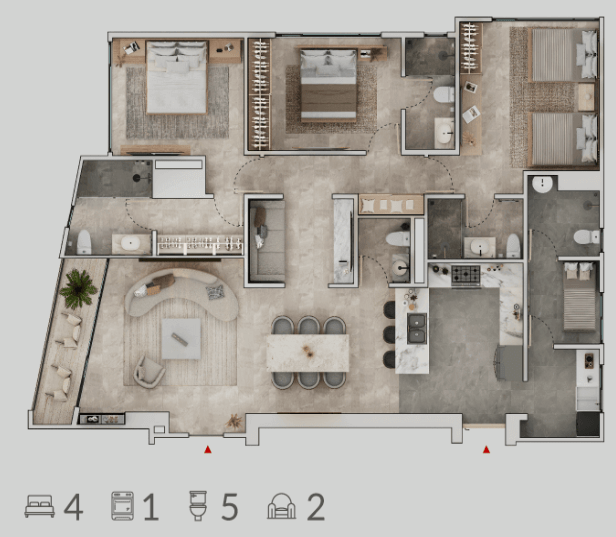
Can't wait to move, or to start investing again.
The Simple Retirement Portfolios provide retirees with a simple way to invest and save during their retirement and have generally performed well in the past. I believe that the funds selected and portfolios created will outperform in the coming years. Hopefully, the information here was of use and interest to readers and investors.