
BrianAJackson
BrianAJackson
Having been engaged by activist investors who want Twilio (NYSE:TWLO) to sell itself as a whole or sell off its underperforming Segment business, focus on its original communications business, cut costs, and move towards profitability. Twilio spent 2023 re-designing its business, changing its cost and capital structure.
2024 began with the resignation of the founding CEO, more restructuring, and a promise to deliver the result of a strategic review of Segment in early March.
It seems that Twilio has changed everything, yet nothing has changed.
Twilio bought the start-up Segment in 2020 to integrate it with their communications business. That plan did not deliver growth or profits, and the activists want Segment sold off. In 2023, Twilio split its operations into two divisions, separating Communications from the rest; they changed their mind later in the year and restructured to separate Segment from the rest. Now, they have announced they are integrating Segment with the Communications division.
There is a famous quote about doing the same thing and expecting a different result.
Twilio was founded in 2008 to provide programable communication tools to software developers. They intended to build a cloud platform enabling phone calls and text messages between companies and customers. In November 2008, they launched their first voice API, adding text and SMS APIs soon after. An API or application programming interface is a set of rules that allow software applications to communicate and enable seamless communication.
The market for cloud-based communications has snowballed; it is expected to approach $40 billion by the end of this decade with a CAGR of 18%. The growth is fuelled by organizations moving to cloud-based solutions and the rise of connected devices and the Internet of Things. Mordor quotes the significant players in this market as Cisco (CSCO) and TWILIO, amongst others.
Twilio has a rock-solid balance sheet, including $656 million in cash and over $3 billion in short-term investments.
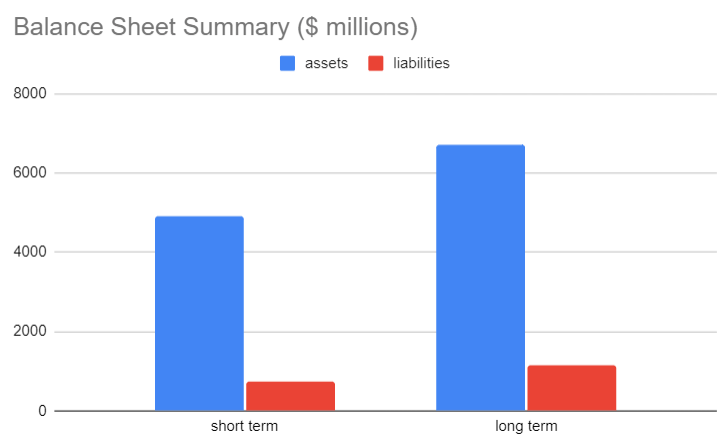
Twilio Assets and Liabilities (Author Database)
Profit performance has been lackluster, and growth has slowed significantly.
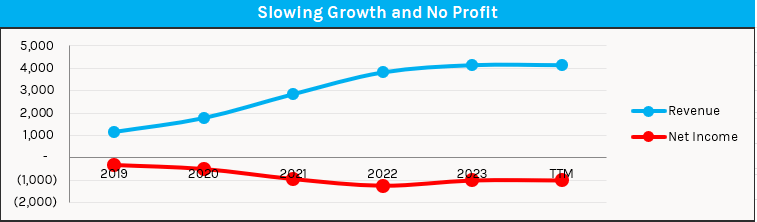
Key Line items over time (Author Database)
The gross profit margin has been falling, and the return on capital remains stubbornly negative.
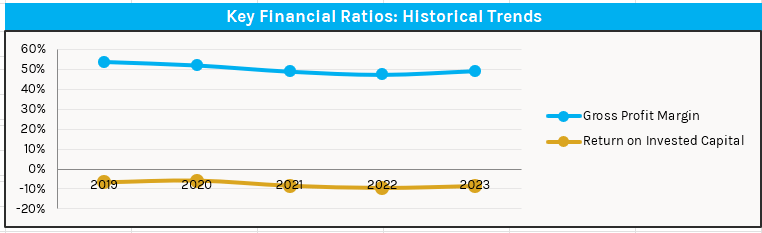
Ratios over time (Author Database)
Slowing growth, negative return on invested capital, and a large cash balance may have attracted Twilio's activist investors. With so much cash and $4 billion in revenue, this business should deliver more value to its shareholders.
Twilio has grown organically and, by acquisition 11 deals in total. I will highlight two key ones.
Segment was bought in 2020 for $3.2 billion. In the Q4 2020 earnings call, the CEO said
We acquired Segment, combining the market-leading customer data platform with our leading communications platform….. to provide a unified customer view to help companies better understand customers and engage more effectively over digital channels.
The rationale for this deal was the prospect of cross-selling the communications platform and Segment platform customers. The concept was for an integrated one-stop communications and customer data management platform.
In 2021, Zipwhip, a business SMS and MMS communication platform was acquired.
These large deals took place when Twilio was at the height of its market cap; it hit $40 billion in 2020 But has since fallen 75%. Twilio has just not delivered on its potential.
Two activist investors have acquired stakes of around $50 million each and are pushing for the same things; both want a total sale of Twilio or a partial sale with Twilio focusing on its communication business.
The timing of the two deals implies that one person, Sagar Gupta, is leading this activism. He led Legion Partners' activist engagement with Twilio before moving firms to Anson Funds. The Anson Twilio stake coincides with this move; both companies continue to engage with Twilio, pushing for change.
When Twilio came to the market via an IPO in 2016, Lawson, the founder and CEO, was granted special voting rights, giving him an outsized influence on the company's direction. The super-voting shares lasted seven years, expiring in late 2023. As long as the super-voting shares were in place, it would be impossible for any shareholders to make meaningful changes to the company without Lawson's agreement.
As the super-voting shares have expired, decision-making will be dominated by the institutional shareholders, who will act to maximize shareholder value. The resignation of Lawson, coming immediately after the expiration of his super-voting shares, could suggest that activist investors have significant sympathy for their views among the shareholders.
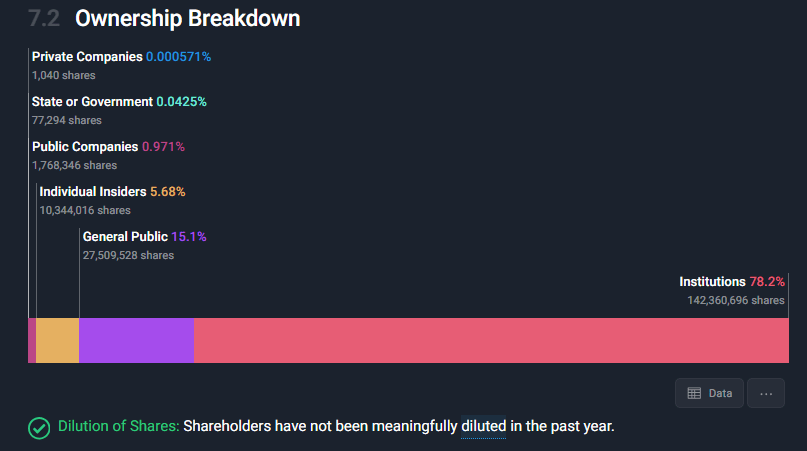
Twilio Ownership (simplywall.st)
When an activist investor gets involved with a business, companies either fight the activist and deny the value of the input or consider the possibility that the activist might be right. In this case, Twilio appears to have engaged with the activist and began changing in a way that looked like they would follow the plan and changed their mind at the last minute.
Twilio began restructuring in 2022 when it announced that it would shutter Zipwhip, a company it had bought for $850 million in May 2021. When it closed the platform Twilio did not have a replacement product for Zipwhip's 30,000 customers, advising them to go elsewhere. $850 million to zero in a year seems a terrible waste of capital.
From Geekwire who reported the move
Twilio does not have a similar service to Twilio Zipwhip that is 'out-of-the-box' ready so there is no migration path after the Zipwhip services shut down…….Twilio points to its long-time partners Podium, Voxie, and Text Request as potential replacements.
In May 2022, Twilio announced the transition to being a remote-first company, allowing employees to work remotely permanently (cost $98 million), resulting in the closure of several offices.
In February 2023, Twilio announced significant restructuring of its business when it split into two divisions: Communications (messaging software), led by Khozema Shipchandler, and Data and Applications (customer engagement platform), led by Elena Donio. The contentious Segment was placed in Data and Applications along with two other vital offerings, Flex and Engage. It made some strategic sense to reorganize the business in this way. It separates the communications business from the customer engagement platforms.
The founding CEO Jeff Lawson, said that the change prioritized profits over growth. In his penultimate call as CEO (Q2 2023), he said Twilio "had to spend less, streamline and become more efficient."
By the Q3 earnings call, Elena Donio had been moved to an advisory role, and the CEO, Jeff Lawson, had taken over running her division. Lawson described the efforts as rebuilding and said that so far, they had not been enough. He said they continue to see churn and contraction in the division.
Significant cost-cutting initiatives were reported at this time. The employee sabbatical program closed (cost $10 million), and further job losses were announced. Twilio started cutting jobs in 2022, 11% of staff were let go in September 2022, followed by another 17% in February 2023, and a third round of cuts measured 5% in December 2023. Job cuts amount to more than 3,000 positions over the period.
In January this year, the founder and CEO, Jeff Lawson, resigned from the board, leading to more restructuring; the move coincided with the expiry of the super-voting rights Lawson had enjoyed.
Khozema Shipchandler was named CEO after moving from Communications. In the Q4 earnings call, he announced more structural changes to the two divisions.
Data and Applications lost Flex and Engage, leaving only Segment. The division was renamed Segment as a result. Segment recorded a $285 million impairment loss on intangible assets.
Flex is a digital platform and pre-sale conversation tool that uses an in-app digital human or a cloud-based contact center. We have all used this service when a little window pops up at the bottom of the screen asking to start a conversation with you that's Flex.
Engage is a platform that manages the interaction with a customer across all of a business's communication channels. It captures information from across a company and uses it to develop a personalized marketing plan for individual customers. It is a customer engagement tool, hence the name, designed to drive growth and brand awareness.
Isolating Segment in this way seemed to lay the groundwork to sell the business, as suggested by the activists. It did indicate that the new CEO was contemplating selling Segment, but his messaging was mixed in his first earnings call
On the one hand, he seemed to be preparing to sell:
Our Twilio Segment business, formerly Twilio Data & Applications, while still strategically important to Twilio, continues to underperform. Although we drove sequential bookings improvement in Q4, growth is not yet accelerating up to our expectations. We need to execute better and I believe that we can. Over the past five weeks, I've been working with the team to conduct an extensive operational review of Segment, and this work is ongoing. We plan to do a read-out of these results in March at which time I'll be ready to share our findings
In the Q and A section, the CEO confirmed that the review would include looking at selling the business; it appeared that the activist investors might get their wish.
Flex and Engage are the areas that could benefit the most from generative AI and are areas of potential growth. The fact that they were moved out of Segment at that time suggested that the company was looking to hold onto these two growth areas and isolate Segment perhaps for a sale.
He then discussed AI, and Segment appeared essential to this identified growth area.
Q3 saw the announcement of CustomerAI, a predictive generative AI solution pairing customer data with LLM, hoping to improve the link between a company and its customers
This is the initial set of opportunities we are working with customers using Segment to get their customer data AI-ready and then activating on that data with Twilio Communications. This communications and data flywheel will empower brands to enter the AI race steps ahead of their competitors armed with the AI-ready data, the platform that will allow them to interact with customers informed by that knowledge, and enable them to glean more insights from each message, call and email interaction. We believe this will improve their customer data sets and in doing so, help them deliver more effective, personalized customer communications.
By Q3, more than 100 customers had been using Twilio's AI. The CEO stated that Segment's long-term goal was to provide unprecedented automation, cost savings, and improved customer relationships by using increased AI.
Recent customer wins highlighted in the recent earnings call suggested that the new CEO believed Twilio is better with Segment than without it. He discussed some large orders the company had signed and stressed that they bought both Communications and Segment.
In the fourth quarter, we signed a competitive, multi-year, eight-figure deal with a leading US financial services company whose usage of our platform spans both Communications and Segment……… signed a seven-figure deal with an international salon management software company. With Twilio, this company moved away from the incumbent providers and now relies solely on Twilio Messaging for all of its one-to-one messaging with customers. And the company already deployed Segment for its B2B business
Twilio will not sell Segment.
In the press release announcing, the plan seemed to have reverted to the original one when Segment was purchased in 2020. Integrating Segment and Communications to provide a single platform.
The convergence of Segment's data capabilities combined with Communications creates opportunities to deliver outsized outcomes for customers,
Twilio already had a $1 billion share repurchase scheme in operation, and in the March announcement, it added another $2 billion. Twilio has the cash to afford this already on the balance sheet and did record positive cash flow in Q4.
In the March update, we had guidance for 2024 and 2025

Forward Guidance (Twilio March Update)
The revenue growth represents a continued slowing (7.5% midpoint).
The vague plans to focus on the profitability of Segment would not appear to be enough as it represents only 7% of Twilio's revenue. Another two years to reach GAAP profitability, perhaps another 1 or 2 billion dollars of negative net income, it may have been better for shareholders to sell the whole operation.

Key Line Items (Author Database)
Twilio acquired Segment in October 2020 for $3.2 billion. It was a start-up in the burgeoning customer data management market that allowed data to be pulled from one app to another.
In 2020, Twilio had a market cap of over $40 billion and hoped to expand its market beyond the communication APIs it developed into a developer of customer-centric apps.
With a market cap today of $11 billion, the rationale is not as straightforward as it was four years ago, and Segment would appear to be a drag on the company's performance. Q4 2023 saw Segment deliver $75 million in revenue, growing 4% year-on-year, but its gross margin dropped, and it delivered a non-GAAP operating margin of -25%.
Activist investors want to see Segment sold and capital returned to shareholders.
I sympathize with the activist investors; Twilio is sitting on a lot of cash, has considerable revenue, and is a market leader in a growth industry, yet it continues to make losses and, even with its latest plan, is not expecting a GAAP profit for two years. Selling the business would likely have generated a significant return for investors and may have been the best option.
I also sympathize with the management; they have built a market-leading communications platform and a customer engagement platform that should deliver significant growth. Generative AI could deliver enormous gains for this platform. The problem is that they have been trying to grow it for four years and have not gotten anywhere.
In response to the activist investors, Twilio separated into two divisions, rearranged them, and changed its CEO, losing its founder.
The new plan is to integrate Segment with its Communications division; that was the original plan when it bought Segment in 2020.
Twilio is a business that stands to benefit directly from the potential of Generative AI. My search for such a business led me to look at Twilio in the first place, but I will wait and see how the new CEO develops the business in the coming quarters and how the shareholders react to his latest plan.