
Matteo Colombo/DigitalVision via Getty Images
Matteo Colombo/DigitalVision via Getty Images
Turkey is what amateur international relations aficionados (such as myself) would refer to as a geostrategic location. For over a millennium, back in the age of empire, what is now Turkey has economically benefited from sitting at the nexus of East and West. This significance has not abated in the modern era. Due to its geographic positioning, the country has the ability to serve major markets in Europe, the Middle East, and Asia. For those considering a pure play on this niche country, the iShares MSCI Turkey ETF (NASDAQ:TUR) presents an opportunity.
TUR's performance has been strong in the new year, coupled with decent macroeconomic growth prospects. However, continued currency depreciation and a few question marks around the government's ability to deliver on supporting infrastructure for continued growth are why we rate TUR a HOLD... for now.
TUR tracks the performance of the MSCI Turkey IMI 25/50 Index (USD). This index is aims to measure all segments (large, mid, and small cap) of the Turkish economy. The fund hovers around $200M in AUM and is priced in line with many single-country or emerging markets ETFs, with an expense ratio of 0.59%
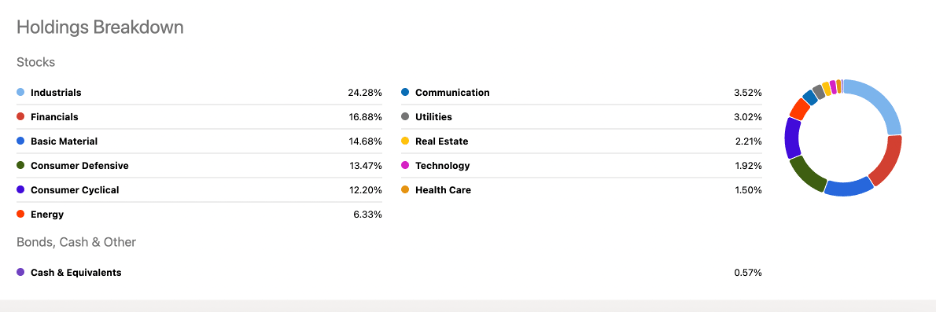
The fund holds roughly 100 stocks, with the largest allocation to Industrials (~25%), followed by Financials and Basic Materials.
Seeking Alpha
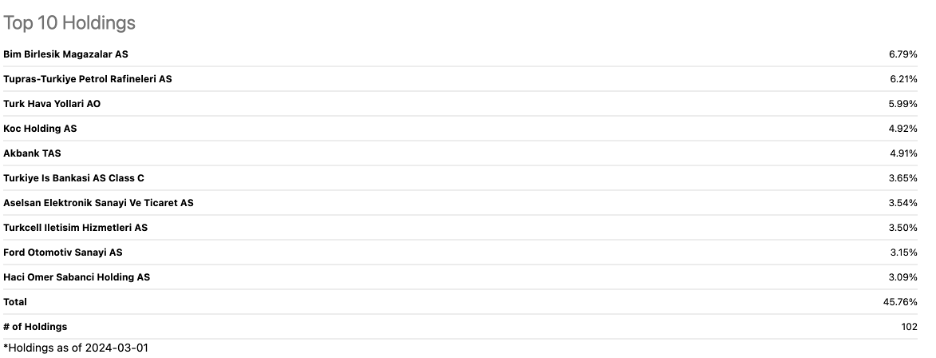
Roughly 45% of the fund’s assets are in the top 10 holdings, though it is not overwhelmingly allocated to one single holding. The largest allocation is to BİM Birleşik Mağazalar (OTCPK:BMBRF), a retail company that follows a similar model to the privately owned and much beloved German discount grocer and consumer goods purveyor ALDI. The company has a large presence in Turkey, as well as neighboring Egypt and Morocco. Some notable stock allocations also include Koç Holding (OTCPK:KHOLY). This is the largest industrial holding company in Turkey and was included in the Fortune Global 500, as well as the Fortune 500 Europe in 2023. Koç is diversified across several business lines, including energy, finance and automotives.
Seeking Alpha
There are a few different draws to investing in Turkey. For starters, the population is sizable, with around 85 million people. According to the CIA Factbook, the median age of a Turkish citizen is 33.6, ranking it 106 out 227 recognized countries or territories, making it relatively young. A young workforce can be beneficial for future economic growth and productivity. It also provides a sharp contrast to its neighboring continent to the west, Europe which is increasingly burdened by an aging population and the loss of productivity (not to mention growing pension liabilities). As such, Turkey is able to position itself competitively as a global manufacturing and distribution center, with lower labor costs relative to its neighbors.
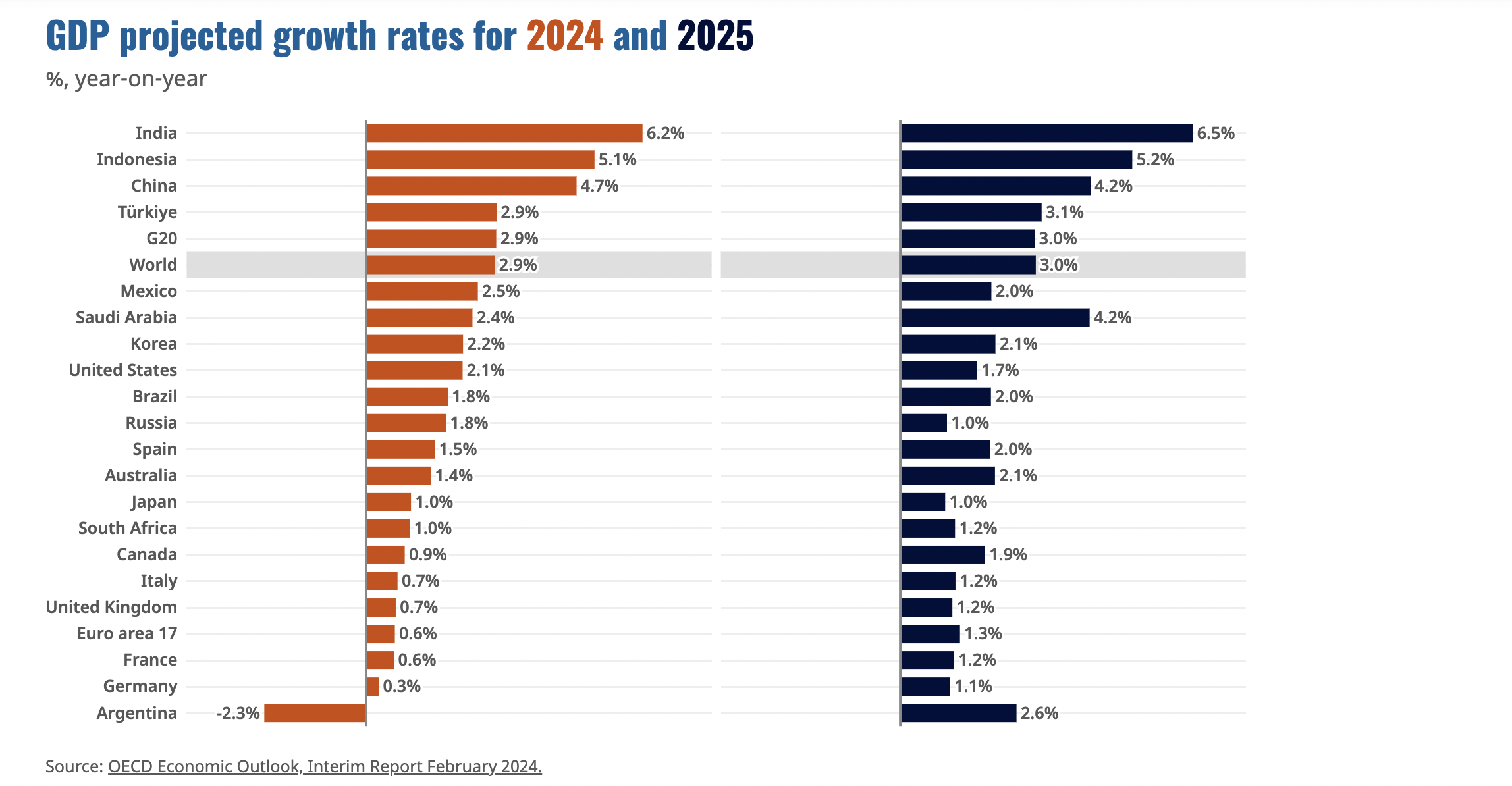
The OECD projects GDP growth in 2023 to tally to 4.5% and moderating to 2.9% in 2024. While these figures don't necessarily pop, they rank in line with both G20 and world estimates and higher than several well known emerging markets.
OECD
Turkey has experienced significant inflation in the post-COVID period, approaching 70% as of early March. Consequently, the country implemented extreme monetary tightening in 2023. According to the OECD, policy rates jumped from 8.5% in June 2023 to 40% in November, and it has been suggested that rates will continue to climb to 45% in an effort to help combat inflation.
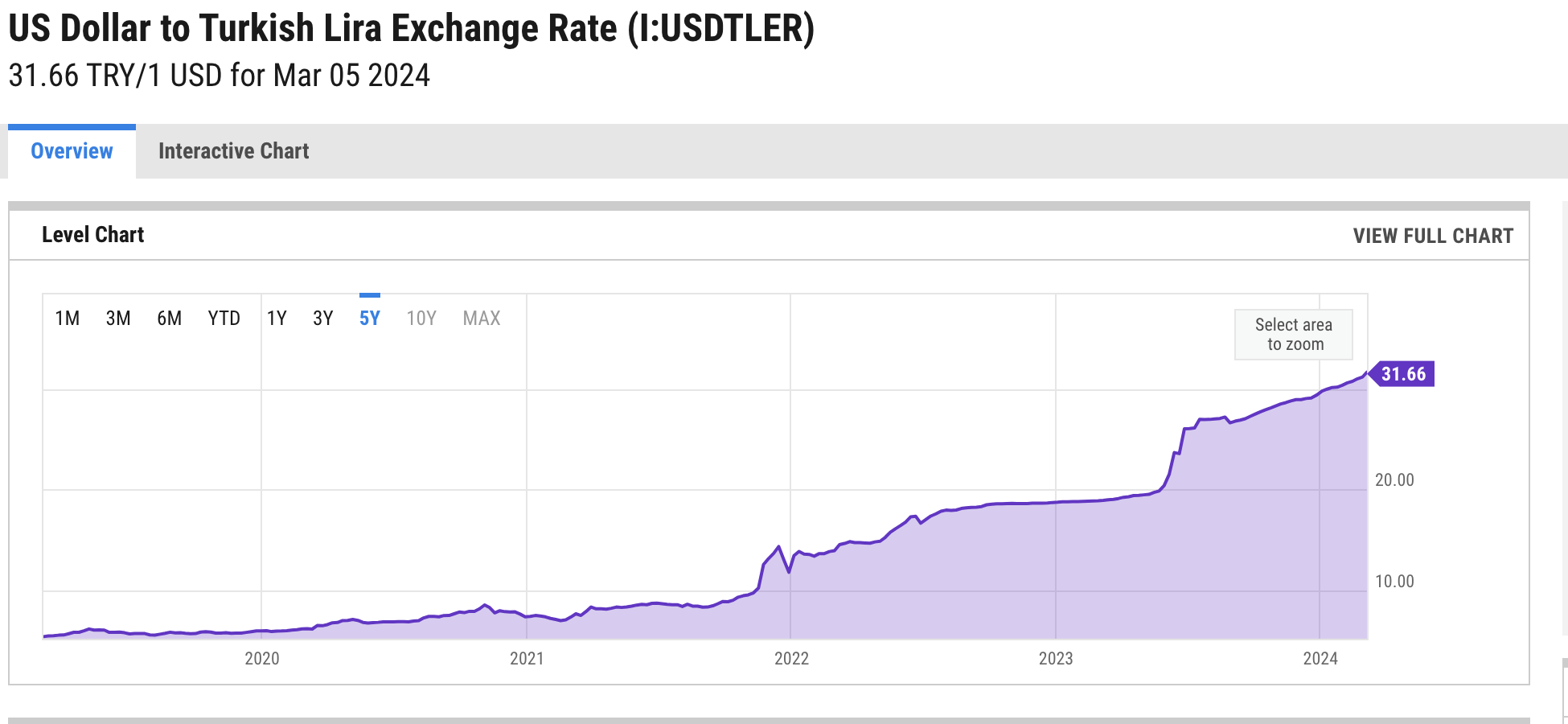
While rate hikes have had their intended effect on moderating inflation, they have yet to have an effect on the devaluation of the Turkish Lira. The Lira has been embattled for a long time, though it has appeared to reach new lows despite a more hawkish monetary environment. High interest rates and a devalued currency are likely to drive domestic investors to safer havens like bank deposits or foreign reserve currencies.
On top of the monetary chaos, local elections are slated for the end of March. Turkey is a country that has experience "democratic backsliding" in recent years. Erdogan's reelection last May solidified his hold on power, but a rebuke by opposition parties could create further turmoil for the country.
YCHARTS
Despite much of the precarity described above, Turkey has managed to outperform both broad emerging markets (EEM) and global stocks (URTH) on a year-to-date basis. However when looking at volatility in the same period, we see 30-day rolling volatility levels are much higher than both EEM and URTH. Typically, single country investors should have a higher tolerance for volatility, as it implicit in the geographic concentration of a single country ETF.
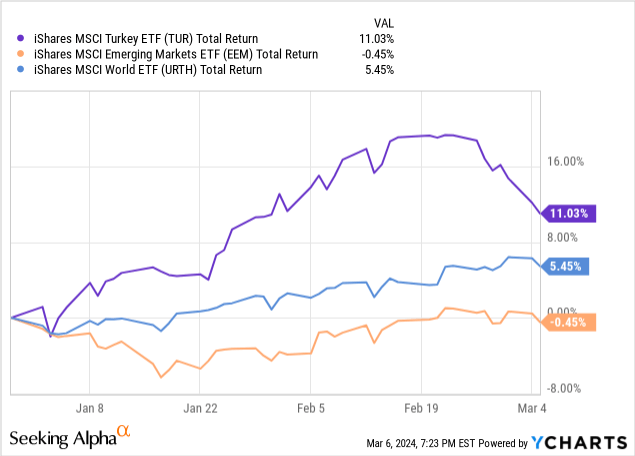
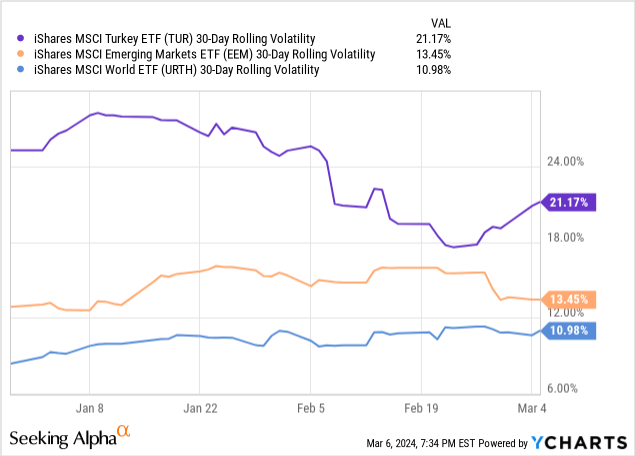
It is also worth noting how cheap TUR currently is, with a P/E ratio of 8.05 and a P/B of 2.60, TUR is offering quite a bit of value for the investor who is inclined.
Turkey appears to be at an inflection point. There are significant economic headwinds. Moving the needle on inflation will likely require a continued period of elevated interest rates. This has the potential to help moderate Lira devaluation, but also has the potential to discourage domestic investment as the cost of borrowing will remain high. While recent market performance has seemed to indicate that the global investor base has endorsed Turkey, it remains to be seen how long the market and economic realities remain decoupled. I am hopeful for this bastion of global commerce, but recommend a HOLD for the time being.
Editor's Note: This article discusses one or more securities that do not trade on a major U.S. exchange. Please be aware of the risks associated with these stocks.