Akarawut Lohacharoenvanich
Akarawut Lohacharoenvanich
TransMedics (NASDAQ:TMDX) provides services that assist organ transplantations, including perfusion devices and transportation. The company has achieved rapid growth in recent years on the back of technology which improves the utilization of organs and creates better clinical outcomes. Growth is likely to remain robust going forward, driven by increased market share and vertical integration to capture more of the value chain. While TransMedics' valuation is relatively high, expansion into new organs (particularly kidneys) could still result in strong returns.
The incidence of end-stage organ failure is increasing globally, driving demand for organ transplants and transportation. Supply is restricted though, in large part due to the inability to get functioning organs from donors to recipients. Cold storage is generally used to preserve organs during transplantation, but this approach has limitations. For example, the lack of oxygenated blood during transportation can cause significant damage and doesn’t allow physicians to assess organ viability.
The inability to assess organs largely limits the donor pool to Donated after Brain Death (DBD) donors, whose organs can be assessed for viability prior to retrieval. It also increases the probability of post-transplant complications.
Time-dependent ischemic injury also limits the time between organ retrieval and transplantation to 4-6 hours, limiting the distance organs can be transported, which contributes to the underutilization of donor organs.
There are 67,000 potential donors annually in the US, Canada, the EU and Australia. The majority of lungs and hearts donated after DBD go unutilized though, and almost no lungs and hearts Donated after Circulatory Death (DCD) are utilized. For example, approximately 77% of donated lungs and 68% of donated hearts in the US were unutilized in 2016.
Figure 1: Underutilization of Donor Organs for Transplants (source: TransMedics)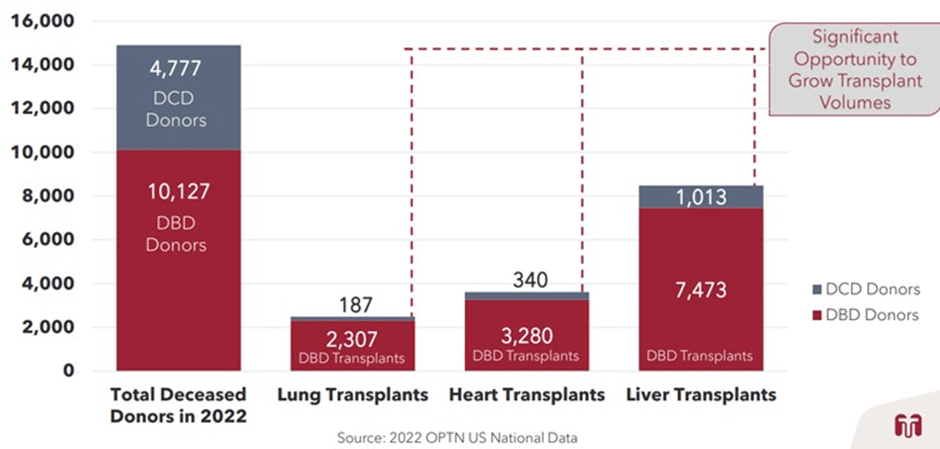
Transportation is an important part of the transplant process due to the distance between donors and recipients and limited time available in which to transplant an organ. Transportation is generally performed using charter planes, but there can be problems with inefficient routes and plane availability.
With sufficient scale it becomes feasible with logistics providers to operate their own planes on certain routes, and this is an option TransMedics is now pursuing. There will likely always by a long tail of transplants requiring the use of charter planes though due to plane availability or route issues.
The majority of transplant procedures are performed at a relatively small number of hospitals, simplifying transportation to some extent. TransMedics believes that around 50 transplant centers perform over 70% of the lung, heart and liver transplants in the US.
TransMedics believes that its addressable market is approximately 8 billion USD for lung, heart and liver transplantation combined. This estimate is based on the pool of potential donors, with each donor able to donate more than one organ and assumed utilization rates based on the efficacy of the technology. Transportation also probably provides a several billion USD opportunity.
Figure 2: Organ Transplants in the US (source: Created by author using data from The Department of Health and Human Services)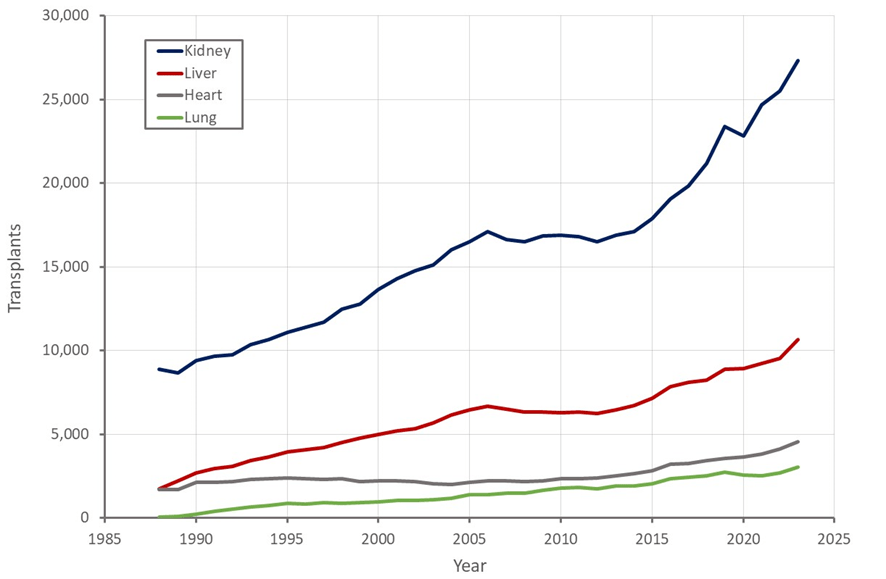
It is worth noting that on a long enough timeline bioprinting could become a viable alternative to organ transplants. This is likely still decades away as there are still limitations around economically producing viable cells and creating the intricate structures required in organs. This is something that companies are actively working on though and progress is being made. For example, 3D Systems (DDD) is developing 3D printed lungs in partnership with United Therapeutics and is targeting clinical trials in the next 5 years.
TransMedics’ Organ Care System (OCS) is at the heart of the business. It is a system that helps to preserve organs during transplants by providing warm, oxygenated, nutrient-rich blood, thereby improving the rate of transplant success and clinical outcomes. Compared to cold storage, OCS reduces the time that organs are deprived of blood flow. It also enables the optimization and assessment of donor organs. TransMedics’ OCS currently addresses lung, heart and liver transplants but could be expanded in the future to organs like kidneys.
Figure 3: Clinical Evidence of Impact on Utilization and Efficacy (source: TransMedics)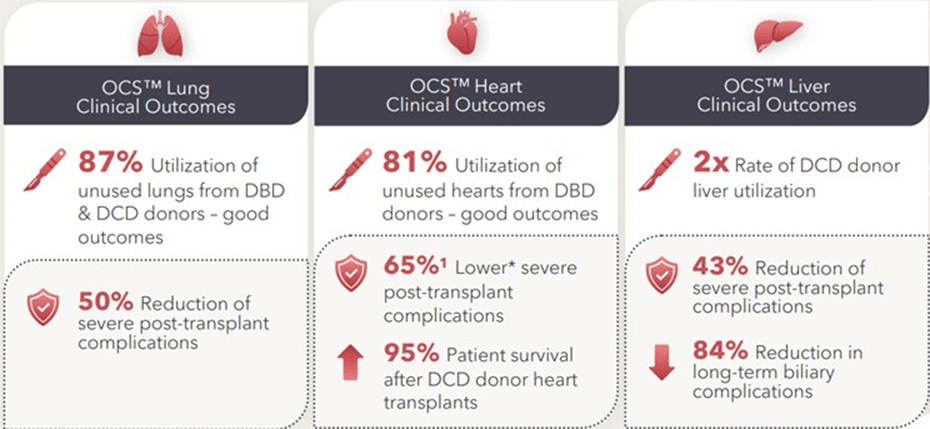
TransMedics completed approximately 2,300 OCS transplants in the US in 2023 and has a target of 10,000 transplants by 2028. Growth is currently being driven heart and liver transplants.
Table 1: OCS Organ Transplant Penetration (source: Created by author using data from TransMedics)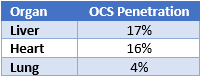
In addition to its core OCS technology TransMedics is also expanding into transplant logistics. While this may seem like a questionable move, it significantly expands TransMedics' addressable market and should still provide reasonable margins. It will also allow TransMedics to offer customers an end-to-end solution, including ground transportation, with better outcomes. Q4 of 2023 was the first full operational quarter for TransMedics transplant logistics service.
Organ transportation has historically relied on charter flight brokers and small local operators. TransMedics believes that this approach has limitations though, including cost and efficiency, and is a bottleneck to its growth. Operators also often use older aircraft that are incapable of covering the distances enabled by TransMedics’ OCS technology. TransMedics believes that growing demand for organ transport is also creating a charter plane shortage.
TransMedics plans on building and operating a modern fleet of jets that can fly longer distances. This will be a dedicated fleet, including crews, that will fly more efficient routes. TransMedics’ NOP network, combined with dispatching algorithms, will be an important contributor to this. It will also help to reduce the cost burden of DCD donors that don’t progress to become a donor.
TransMedics had an average of 7 planes in operation in Q4, compared to 3.5 in the third quarter. At the end of 2023, TransMedics owned 11 aircraft which are all expected to become operational in early 2024. This is expected to expand to 15-20 aircraft by late 2024 / early 2025.
TransMedics' logistic service met around 35% of its NOP flight needs in Q4, with the company targeting 80% coverage in the future. There are already 98 transplant programs utilizing TransMedics' logistics service.
The National OCS Program was established to help maximize the utilization of donor organs. TransMedics has a network of 16 NOP hubs which offer OCS technology and in excess of 200 surgical and clinical personnel. TransMedics manages donor organ retrieval, instrumentation and transportation. NOP represents more than 98% of OCS transplants in the US across TransMedics' three organs.
TransMedics’ revenue was 81.2 million USD in the fourth quarter, up 159% YoY. Transplant revenue in the US was 75.2 million USD. International revenue is lumpy due to the nature of transplants and a lack of reimbursement. International revenue is currently dominated by heart transplants.
Table 2: TransMedics Revenue by Organ (source: Created by author using data from TransMedics)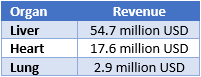
Service revenue was 29.3 million USD in Q4, which includes surgical procurement, organ management, organ procurement and transplant logistics.
Logistics revenue was 9.2 million USD, up from 2.1 million USD in the third quarter. TransMedics' logistics business was only operational for 4-5 weeks in the third quarter though. It should be noted that 2.5 million USD of this is from a legacy business that is non-transplant related and is expected to go to zero in the first quarter of 2024.
Transportation is already a meaningful contributor to TransMedics’ business, despite only recently launching, and it has significant room for further growth. For example, Blade’s Medical segment is generating over 30 million USD a quarter at the moment.
Figure 4: TransMedics Revenue (source: Created by author using data from TransMedics)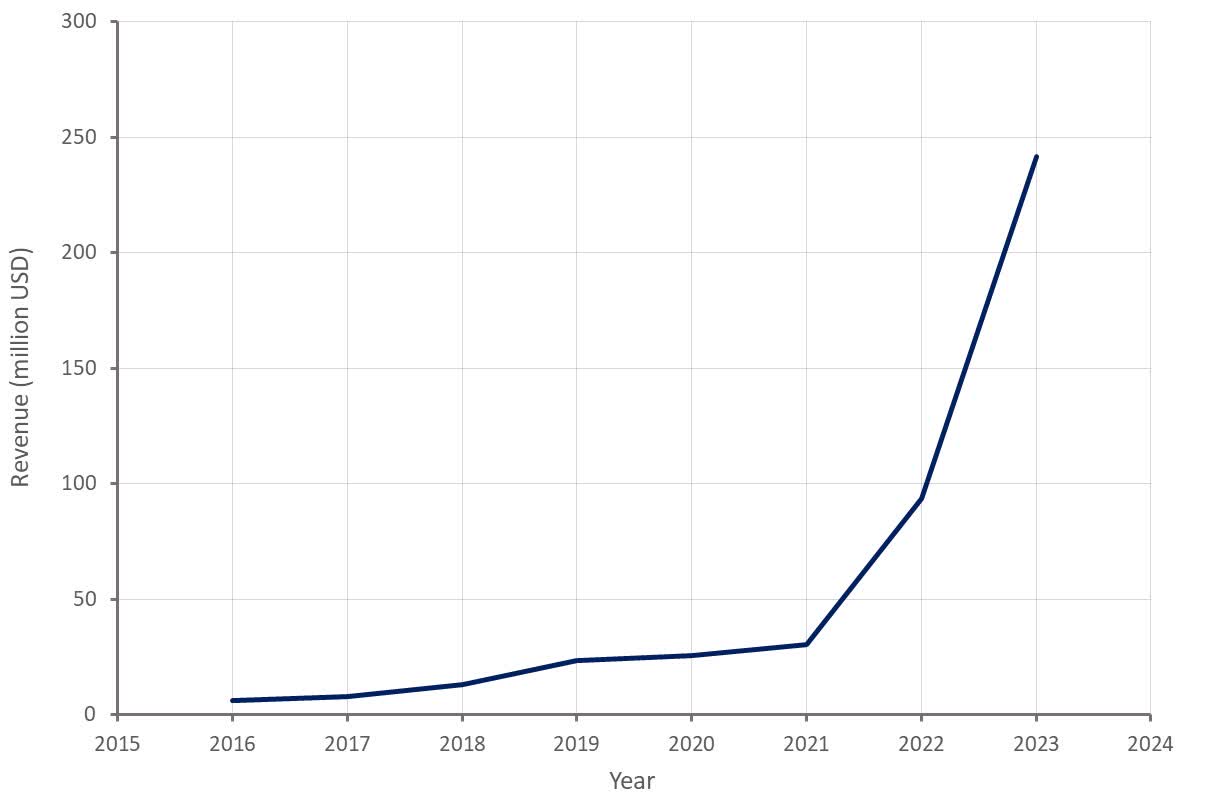
TransMedics is guiding to 360-370 million USD revenue in 2024, representing 49-53% growth over 2023.
Table 3: Analyst Revenue Estimates (source: Created by author using data from TransMedics)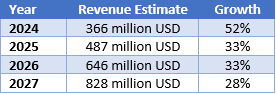
TransMedics gross profit margin in the fourth quarter was 59%, down from 66% in Q4 2022. This decline is due to the growth of the relatively low margin logistics business. Product margin was also impacted by an inventory issue in the fourth quarter that is not expected to be repeated.
TransMedics service gross profit margin was 35% in the fourth quarter, which is impressive given that the transportation business is still nascent. This also compares favorably to Blade’s 20% Medical flight margins. The difference is presumably due to the fact that transportation currently provides a minority contribution to service revenue. TransMedics is targeting service gross margins in excess of 35% longer term, slightly above Blade’s 25% margin target.
Figure 5: TransMedics Profit Margins (source: Created by author using data from TransMedics)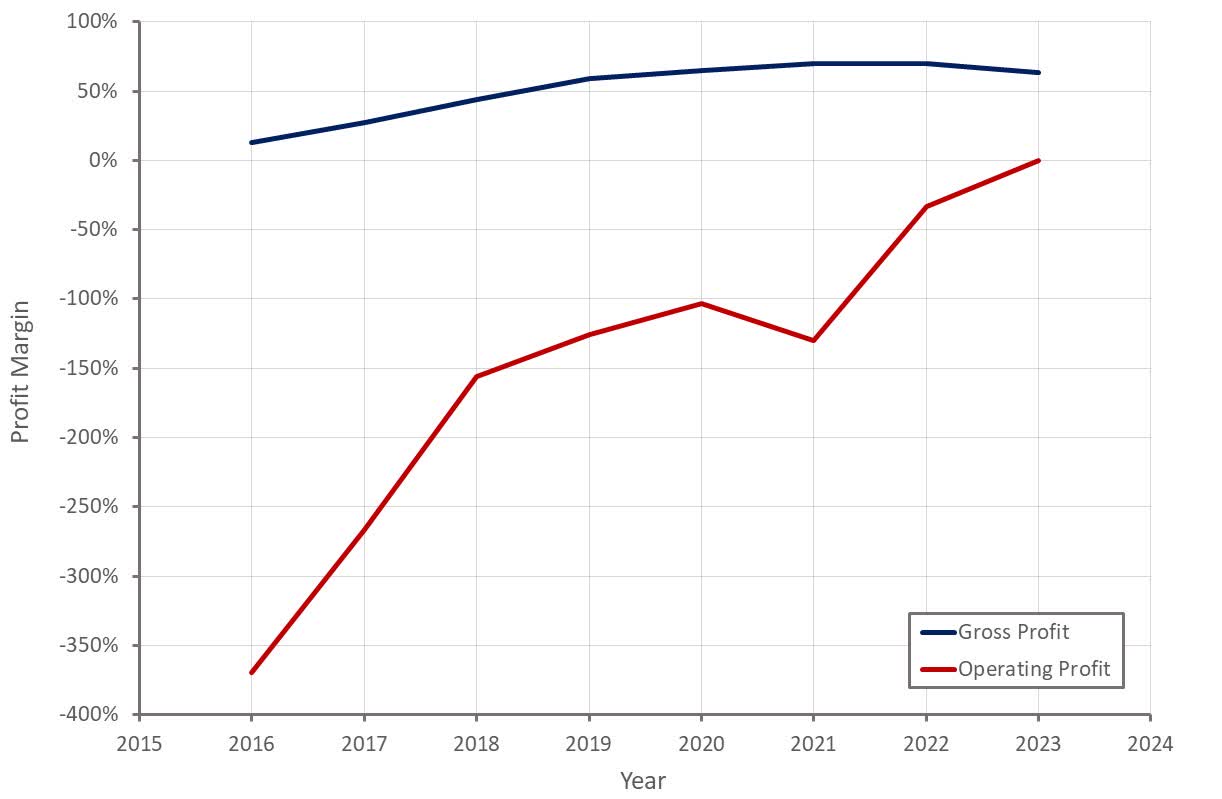
TransMedics' operating profit margin are improving rapidly on the back of strong growth and operating leverage. The company recorded its first profitable quarter in Q4 2023, although the margin was low and TransMedics had a sizeable loss for the full year. TransMedics should be profitable in 2024 and begin to achieve higher margins over the next few years. This improvement in profitability will likely be supportive of the share price in the near-term.
Figure 6: TransMedics Operating Expenses (source: Created by author using data from TransMedics)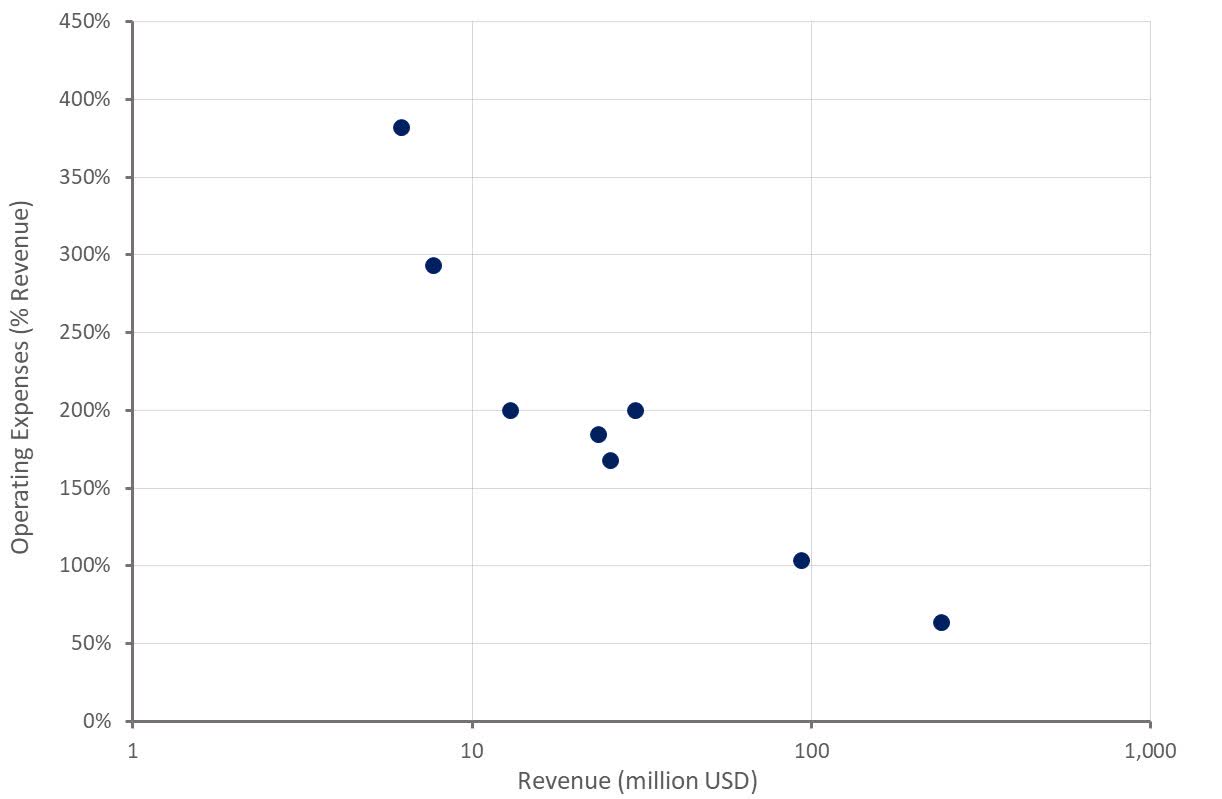
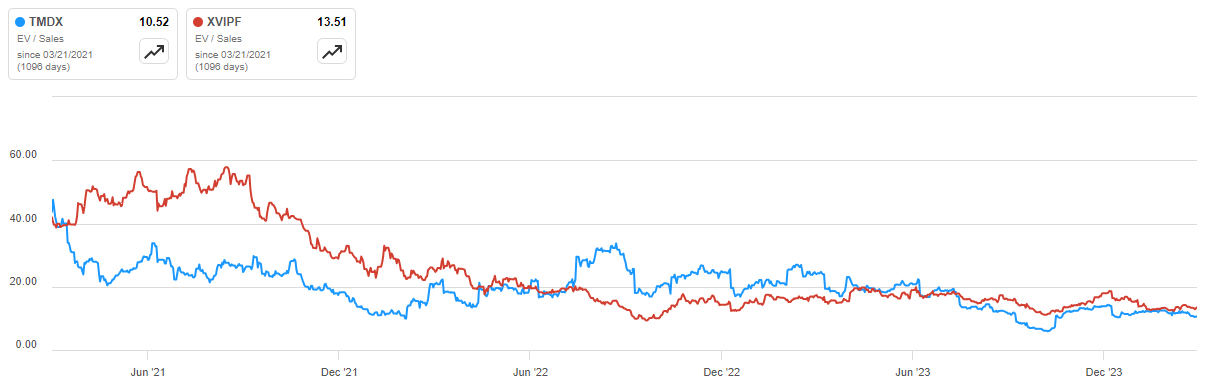
While TransMedics' has a strong business and is rapidly establishing a dominant position in the market, its valuation already reflects this. TransMedics' EV/S multiple is lower than Xvivo Perfusion (OTCPK:XVIPF), despite growing significantly faster. An EV/S multiple of in excess of 10 implies significant growth and/or high margins though. A premium valuation is supported by the fact that over 90% of TransMedics' revenue comes from single-use disposable sets. TransMedics' growth should also remain robust over the next few years and the company should begin to generate decent margins over the next few years.
Investors should be cautious about overpaying for TransMedics though, as the market size is limited. Based on current organ utilization, TransMedics' addressable market is probably less than 2.5 billion USD. TransMedics’ technology is helping to expand the opportunity though and additional organs provide further expansion potential, particularly kidneys. If TransMedics can receive reimbursement internationally, this would also be a substantial growth tailwind.
On a long enough timeline TransMedics’ business also has a high probability of being disrupted by bioprinting, although this likely won’t be for decades. This is still important though, as it is not clear TransMedics will have a terminal value.
Figure 7: TransMedics EV/S Ratio (source: Seeking Alpha)