
amriphoto/E+ via Getty Images
amriphoto/E+ via Getty Images
SiTime Corporation (NASDAQ:SITM), a supplier of semiconductor chips for precision timing, wrapped up FY2023 with the release of the latest Form 10-K on February 26. SITM saw big drops in sales and profits in FY2023 and Q1 FY2024 guidance was tepid at best, but SITM tried to offset any blowback by holding out the prospect of a return to much faster growth in the not so distant future. Still, SITM could not prevent the stock from collapsing. SITM may not grow as fast as it believes it can. Why will be covered next.
A previous article from last December speculated SITM could be getting ready for a breakout after spending quite a bit of time going in circles. Nonetheless, the article rated SITM a hold for a number of reasons, including the possibility SITM could fail to meet high expectations from certain sections of the investing community. These expectations were what allowed the stock to go on a run in recent years you do not get to see all that often. At one point, SITM multiplied in value by over 20 times in less than two years, driven by an explosive increase in earnings.
Source: Thinkorswim app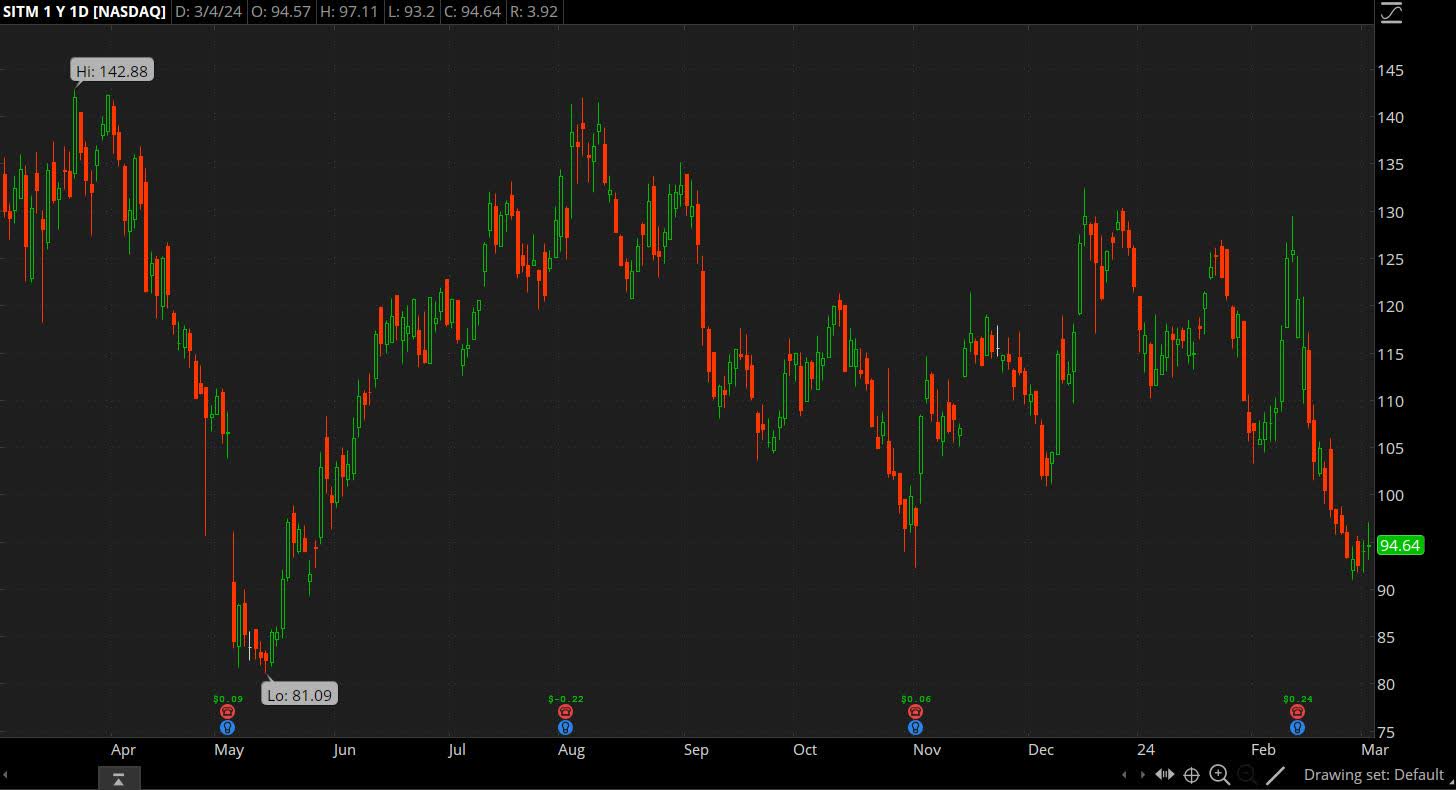
The chart above shows why staying cautious turned out to be warranted. Most semiconductor stocks have done great in 2024, but there are exceptions, and SITM is one of them. SITM has lost 22.5% of its value YTD, with the stock closing at $94.64 as of March 4, 2024. In comparison, the iShares Semiconductor ETF (SOXX) has gained 19.2% YTD in 2024. SITM has underperformed in what has thus far been a very good year for semis.
Note how the losses came after February 13, which happens to be the day SITM announced its Q4 results and Q1 guidance. The stock was up 6% for the year as recently as February 12 when it hit a 2024 high of $129.43, but the stock fell off a cliff to wipe out all gains and then some. On the other hand, the stock is close to oversold, which may prevent further losses in the short term. SITM has lost 27% in three weeks, so a bounce would not be a surprise.
SITM entered FY2023 on a roll, having grown revenue from $84M in FY2019 to $284M in FY2022 for a CAGR of about 50% in FY2019-2022. However, FY2023 turned out to be a different story, with both the top and the bottom line collapsing. FY2023 revenue shrank by 49.2% YoY to $144M and non-GAAP EPS fell by 95.1% YoY to $0.18. The table below shows the numbers for FY2023.
In terms of GAAP, SITM wound up with a net loss of $80.5M or $3.63 a share, down from a net profit of $23.3M or $1.03 a share a year ago. The main difference between the GAAP and non-GAAP number can be attributed to stock compensation expense, totaling $76.8M in FY2023. GAAP takes stock compensation expense into account, but non-GAAP does not.
SITM finished FY2023 with cash, cash equivalents and short-term investments of $528.2M and no long-term debt on the balance sheet. Keep in mind that this cash pile was raised from investors and not earned through profits. The balance sheet shows $796.45M of additional paid-in capital. In contrast, there is an accumulated deficit of $88.4M on the balance sheet.
SITM has mostly lost money since going public in November 2019. Nevertheless, the cash hoard declined sequentially since it stood at $568.1M in the preceding quarter, which is mostly due to the acquisition of Aura Semiconductor in November 2023. Cash is likely set to decline further, since the Aura transaction involves fixed payments of $148M and earnout payments up to a maximum of $120M. Note that SITM has announced its intention to sell another 1.4M shares, which could affect the balance sheet if it does.
(Unit: $1000, except for EPS, margins and shares) | |||
(GAAP) | FY2023 | FY2022 | YoY |
Revenue | 143,993 | 283,605 | (49.23%) |
Gross margin | 57.0% | 64.5% | (750bps) |
Income (loss) from operations | (107,200) | 16,142 | - |
Net income (loss) | (80,535) | 23,254 | - |
EPS | (3.63) | 1.03 | - |
(Non-GAAP) | |||
Revenue | 143,993 | 283,605 | (49.23%) |
Gross margin | 59.2% | 65.2% | (600bps) |
Income (loss) from operations | (22,438) | 75,808 | - |
Net income | 4,227 | 82,920 | (94.90%) |
EPS | 0.18 | 3.66 | (95.08%) |
Weighted average number of shares | 22,967K | 22,664K | 1.34% |
Source: SITM Form 10-K
FY2023 was a bad year for SITM, but the year did improve towards the end. In Q4, revenue declined by 30.3% YoY, but it also increased by 19.4% QoQ to $42.4M. Non-GAAP EPS declined by 62.5% YoY, but it also increased by 300% QoQ to $0.24. The table below shows the numbers for Q4 FY2023, which actually surpassed the consensus of $0.20 on revenue of $41.7M.
(Unit: $1000, except for EPS, margins and shares) | |||||
(GAAP) | Q4 FY2023 | Q3 FY2023 | Q4 FY2022 | QoQ | YoY |
Revenue | 42,403 | 35,520 | 60,840 | 19.38% | (30.30%) |
Gross margin | 55.9% | 56.1% | 62.1% | (20bps) | (620bps) |
Income (loss) from operations | (27,468) | (25,177) | (5,731) | - | - |
Net income (loss) | (19,997) | (18,125) | (1,527) | - | - |
EPS | (0.89) | (0.81) | (0.07) | - | - |
(Non-GAAP) | |||||
Revenue | 42,403 | 35,520 | 60,840 | 19.38% | (30.30%) |
Gross margin | 58.3% | 58.2% | 63.1% | 10bps | (480bps) |
Income (loss) from operations | (1,931) | (5,648) | 10,209 | - | - |
Net income | 5,540 | 1,404 | 14,413 | 294.59% | (61.56%) |
EPS | 0.24 | 0.06 | 0.64 | 300.00% | (62.50%) |
Source: SITM Form 8-K
However, a major reason why the stock sold off was because guidance disappointed. Guidance calls for Q1 FY2024 revenue of $31-33M, a decline of 16.4% YoY at the midpoint. The forecast calls for a non-GAAP loss of $0.12-0.17 a share. In comparison, SITM posted a non-GAAP profit of $0.09 a share on revenue of $38.3M in Q1 FY2023. From the Q4 earnings call:
“Let me now review our outlook for the March quarter. As we enter 2024, we are expecting typical Q1 seasonality, as well as continued progress toward channel inventory normalization. We are taking a prudent approach to managing our cost structure as we absorb the acquisition and prioritize investments to drive long-term growth. With that in mind, we are providing the following outlook for the first quarter.
We expect revenue of approximately $31 to $33 million, gross margin to be in the range of 57% to 58%; operating expenses to be roughly flat year-on-year, and interest income of roughly $5.5 million. As a result, we expect non-GAAP earnings per share to be a loss in the range of $0.12 to $0.17 per share.”
Source: SITM earnings call
SITM did reference expectations of an acceleration in growth as the year goes by. Q1 is expected to be the low for FY2024, with expectations of sequential growth throughout the year. FY2024 is expected to achieve positive YoY growth as SITM gets back on track to the model of 30% annual growth.
“For 2024, we expect sequential growth from quarter-to-quarter, with growth accelerating in the second half of the year. We also expect revenue this year to exceed 2023 as our growth trends back to our model of 30% annual growth.”
Using these guidelines from SITM, FY2024 revenue is estimated to grow by 25% YoY to $180M. Such a top line would result in non-GAAP EPS of around $0.60 in FY2024, or more than three times the $0.18 SITM earned on revenue of $144M in FY2023. This would give SITM a forward non-GAAP P/E ratio of 157.7x with a stock price of $94.64. In comparison, SITM has a trailing non-GAAP P/E ratio of 525.8x with EPS of $0.18 in the last 12 months and the stock priced at $94.64. A stock price of $94.64 implies a market cap of about $2.15B, or about 15 times FY2023 sales of $144M. In comparison, the sector median is valued at three times sales. SITM is an expensive stock to own.
The FY2024 numbers are expected to improve upon FY2023, but the FY2024 numbers will in all likelihood remain way below the record highs of FY2022, which saw revenue of $283.6M and non-GAAP of $3.66. If SITM is to achieve the 30% CAGR targeted, growth will need to take it up a notch relative to FY2024.
The advantage SITM has is that the base is very low with FY2023 revenue of $144M and non-GAAP EPS of $0.18. If SITM does achieve the targeted growth, it could potentially get back to FY2022 levels in FY2026 if we extrapolate recent numbers into the future. However, there are no guarantees this will happen.
Keep in mind, SITM is relatively unproven since it only went public in 2019 and its track record is not as firmly established like other companies who have been around longer. It’s true SITM managed to grow very fast in the few years it has been around with, for instance, revenue growing from $84M in FY2019 to $284M in FY2022, but this level of growth may not necessarily be an accurate representation of what to expect from SITM in the coming years.
Remember that the aforementioned growth years were unusual in the sense that they happened during exceptional circumstances caused by the pandemic when companies had a right to fear supply chain disruptions. Many companies tended to place larger orders than normal to build inventories and minimize the impact of potential disruptions to production.
While SITM can claim to have a superior product for precision timing, this alone does not guarantee success as anyone familiar with the history of tech can attest to. It remains to be seen how much uptake there really is for SITM products in the coming years. SITM could replicate the boom years of FY2019-2022, but it would be premature to assume such growth levels because of what happened in recent years. SITM has too short a track record as a listed company. It is possible growth could be much less.
SITM reported huge drops in the top and the bottom line in the latest Form 10-K. FY2023 revenue fell by 49.2% to $144M and non-GAAP EPS collapsed by 95.1% YoY to $0.18, but SITM countered the latest numbers by projecting a return to annual growth of 30% per year, possibly before the end of next year. This is much faster than what most companies can achieve in one year, let alone year after year with a CAGR of 30%.
At first, a target of 30% annual growth does not seem like too ambitious a target. SITM posted similar or even faster growth as recently as during FY2019-2022. SITM is also coming off a very low base, which makes it easier to post very fast growth. SITM has a track record of growing at an extremely fast rate after increasing revenue from $84M in FY2019 to $284M in FY2022.
However, there is reason to doubt SITM would have achieved this level of growth under normal circumstances. And if we exclude FY2019-2022, then there is not much else to gauge SITM’s ability to grow since SITM has only been listed for five years. SITM has yet to show it can grow without the aid of a very favorable environment. The fact that sales collapsed so quickly in FY2023 suggests real demand was almost certain much less in FY2019-2022 than the headline numbers would lead someone to believe, although it remains to be seen by how much.
Valuations for SITM are on the high side. SITM, for instance, is valued at 15 times FY2023 sales with a market cap of $2.15B. P/E ratios are in the triple digits. Such high multiples can be justified if SITM manages to grow as fast as it says it will, but not so if FY2023 does not turn out to be an anomaly and growth is much less than expected.
SITM’s ability to earn a profit remains unproven. SITM has an accumulated deficit of $88.4M on the balance sheet and that is with very fast growth since the IPO. It’s worth asking what the number would be if growth was much less. SITM is profitable on a non-GAAP basis, but that is due to the exclusion of stock compensation expense. Stock compensation is comparatively high at $76.8M in FY2023, which is over half of FY2023 revenue of $144M.
The balance sheet also shows $796.45M of additional paid-in capital, which is almost certain to grow as long as there are no real profits and with SITM determined to sell a large number of shares in the future. In short, SITM is losing money with investors footing the bill. Valuations are high due to the potential for growth, but there is reason to question its true growth potential.
I am neutral on SITM stock. The fact that the stock has greatly underperformed in what has been a great year for semis is a red flag. SITM is likely to post much better numbers in the next 12 months than it did in the previous 12 months, mostly because FY2023 was such a bad year and the base is low, but the risk growth could come up short is there. Still, there is not much to be excited about, yet a lot that should give people pause, especially as it relates to what real demand is like for SITM. Long SITM may be worth considering down the road, but not now.