Rose_Carson/iStock via Getty Images
Rose_Carson/iStock via Getty Images
Silver has been underperforming gold. But both of these metals can do a much better job, in my view. The economy is slowing down, the interest rates are high, everyone is panicking the industrial demand is not there. Still, given the circumstances, silver prices are showing great resilience. But I still believe that silver may surge further. In fact, silver at triple digits is a possibility. I will explain how it is possible in this article.
There has always been a strong negative correlation between the interest rates and precious metals.
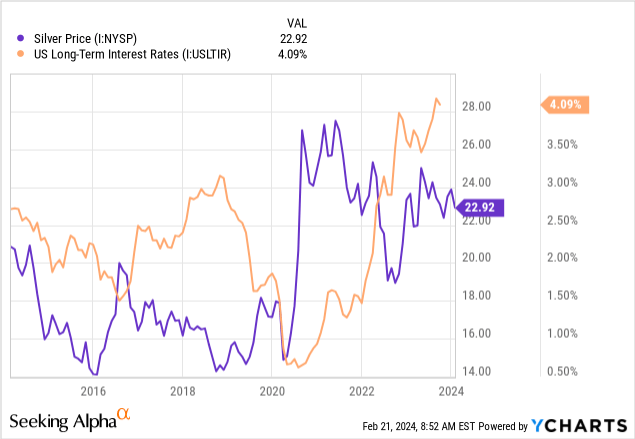
The diagram above shows the US long-term interest rates as well as the silver price, which is now lingering near the $23 per ounce mark. The rates are at 10-year highs, whilst the silver price is not very low. The lowest silver price on the graph was $14. This price was reached in 2016 and 2019, whilst the interest rates were 2.50% and 3% respectively. So, given the fact the US long-term interest rates, not to be confused with the base rate, are now at 4.09%, the silver price should trade at a price far lower than $14 per ounce. But it is trading at $23. Imagine what would happen to the silver prices if the rates start falling.
Silver prices unadjusted for inflation
Macrotrends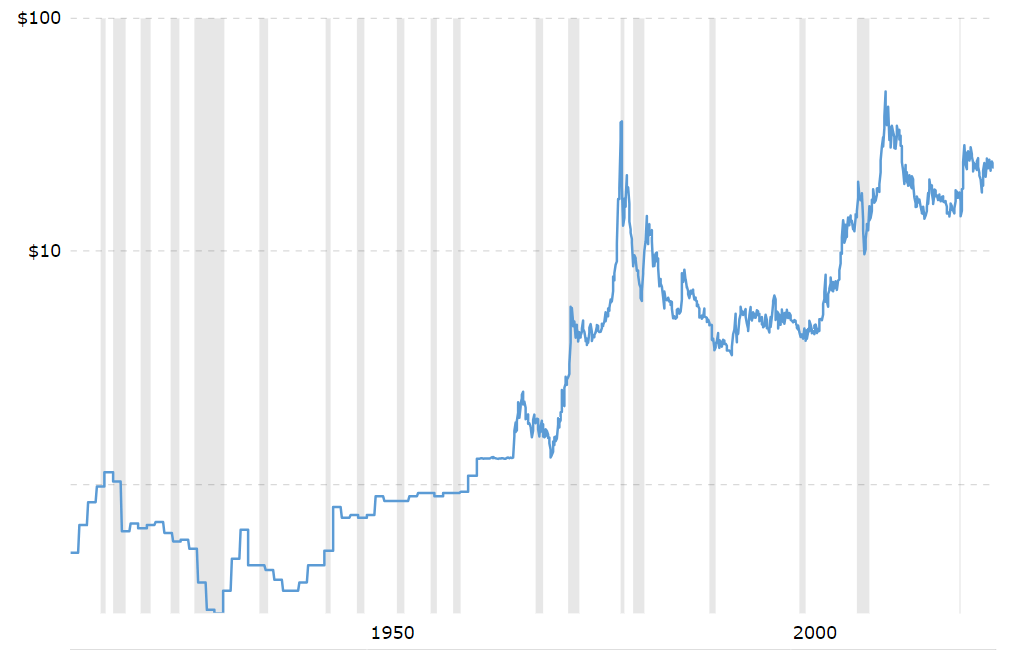
The graph above borrowed from Macrotrends clearly shows that silver used to trade much higher than it is trading now.
Silver prices adjusted for inflation
Macrotrends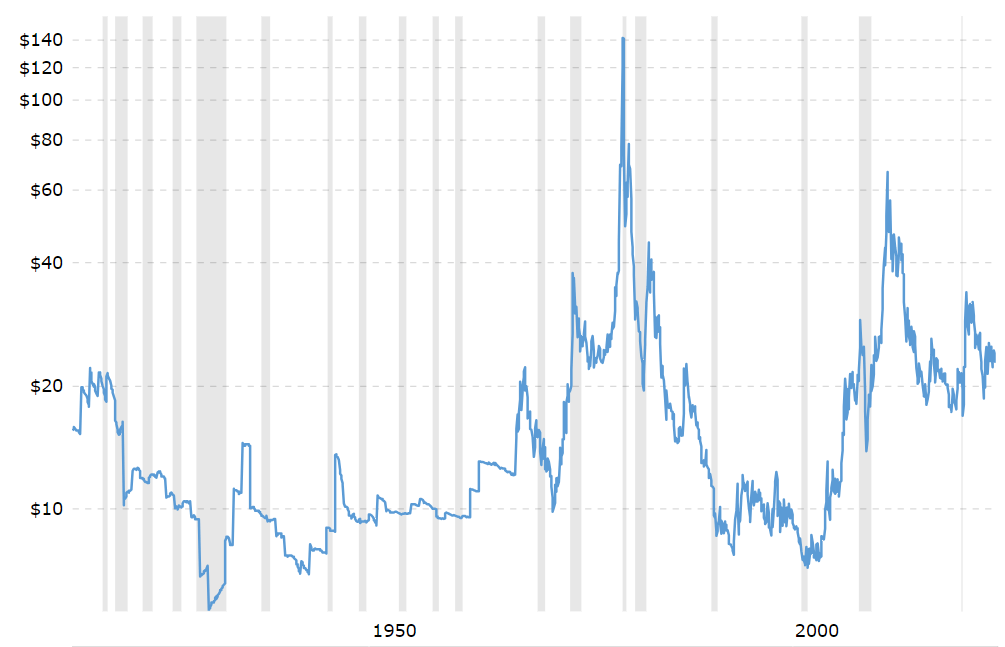
This is particularly clear if we have a look at the inflation-adjusted silver prices diagram. The last time that silver used to trade very high was in 2011. Its price reached a high of $48 per ounce in 2011. However, if we adjust the prices for inflation, it would have been about $70 in today's money.
This was three years after the Great Recession of 2008. In order to stimulate the US economy, the government had to substantially exceed its tax revenues. So, there were several large debt deficits in a row.
InvestFuture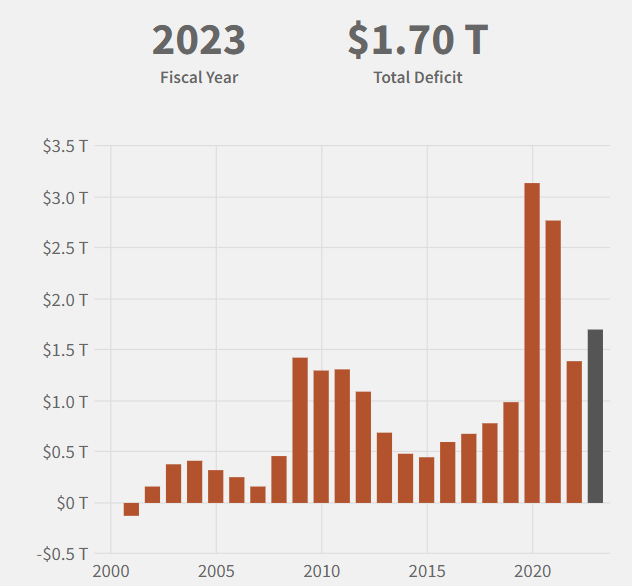
Apart from low interest rates, the Fed used to print a lot of money as it launched its quantitative easing (QE) program. As a result, the value of money decreased, the USD depreciated, whilst precious metals, including gold and silver, appreciated substantially. As can be seen from the diagram below, it took gold around three years to jump from around $800 per ounce to more than $1800.
Gold prices unadjusted for inflation
Macrotrends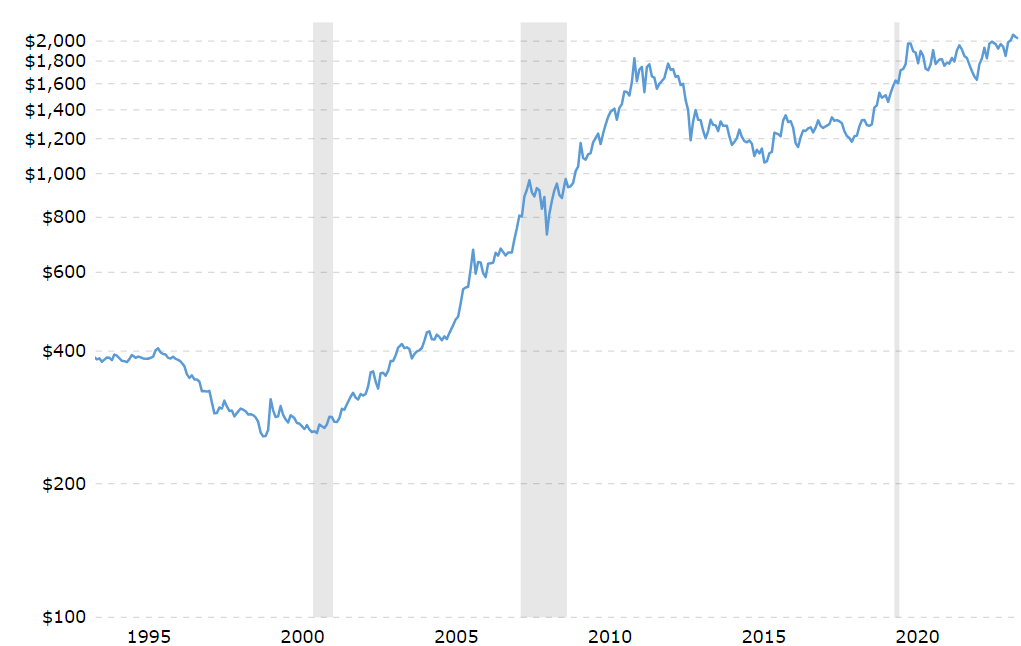
It is highly likely the Fed would start decreasing the interest rates sooner rather than later. If not, then there will be a recession and the Fed would have to ease radically the way it did during the coronavirus pandemic in 2020 or in 2008 during the house crisis. Obviously, this alone will be a winning factor for silver. Between 2008 and 2011 silver prices jumped from around $10 per ounce to $50 per ounce, fivefold, that is. So, if the situation repeats itself, silver can rise from $23 per ounce, the price it is selling for now, to $115 if we take a 5x factor rise.
Right now, I am not talking about other factors, including industrial demand, artificial intelligence and market manipulations.
The demand for silver can be both industrial and coming from investors. In other words, businesses buy silver as a raw material. Simultaneously, silver is used as an investment metal. Most investors, however, do not buy the grey shiny metal in the form of coins and bars but prefer derivatives instead. I will explain why this can be a way to manipulate the market later on in this article.
Now, let me also touch on article "USGS 2024 Report: Silver Reserves And Silver Production" written by my fellow Seeking Alpha contributor Katchum.
Silver Institute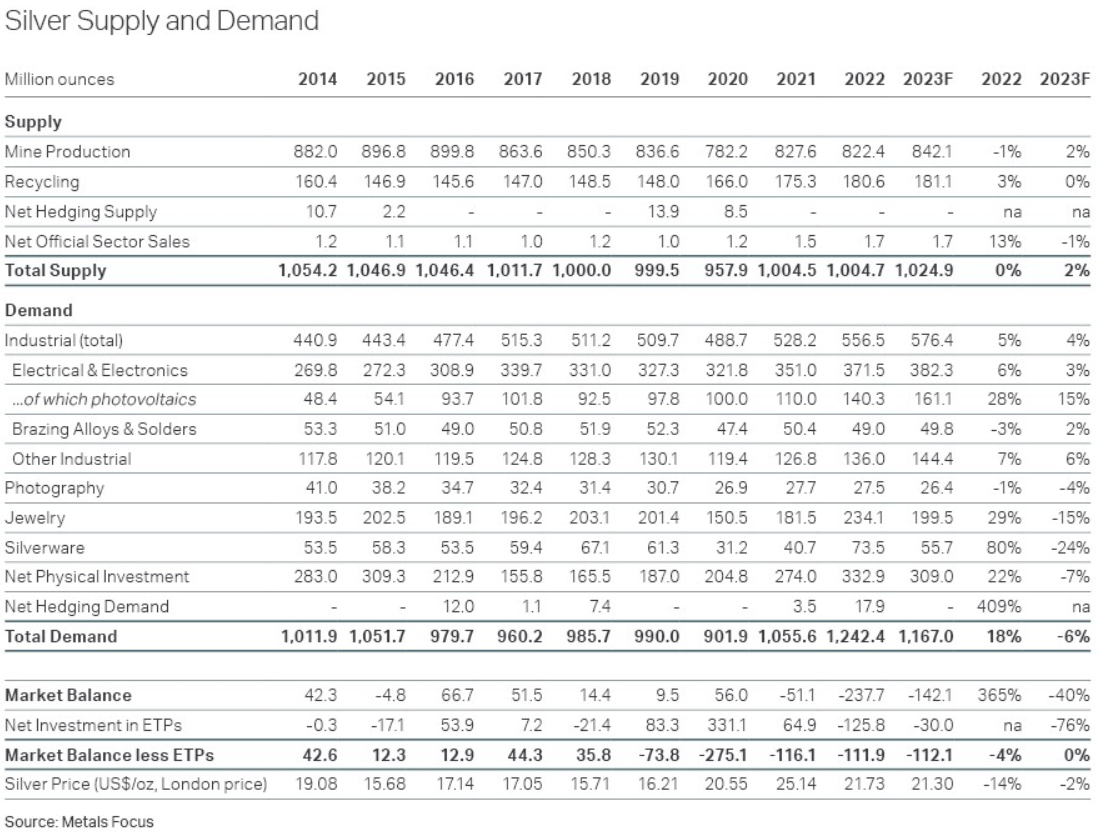
According to Katchum's logical and well-composed article, 30.2% of silver supply comes as a by-product of zinc and lead mine production, while 25.8% comes as a by-product of copper extraction. So, 56% of world's silver is due to copper, zinc, and lead production. The supply of these commodities is expected to rise. That may well be true. But according to Silver Institute's estimates, in 2023, there was no real silver supply rise. The supply rise has likely totalled only 20 million ounces or just 2%. So, if we see the graph illustrating the table above, we will see that silver production has stayed uneven for a while. In other words, there was no real supply growth over the last 10 years.
Silver Institute - the graph is prepared by the author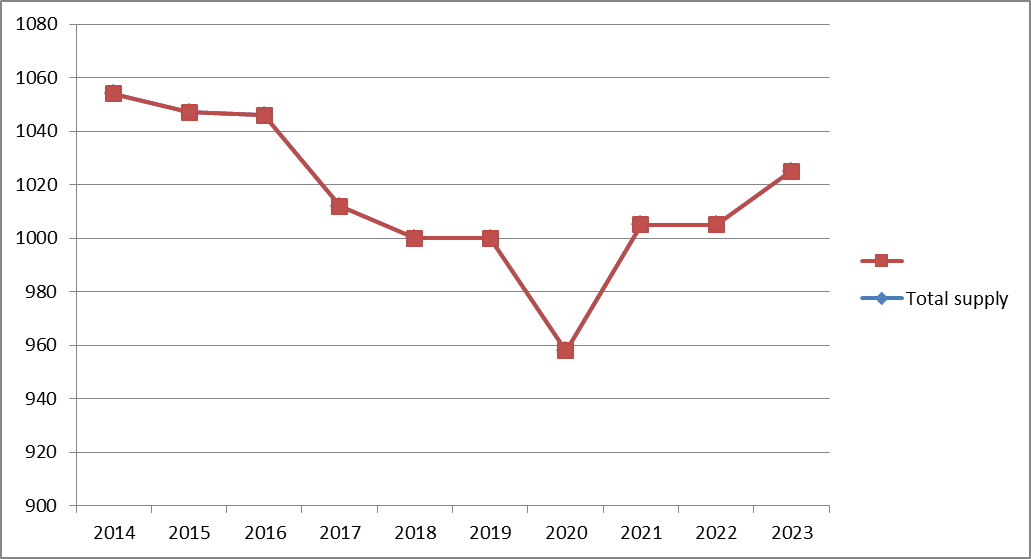
Of course, the past is no guarantee of the future. But there is no real supply growth trend, I would say.
Moreover, the industrial demand for silver is highly dependent on photovoltaics, power grid, and 5G networks, along with growth in consumer electronics and rising EV output. But apart from these silver uses, there will be a higher demand for chips powering AI technology. As I wrote in my previous article, in order to produce chips, precious metals are required. According to Metals Focus, the demand for AI servers and switches will rise by double digits over the next several years to catch up with the evolution of AI algorithms. Demand is also expected to rise for silver-palladium Ag-Pd multi-layer ceramic capacitors in high-power components.
Apart from objective investment and industrial demand, there are also potential silver market manipulations.
There were two very obvious cases when the silver market was manipulated.
The first was in the 1970s - 1980s when the brothers Hunt used their fortune and even borrowed money to buy more silver. The brothers began to invest in physical silver as well as future contracts. Instead of closing out contracts with cash, they took delivery on silver. They stockpiled these silver reserves and bought even more futures. They also borrowed heavily to take out even more futures on silver once their immediate cash was all tied up. The general market also got very enthusiastic as silver prices kept increasing. So, the silver price per ounce reached $50.
Silver prices adjusted for inflation
Macrotrends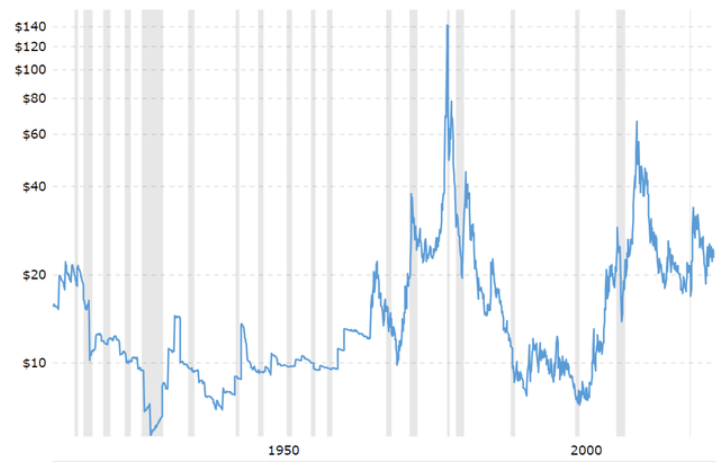
As can be seen from the diagram above borrowed from Macrotrends, the price used to be $140 per ounce in today's money. So, silver at triple digits is not crazy if there is a similar market situation again.
The second was in February 2021 during the famous silver market squeeze when a group of redditors decided to push the prices of silver up. In the first week of January 2021, silver peaked at around $27.50. The price only rose slightly from less than $25 to $27.50.
Silverprice.org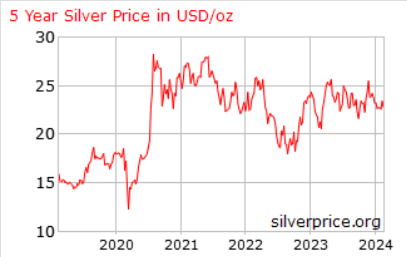
So, the squeeze did not go as planned. But if there is a silver squeeze in the near future, it could possibly turn out the way it did for the Hunts. That is why the grey shiny metal can surge to a price of $140 per ounce.
The risks are very obvious. The first and foremost is that of more monetary tightening ahead. This will have a negative short-term effect on the prices of precious metals. But this will eventually provoke a recession and lead to more monetary easing and higher silver prices as a result.
Another risk is that of a prolonged recession. This will be a negative for industrial demand but a positive for investment demand because investors would buy precious metals to hedge against higher inflation numbers.
Then, there is a risk that silver production might rise. However, this will not be a very important factor if the demand rise outweighs the higher supply. It will still lead to silver deficits and higher prices.
In spite of the high Fed's rates, the silver prices stay quite resilient but do not show very high growth. It is likely that any bullish factors, including rate cuts and higher industrial demand would make the silver prices soar. There are possible risks, including a prolonged recession and higher rates for longer. But these risks provide a good buying opportunity, in my opinion. If the scenarios like the Hunts' manipulations and the 2008 crisis repeat themselves, then silver prices can reach triple digits.