AlbertPego
AlbertPego
The global shipping industry has been stuck in a so-called freight recession as companies worked through bloated inventories. However, many have now begun to replenish those supplies. Juliana Faircloth, Vice President for Portfolio Research at TD Asset Management, discusses the implications for transportation stocks with MoneyTalk's Greg Bonnell.
Greg Bonnell: The global shipping industry was hit by a freight recession in 2023. That's as their customers worked down bloated inventories and shipped fewer goods as a result. We're well into a new year, and our featured guest is keeping an eye on a potential catalyst for the industry -- a trend toward restocking. Joining us now to discuss, Juliana Faircloth, VP for Portfolio Research at TD Asset Management. Julia, great to have you back on the program.
Juliana Faircloth: Thank you. Thanks for having me.
Greg Bonnell: So last time we were on, we probably talked a bit about this freight recession, shifting consumer demands, all this sort of restructuring of our lives coming out of the pandemic. But as you look forward to this year, obviously, if companies have been working down inventories, is it time to actually start building them back up?
Juliana Faircloth: Yeah. So I think it's an interesting topic. And obviously, these types of inflection points can often present opportunities for investors. So it's an interesting topic to think about, particularly in the context of the US economy has been growing pretty well over the last three years. But under the surface, as you mentioned, we've been in a freight recession.
And we've seen some waves of destocking and some changes kind of under the hood that have had a lot of implications for different industries, like retail, like freight. I brought a couple of charts just to illustrate what has been going on. So, the first one, I believe, is US personal consumption expenditures. And you can see there that green line reflects consumption of goods. There was a huge surge through 2020 and 2021.
We were all at home. We were ordering computers. We were ordering athleisure -- all sorts of stuff. As you look through late 2021 and into 2022, and even 2023, that's when that destocking took place. We heard a lot about that from retailers like Target Corporation (TGT), Walmart Inc. (WMT) destocking, and having to unwind huge inventory positions that they built up on their balance sheet.
We also saw the same thing across the more industrial-facing economy. So a second chart, which looks very similar, shows US manufacturing new orders. Again, that spike through 2020, into 2021, and then into contraction through 2022 and 2023. Exciting moment right at the end of that chart in the beginning of 2024 --
Greg Bonnell: Little tick up there at the end.
Juliana Faircloth: -- is that tick up above the 50 level, which represents an expansion. And so that's the sort of interesting potential restocking thesis that might mark an inflection point that investors should be paying attention to.
Greg Bonnell: Obviously, if you're restocking, you're restocking with goods, you're restocking with raw materials, whatever your business is -- so let's talk about what it means for the global shipping industry. We started breaking it down by sector. Obviously, we talk a lot about rails, but there's a lot of ways that goods get to us.
Juliana Faircloth: For sure. So I think within freight, the two sort of interesting examples to think about would be rails and trucking. To start with rails, as you mentioned, it was a tough year through 2023 for the rails. Almost all of the class one rails reported an earnings decline.
And that was as they moved fewer and fewer volumes across their large asset base. And we know that that can have a really big impact on profitability. Looking ahead, the outlook looks a little bit more interesting. In Q4 of 2023, which the rails reported earnings just a couple of weeks ago, all of the large North American class one rails reported volume growth. And that's the first time that's happened in a while. So the outlook is pretty interesting for a re-acceleration of earnings growth through 2024 driven by volumes and that positive operating leverage story as the economy kind of restocks.
Greg Bonnell: So those are the rails -- what about the trucks on the road?
Juliana Faircloth: For sure. So trucking another industry very impacted. We even saw a large, pretty high-profile bankruptcy last year. A company called Yellow Corporation (OTC:YELLQ) in the US went bankrupt through this quite tough operating and tough volume environment for the trucking industry. So, again, the hope for 2024 is looking forward that we have some volume benefit from restocking. You may have some capacity rationalization in the industry with a large player no longer present in the industry.
And so it creates an interesting setup for earnings acceleration through 2024. And I think that stands out, potentially, in the context of the broader industrial landscape. You've got rails and trucks set to possibly see their earnings accelerate through 2024. And if I contrast that with a couple of other pockets of industrial end-markets, say airlines or construction, there we're starting to see earnings kind of roll over and slow down as their peak of their demand is starting to normalize from a very high level.
Greg Bonnell: So those things that you and I buy that we expect to show up on our doorstep magically -- obviously, freight and trucking is a big part of it. But there's not a train pulling up in front of my house or a big transport truck. By the end of the time it comes to me, it's probably -- what -- it's a United Parcel Service, Inc. (UPS) or it's a FedEx Corporation (FDX). So let's talk about those companies and what they look like in this environment.
Juliana Faircloth: For sure. So those name brands that we know that pull up and bring our packages to our house -- it's been a really interesting period from a stock perspective for FedEx and UPS. Both have been challenged by the operating environment we've talked about and by that destocking theme. But the stocks' performance has really diverged. So FedEx has materially outperformed UPS over the last year.
And I think what's been driving that is a focus on -- we know that volumes are pretty weak for these companies, but let's narrow in on the cost side and see what these companies are doing from a cost perspective. And so FedEx stock has really benefited from a huge cost-cutting and restructuring plan that they announced about over a year ago, whereas UPS has been sort of muddling through the operating environment in a different way. Looking to 2024, I think it will be important for both of these companies to demonstrate that they can bring on volumes and handle some of this restocking tailwind without taking on too much additional cost.
Greg Bonnell: Let's talk about some of the risks because the thesis we're laying out here is, yes, we went through a freight recession. Companies have worked through those bloated inventories that are a result of us shifting our habits coming out of the pandemic. It's all sort of behind us. Restocking could mean some good things. What could be the risks to this thesis?
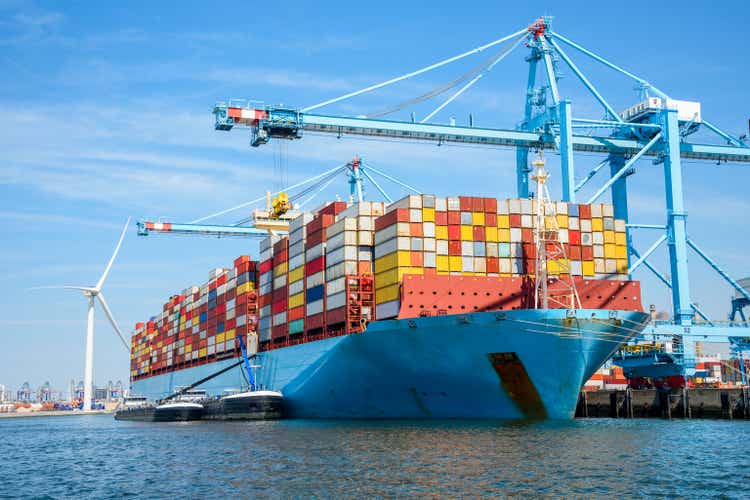
Juliana Faircloth: For sure. So, again, this sort of inflection is an exciting potential opportunity for investors, but, of course, there's risks. One big risk that I would highlight is global supply chains are still quite fragile. And so to the extent that we rely on ocean shipping to bring freight into North America that can move across rails, that can come on a UPS truck to the front of your house, that's a pocket of potential risk.
Right now, we're seeing geopolitical conflict in the Red Sea. There's droughts in the Panama Canal. This is having a huge impact on ocean shipping. We've seen ocean freight rates spike over 100% since October when the Red Sea crisis started.
So that could be a difficult environment in terms of cost and also in terms of the time it takes for products and goods to move from point A to point B. The other interesting sort of implication to highlight, I would say, from this theme is that if we have surging ocean freight rates, and higher transportation costs, and a lot of demand for some of these transportation needs, that sounds a little bit inflationary to me.
Greg Bonnell: That sort takes me back to 2021, 2022 when everyone said, don't worry, transitory.
Juliana Faircloth: Exactly. So that sounds a bit inflationary. And that's something that I think we'll have to watch pretty closely as we know central bankers are keenly focused on keeping inflation -- keeping a lid on inflation.