
Rangsarit Chaiyakun
Rangsarit Chaiyakun
The previous time I reviewed the ALPS Sector Dividend Dogs ETF (NYSEARCA:SDOG), a smart-beta minimalist dividend-focused exchange-traded fund, was in June 2021, and it goes without saying that an update is long overdue. Today's reassessment is supposed to answer a few questions, including those related to its past performance, current portfolio holdings, and essential style factor characteristics, all of which are necessary to decide whether the Hold rating should be revised higher or lower.
To recap, SDOG has a rather minimalist and unsophisticated approach to stock selection. According to its website, its basis is the S-Network Sector Dividend Dogs Index. To qualify for inclusion, as described in the summary prospectus, a stock must be in the group of the 5 names with the highest dividend yields in the sector, with the exception being only real estate, which is entirely ignored. 50 equities that qualified are weighted equally, and so are the GICS sectors. The index is reconstituted just once a year in December, while rebalancing follows a quarterly schedule.
In short, it has not been a success since the article was published on June 6, 2021, underperforming the S&P 500 index grossly, even with the fairly sizable dividends factored in, partly proving my unenthusiastic Hold rating was justified.
Seeking Alpha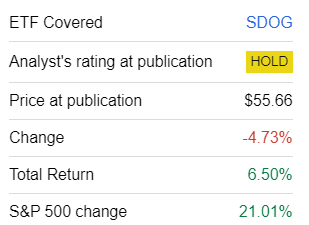
Besides, I should also mention that among the dividend funds I cover, including those focused on international equities, SDOG delivered one of the weakest results over the 3-year period. The median price return in the group is 10.18% (as of March 11), with the Global X SuperDividend ETF (SDIV) having the worst result of negative 47.23% and the First Trust NASDAQ Technology Dividend Index Fund ETF (TDIV) being the champion with about 36.94%; SDOG delivered just 3%. The total returns are shown below. Again, the Dividend Dogs ETF was far from the best.
| 3Y Median Total Return in the Group | 21.52% |
| 3Y Best Total Return in the Group | TDIV, 45.72% |
| 3Y Worst Total Return in the Group | SDIV, -26.84% |
| SDOG's 3Y Total Return | 16.21% |
Calculated by the author using data from Seeking Alpha. Returns as of March 11
Nevertheless, there are still a few nuances illustrating that SDOG's performance was not as dismal as investors might suggest from the metrics above. First, it is worth noting that during the July 2021-February 2024 period, SDOG had a much lower downside capture ratio than the iShares Core S&P 500 ETF (IVV), as shown below:
| Metric | SDOG | IVV |
| Upside Capture | 64.29% | 103.62% |
| Downside Capture | 75.73% | 96.78% |
Data from Portfolio Visualizer
Next, the fact that is directly connected to these data is that it performed much better than the bellwether fund during the bear market of 2022, declining by just 21 bps while IVV was down by 18.16% for the year. And its maximum drawdown over the period concerned was just 17.72% vs. IVV's 23.93%. However, during the March 2020 market carnage, SDOG underperformed IVV, going down by approximately 21.4% while the S&P 500 ETF declined by only 12.1%, which means that it can provide a bit healthier results when depression engulfs the markets, thanks to the margin of safety its undervalued holdings should have, but not always.
Besides, SDOG drastically lags when the S&P 500 rebounds. So it is no coincidence that its annualized return over the August 2012-February 2024 period (it was incepted in June 2012) was just 10%, more than 4% lower than the result delivered by IVV.
As of March 9, SDOG had 50 equities in the portfolio, with Viatris (VTRS) being the key holding with a 2.34% weight. Unsurprisingly, the current version is offering a rather strong weighted-average forward dividend yield of 4.4%, with the major contributors being the tobacco and diversified telecommunication services industries. Regarding sectors, it is energy and materials that are added most.
| Sector | Weight | Median Fwd DY |
| Communication Services | 9.79% | 4.09% |
| Consumer Discretionary | 10.41% | 3.05% |
| Consumer Staples | 9.11% | 4.98% |
| Energy | 9.91% | 5.13% |
| Financials | 10.53% | 4.88% |
| Health Care | 10.17% | 4.1% |
| Industrials | 9.70% | 3.54% |
| Information Technology | 10.56% | 3.39% |
| Materials | 9.68% | 5% |
| Utilities | 9.48% | 4.76% |
Calculated by the author using data from Seeking Alpha and the ETF
The forward dividend yield is not the only metric illustrating that value characteristics are fairly strong portfolio-wise. For example, almost 59% of the holdings have a Quant Valuation rating of B- or higher, while the weighted-average earnings yield stands at 4.6%. With the impact of loss-making companies removed (11.6% of the net assets), it goes up to 5.3%.
So when it comes to delivering appealing yields from underappreciated companies, its strategy obviously works. But what about dividend growth? I would not say so. The WA dividend CAGRs of the portfolio illustrate that:
| 3Y CAGR | 5Y CAGR |
| 6.46% | 5.15% |
Calculated by the author using data from Seeking Alpha and the ETF
An essential remark is that the 3-year figure is skewed by Darden Restaurants (DRI), which had an over 97% CAGR for the period. Certainly, the figure is driven primarily by the dividend suspension amid the pandemic and then its reinstatement and gradual DPS increases as the coronavirus loosened its grip on the hotels, restaurants, and leisure industry.
Even though I expected a generally subdued growth profile as a direct consequence of the ETF's value-centered investment philosophy, I was still negatively surprised by how poor the growth characteristics turned out to be. In fact, neither forward revenue nor earnings per share growth rates are positive, as shown in the table below:
| Metric | EPS Fwd | Revenue Fwd | EBITDA Fwd |
| SDOG | -0.51% | -0.05% | 0.65% |
Calculated by the author using data from Seeking Alpha and the ETF
The weighted-average EBITDA growth rate (the impact of the financial sector was stripped off) is just marginally better, but still even below 1%. What are the culprits behind it? It is worth remembering that high-yield dividend stocks represent predominantly old-economy industries, so it is counterintuitive to expect outsized growth rates from them. In this particular case, the impact of companies that are forecast to see their sales and/or EPS, and/or EBITDA declining is the main culprit:
| Metric | SDOG |
| % of holdings with negative forward revenue growth rates | 41.8% |
| % of holdings with negative forward EBITDA growth rates | 41.7% |
| % of holdings with negative forward EPS growth rates | 52.3% |
Calculated by the author using data from Seeking Alpha and the ETF
Also, this is the flip side of smart-beta strategies, as equal weighting allowed detractors to have such a substantial impact on the portfolio-wise figures.
Despite not targeting the most profitable and financially sound companies through a scrupulous screening process, SDOG does have mostly robust quality characteristics, with the major fact supporting this suggestion being a large share of the holdings with no less than a B- Quant Profitability rating or higher (almost 92%, 46 holdings). Besides, there are no cash-burning or EBITDA-negative companies in this mix. Obviously, there are vulnerabilities nonetheless. I should note that my calculations showed a weighted-average Return on Assets of just 4.1%. This is a clearly weak result for a large-cap mix (there are no mid-caps in SDOG, and the WA market cap is at $80.8 billion). Alas, the median Return on Total Capital for non-financial companies at just 6.8% is also well below the desirable level of 10%.
Targeting stocks with high dividend yields, SDOG ends up accumulating mostly slowly growing old-economy players. While beneficial amid downturns like the one the markets went through in 2022, it is anything but opportune when enthusiasm returns, as value-heavy portfolios have materially smaller potential to participate in the bull run, let alone outperform their more expensive counterparts amid omnipresent ebullience. In this regard, assuming a remarkable value tilt, SDOG might be a top-class contrarian bet at this juncture as the market is in euphoria mode, which might be reset at any time. However, I would abstain from defending a contrarian view here, maintaining a Hold rating.