
AlexSecret
AlexSecret
Is anyone else tired of it being a large-cap-only world? I'm much more of the mindset that the next phase of any move should be a rotation out of large-caps into mid or small, but then again I've been saying that for a couple of months now. Assuming large-cap momentum continues, you may want to consider allocating to the Schwab U.S. Large Cap ETF (NYSEARCA:SCHX). SCHX is a passively managed ETF that seeks to track the total return performance of the Dow Jones U.S. Large-Cap Total Stock Market Index. Launched in 2009, this ETF offers investors a low-cost, tax-efficient way to invest in the 752 largest U.S. companies as ranked by full market capitalization. The fund manages assets worth over $39 billion, making it one of the largest ETFs in its category.
SCHX's broad investable universe provides exposure to a diverse set of companies across various sectors. Its top holdings are exactly what you see in all the major large-cap funds.
These five companies, all tech giants, collectively accounted for 22% of SCHX's total portfolio, demonstrating the fund's significant exposure to the Information Technology sector.
SCHX's sector allocation is heavily skewed towards the Information Technology sector, which accounted for 28.7% of the portfolio. Other significant sector exposures include Financials (13.3%), Health Care (12.3%), Consumer Discretionary (10.7%), and Industrials (9.3%). Communication Services, Consumer Staples, Energy, Real Estate, Materials, and Utilities make up the rest of the portfolio. Over 70% of the fund is in stocks with a market cap greater than 70 billion.
schwabassetmanagement.com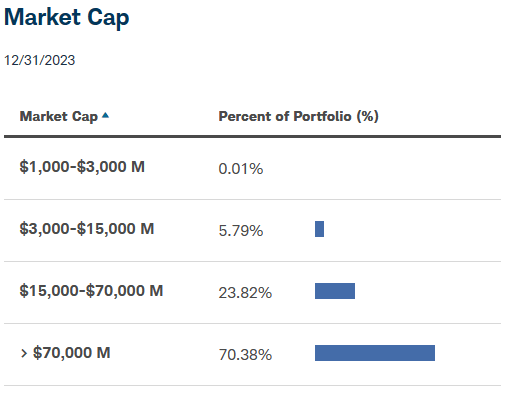
When comparing SCHX with other similar ETFs, the Vanguard Large-Cap ETF (VV) often comes up. While both ETFs aim to track the performance of large-cap US companies, there are subtle differences. For instance, SCHX boasts a broader investable universe with 752 holdings compared to VV's 527. Furthermore, SCHX offers a slightly lower annual expense ratio of 0.03% compared to VV's 0.04%. The two funds have tracked in line with each other, which is no surprise given market-cap weighting.
Diversification: With exposure to 752 of the largest U.S. companies, SCHX provides investors with broad diversification across various sectors and companies, reducing the risk associated with investing in individual stocks.
Low Costs: With an annual expense ratio of just 0.03%, SCHX is one of the most cost-effective investment options in its category.
Tax Efficiency: As a passively managed ETF, SCHX generates fewer taxable events, potentially reducing the overall tax burden on investors.
Market Risk: Like all investments, SCHX is subject to market risk. The value of the fund can fluctuate based on the performance of the underlying companies and overall market conditions.
Concentration Risk: Despite its broad exposure, SCHX is heavily weighted toward the Information Technology sector, which could expose investors to sector-specific risks.
To me, this is more of an allocation question than a fund question. The sole reason why it's been a large-cap-only world is because of the contribution of a select number of large-cap tech stocks driving large-cap momentum disproportionately, as many stocks beneath the surface of a smaller market-cap are still way below their respective 2021 peaks. When I look at the price ratio of the Russell 2000 ETF (IWM) relative to the S&P 500 ETF (SPY), the relationship is back to March 2000 levels - just when the large-cap blow-off Tech bubble took place. Small-caps then proceeded to outperform large-caps over the next 11 years.
tradingview.com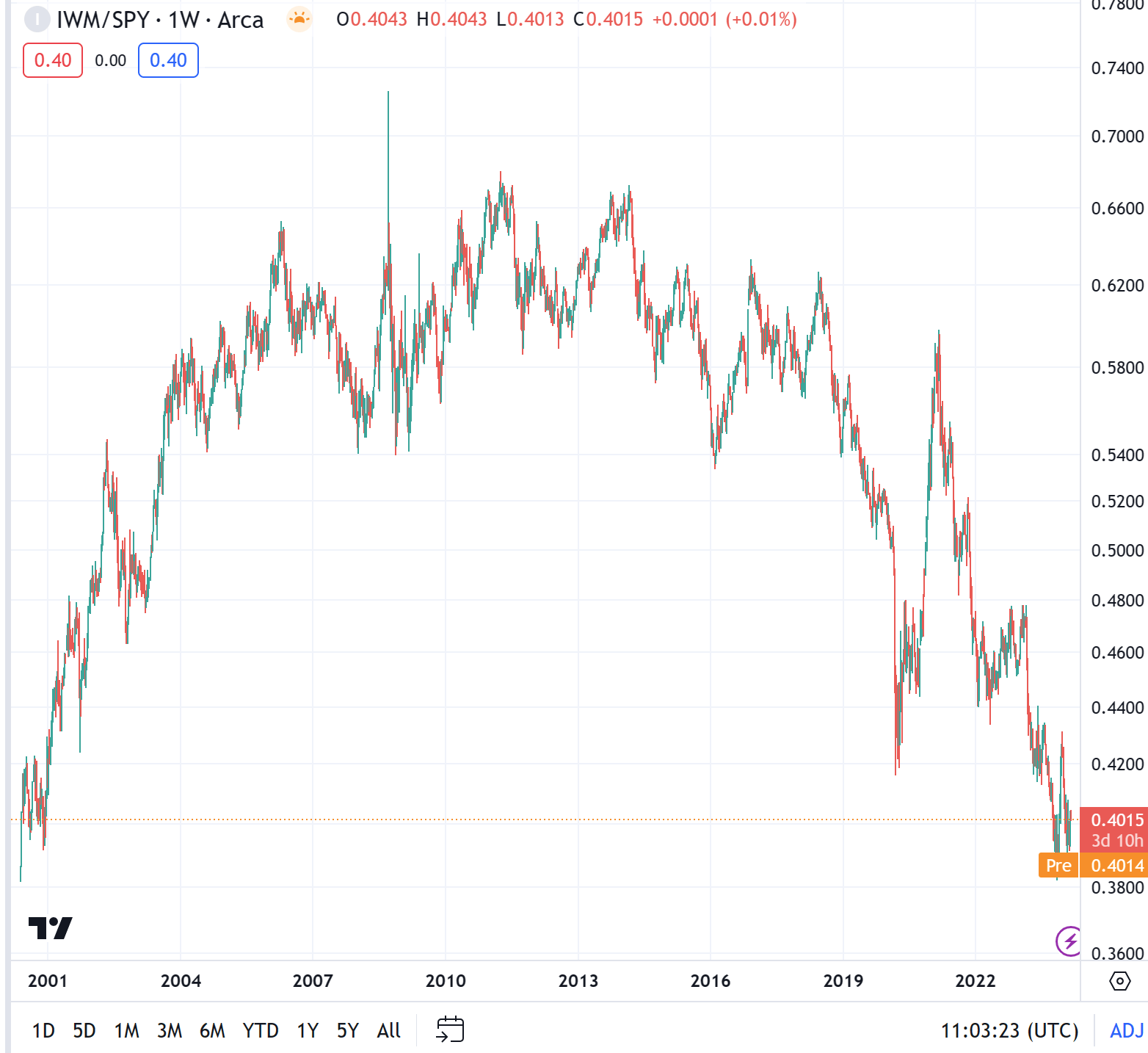
Now, maybe I'm wrong, and the ratio above continues to trend lower, meaning that large-cap relative momentum persists. If that's the case, the Schwab U.S. Large-Cap ETF is a viable investment option for those looking to gain broad exposure to the U.S. large-cap market at a low cost. Its diversified portfolio, coupled with its tax efficiency and low expense ratio, makes it a compelling choice for long-term investors. Just be mindful that large-cap momentum is long in the tooth, so it's more of an asset allocation question now than a specific fund one, in my view.