
Moment Makers Group/iStock via Getty Images
Moment Makers Group/iStock via Getty Images
Today's research is the result of a suggestion by a Seeking Alpha follower on a developmental company we have not covered in these pages below. Shares of engineered cell concern Sana Biotechnology, Inc. (NASDAQ:SANA) are up over 30% since pricing a secondary in early February 2024, as excitement builds over early clinical and research results. Specifically, four B-cell cancer patients did not demonstrate any autoimmune responses from its cell transplantation therapy, while a type I diabetes showed excellent efficacy in the preclinic. The company has data from three studies anticipated in FY24 and has executed a recent secondary to extend its operating runway to the end of FY25. The shares have seen some recent purchases from a beneficial owner. An analysis follows below.
Seeking Alpha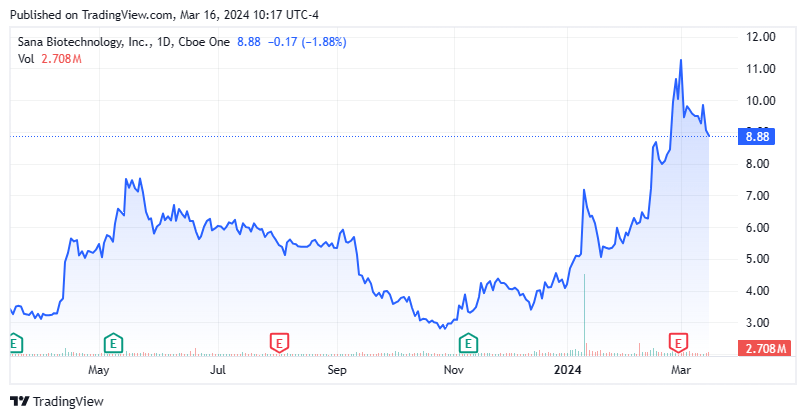
Sana Biotechnology, Inc. is a Seattle based early clinical-stage biopharmaceutical concern focused on the development of engineered cells to treat disease. It has three clinical programs all undergoing Phase 1 evaluation in the treatment of six indications. Sana commenced operations in 2018 and went public in 2021, raising eye-popping net proceeds of $626.4 million at $25 per share. Its stock currently trades just under nine bucks a share with an approximate market of nearly $2 billion.
For approximately 75 years, allogeneic (donor) stem cell transplantation has been employed to treat a broad spectrum of maladies. There are three sources of allogenic cells: embryonic stem cells (ESCs), induced pluripotent stem cells (iPSCs), and donor-derived cells. However, rejection of the transplant by the body's immune system remains a significant challenge to successful outcomes. To address this issue, a donor is sought that has a similar human leukocyte antigen (HLA) type as its respective recipient, which usually is derived from cells, tissue, or organs of a close relative. However, this method significantly limits availability. Autologous (from the patient) transplantation - encompassing ~58% of total - also overcomes the autoimmune issues, but it is limited to certain cell types and has truncated scalability. The current standard of care approach to preventing rejection is a lifetime of immuno-suppressive medication. Gene modification has been added to the arsenal, but with incomplete results to date.
With a goal of creating a universal cell capable of evading immune detection irrespective of cell type or transplant location, Sana believes it has created an effective workaround to the shortcomings of other rejection therapies through its hypoimmune technology platform, which generates 'engineered cells'. They begin as allogenic cells that are then modified to eliminate major histocompatibility [MHC] expression, which is essentially HLA in humans. There are two types of MHC molecules: class I, which is expressed on the surface of all nucleated cells; and class II, which are expressed on antigen presenting cells. By knocking out MHC class I and II expression, T cells from the adaptive immune system do not recognize the peptides on a cell's surface as foreign and thus don't target them for elimination in a dynamic known as tolerance.
However, the human body has built in redundancy through its innate immune system, whereby natural killer cells or macrophages eliminate cells due to lack of MHC expression, known as a 'missing-self' response. To address this dynamic and differentiate itself from other gene modification approaches, Sana then genetically modifies the cell to overexpress CD47, a protein that enables cells to evade elimination by the innate immune system.
The company believes that through these three genetic modifications (MHC class I and class II suppression and CD47 overexpression) to transplanted cells, it will provide protection from autoimmune maladies, eliminating the need for lifelong immuno-suppressive therapy.
Although it currently employs all three sources of allogenic cells, Sana's endgame is to predominantly source iPSCs for its therapies, as they offer regulatory and cultural advantages over ESCs and product consistency superiority to donor-derived cells. These are mature cells that are reprogrammed through the expression of a small number of genes, providing similar potential as ESCs to be employed as an infinitely renewable cell bank for manufacturing cell-based treatments.
From this engineered-cell approach, Sana has developed three clinical programs pursuing six indications, all of which are in Phase 1 trials.
SC291. The only one to produce clinical data is SC291, a CD19-targeted direct allogeneic chimeric antigen receptor [CAR] T program to treat patients with B-cell mediated autoimmune cancers and diseases, such as non-Hodgkin's lymphoma, chronic lymphoblastic leukemia, lupus nephritis, and extrarenal systemic lupus erythematosus. It is being evaluated in two Phase 1 trials: ARDENT for cancers and GLEAM for autoimmune disease.
An early data released in January 2024 from the ARDENT study showed no dose limiting toxicities, no SC291-related serious adverse events, no incidences of graft versus host disease, no cytokine release syndrome, no immune effector cell-associated neurotoxicity syndrome, and no infections Grade 3 or higher in four evaluable patients - supportive of continuing dose escalation. Furthermore, partial responses were observed in three patients, including two complete responses. Potentially the most promising outcome came from another observation. SC291 contains both fully edited and partially edited hypoimmune (HIP) cells. A natural killer cell response was observed against the partially edited HIP cells but not the fully edited ones, suggestive of both functioning innate immune systems in the patients and the ability of the fully edited HIPs to escape immune response.
These extremely early yet encouraging results were presented at the 42nd Annual JP Morgan Healthcare Conference on January 9, 2024, sparking a short-lived, one-day 39% rally in SANA shares to $7.18.
Initial results from GLEAM are expected sometime in 2024.
SC262. The same can be said of a Phase 1 study (VIVID) for SC262, another hypoimmune-modified CAR T program, this one targeting CD22 in patients with relapsed or refractory B-cell malignancies who have received prior CD19 CAR T therapy.
UP421 (SC421). Perhaps the most exciting program has yet to enter the U.S. clinic. UP421 (SC421) is transplanted allogenic HIP-modified pancreatic islet cells, which are missing or dysfunctional in type I diabetes patients. As such, type I patients are unable to produce insulin. Sufferers can expect a lifespan truncated by ~15 years. In preclinical research encompassing one non-human primate, one week after transplantation serum c-peptide level had normalized, remaining that way for six months. More importantly, blood glucose levels were tightly controlled for six months, and the primate was completely insulin-independent. Furthermore, there was no immune response.
An investigator-sponsored Phase 1 study in humans has been authorized in Sweden with initial results (including cell survival, immune evasion, c-peptide levels, and glycemic control) expected in 2H24.
To pay for the advancement of these trials, Sana held cash and investments totaling $205.4 million at YE23, providing a runway only into FY25. As such, the company conducted a secondary on February 5, 2024, raising net proceeds of $179.9 million at $5.50 per share, which should extend the runway to the end of FY25. The company also filed a prospectus for a mixed shelf offering earlier this month.
Since February's capital raise, four analyst firms have reissued Buy ratings on the stock. Price targets proffered range from $8 to $15 a share. Not surprisingly, two of the analyst firms (Citigroup and Bank of America) were joint book-running managers for the secondary offering. TD Cowen assigned a Hold rating on the stock on February 29th.
Also bullish on the company's future is beneficial owner Arch Venture Fund, which used the secondary as an opportunity to add 1.82 million shares, putting its ownership interest at 22%.
Arch's investment has been fruitful, with shares of SANA up some 60% since their secondary pricing, which might be indicative of would-be investors hearing the results from its first four human patients and one non-human primate for the first time, as they were not specifically mentioned in a press release, only at the JP Morgan healthcare conference. And with three readouts (one interim, two initial) scheduled for 2024, there are plenty of potential catalysts for Sana. That said, with a ~$1.6 billion valuation net of cash and limited clinical data on four patients - not to mention many years and a least one more dilutive secondary away from any commercialization - Sana seems more than fairly valued at the moment.
Therefore, I would stay on the sidelines on this name unless the stock fell back much closer to the recent secondary offering price. And given the early-stage nature of Sana's pipeline, this stock is only appropriate for investors with a high risk tolerance and a long investing timeframe.