
DNY59
DNY59
The ProShares Short Russell2000 ETF (NYSEARCA:RWM) is a daily resetting ETF that takes a bear's bet on the Russell 2000 (IWM) market index. The daily reset comes with quirks. While a bearish position on the market may be intelligent, currently we would be worried about making the play with RWM due to the issues that come with daily resetting ETFs. There may be a case for anticipating the CPI data next Tuesday, but markets are much more reactive to the jobs market data that has already passed.
Let's begin with some of the core risks with all these daily resetting ETFs. Unlike a normal short of a market index, the performance of RWM is determined by the compounded rates each day. The price of the underlying index may return to its original point, but depending on the path taken in daily returns, RWM could end up in a very different spot. This gets even worse when using leveraged versions of these ETFs, but RWM is just a -1x factor on the daily returns of the index.
If you don't fully understand these risks, do not proceed with these sorts of ETFs. They are best used over short durations because of value erosion. They are highly speculative burst instruments. Consult the risk disclosures on the ProShares website as well, and consult a financial advisor before taking any actions.
Further links for reference on these risks:
Back to RWM specifically, its name comes from Reverse IWM, the Russell 2000 index's iShares ticker.
Its composition is different from the broader market, focusing on mid-cap and small-cap stocks. Industrials feature highly at 17%, financials also at 17%, healthcare at 14%, IT at 13%, and then consumer discretionary at 11%. These are the main categories.
Sectors (iShares.com)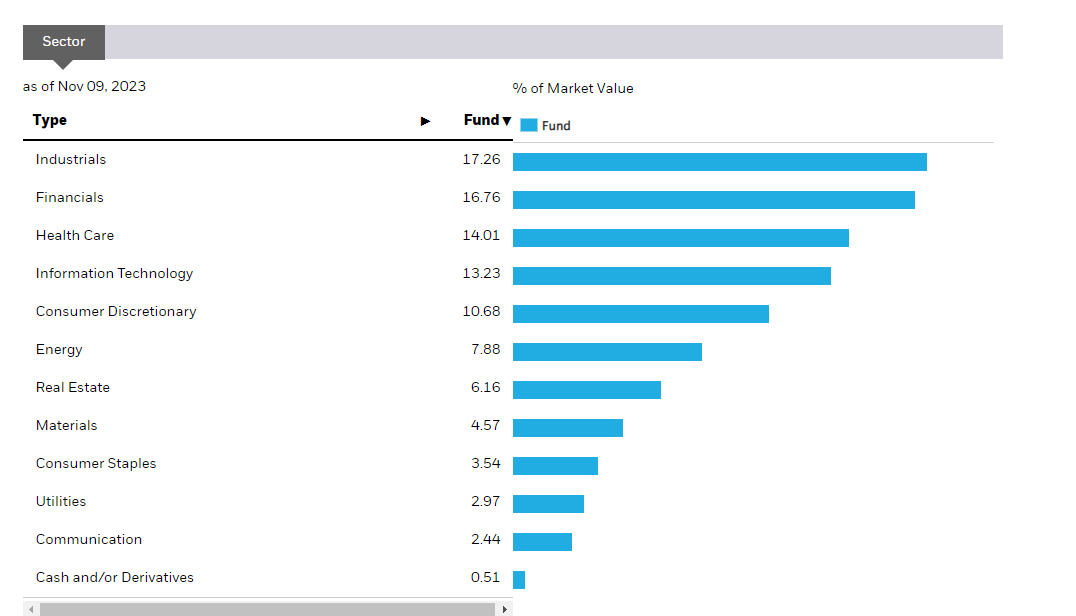
There are several reasons to be wary of the Russell 2000. Firstly, there are more cyclical exposures than in the SPY. The other reasons are all to do with macroeconomic considerations.
In all likelihood, we will see higher for longer or even higher rates in order to combat inflation, and this will be a blow to markets.
The issue is timing the disappointment. To make RWM work best, you have to be quite sure about when market attitudes will turn. Possibly in the coming week with CPI data and some remaining jobs figures, but it's not likely to do the trick. Maybe FOMC comments. But in all, it will probably be next month that markets update their expectations.
The expense ratio is 0.95%. That's even without leverage, which some other daily resetting ETFs have. Doing a direct short on the market, if you wanted to make a bearish bet, would not cost more in borrowing costs, especially against one of the more liquid indices. With the disadvantages of the daily resetting and no real advantage in terms of efficiency against normal shorting, we aren't interested in this instrument.