
marchmeena29
marchmeena29
This article series aims at evaluating ETFs (exchange-traded funds) regarding past performance and portfolio metrics. Reviews with updated data are posted when necessary.
Schwab U.S. Large-Cap Value ETF™ (NYSEARCA:SCHV) started investing operations on 12/11/2009 and tracks the Dow Jones U.S. Large-Cap Value Total Stock Market Index. It has 506 holdings, a 12-month distribution yield of 2.32% and a cheap expense ratio of 0.04%. Distributions are paid quarterly.
As described by S&P Dow Jones Indices, the three main value factors used in the index constitution are the Projected Price-to-Earnings Ratio, the Price-to-Book Ratio and the dividend yield. It is weighted by float-adjusted market capitalization, rebalanced quarterly and reconstituted annually. The portfolio turnover rate in the most recent fiscal year was only 6.3%.
The fund is almost exclusively invested in U.S. companies (over 98% of asset value), mostly in large and mega caps (about 67%), and to a lesser extent in mid-caps (about 30%). This article will use as a benchmark the S&P 500 Index, represented by SPDR® S&P 500 ETF Trust (SPY).
The fund is better balanced than SPY across sectors: none of them weighs more than 20%. The heaviest one is financials (19.9%), followed by industrials (15.7%) and healthcare (12.3%). Other sectors are below 11%. Compared to the S&P 500 Index (SP500), SCHV massively underweights technology and communication services. It overweights mostly financials, industrials, consumer staples, energy, real estate and utilities.
SCHV sector breakdown (chart: author, data: Schwab SSGA)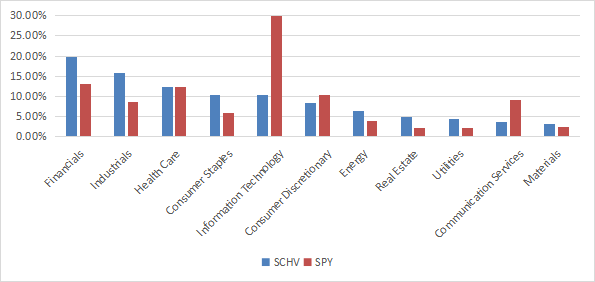
The top 10 holdings, listed below with valuation metrics, represent 18.7% of asset value. The heaviest position weighs about 3.5%, so risks related to individual companies are quite low. As a reference, the largest holding of SPY (Microsoft) weighs 7.2% of the fund’s value.
Ticker | Name | Weight | P/E ttm | P/E fwd | P/Sales | P/Book | P/FCF | Yield% |
Berkshire Hathaway, Inc. | 3.47 | 9.40 | 22.96 | 2.47 | 1.60 | 30.23 | 0 | |
JPMorgan Chase & Co. | 2.60 | 12.11 | 12.33 | 2.36 | 1.91 | 6.56 | 2.34 | |
Exxon Mobil Corp. | 2.06 | 12.72 | 12.88 | 1.36 | 2.21 | 24.48 | 3.36 | |
The Home Depot, Inc. | 1.75 | 25.46 | 25.05 | 2.50 | 366.00 | 39.96 | 2.34 | |
Procter & Gamble Co. | 1.75 | 27.13 | 25.11 | 4.76 | 8.38 | 70.57 | 2.32 | |
Johnson & Johnson | 1.72 | 27.93 | 14.61 | 4.07 | 5.51 | 58.44 | 3.06 | |
Merck & Co., Inc. | 1.44 | 936.84 | 14.42 | 5.24 | 8.35 | 184.75 | 2.49 | |
AbbVie, Inc. | 1.43 | 64.80 | 15.77 | 5.75 | 30.15 | 27.20 | 3.52 | |
Chevron Corp. | 1.23 | 13.62 | 12.24 | 1.46 | 1.79 | 31.52 | 4.22 | |
Walmart, Inc. | 1.20 | 32.01 | 25.95 | 0.77 | 5.92 | 55.27 | 1.36 |
Ratios: Portfolio123.
As expected, SCHV is cheaper than the S&P 500 regarding valuation ratios. Like most value funds, it also has inferior growth metrics, as reported in the next table.
SCHV | SPY | |
Price/Earnings TTM | 18.62 | 24.84 |
Price/Book | 2.73 | 4.36 |
Price/Sales | 1.9 | 2.85 |
Price/Cash Flow | 12.31 | 17.06 |
Earnings growth | 15.16% | 21.01% |
Sales growth | 7.14% | 8.77% |
Cash flow growth | 5.82% | 8.75% |
(data: Fidelity.)
In previous articles, I have shown how three factors may help cut the risk in a portfolio: Return on Assets, Piotroski F-score, and Altman Z-score. In my ETF reviews, risky holdings are companies with at least 2 red flags among: bad Piotroski score, negative ROA, unsustainable payout ratio, bad or dubious Altman Z-score, excluding financials and real estate where these metrics are less reliable.
According to my calculation, 6.6% of SCHV holdings that are not in financials and real estate are risky with these assumptions (I did this calculation with the 233 holdings weighing more than 0.1%, which represent 86.4% of assets). Aggregate quality metrics are similar to the benchmark, as reported in the next table.
SCHV | SPY | |
Altman Z-score | 3.27 | 3.69 |
Piotroski F-score | 5.97 | 6.12 |
ROA % TTM | 7.16 | 7.24 |
Since 1/1/2010, SCHV has lagged the S&P 500 by 2.7% in annualized return. Historical volatility is similar (measured as standard deviation of monthly returns in the table below).
since 1/1/2010 | Total Return | Annual Return | Drawdown | Sharpe ratio | Volatility |
SCHV | 326.08% | 10.73% | -37.08% | 0.72 | 14.55% |
SPY | 499.22% | 13.42% | -33.72% | 0.88 | 14.83% |
Data calculated with Portfolio123.
The gap is 14.5% over the last 12 months:
SCHV vs. SPY, 12-month return (Seeking Alpha)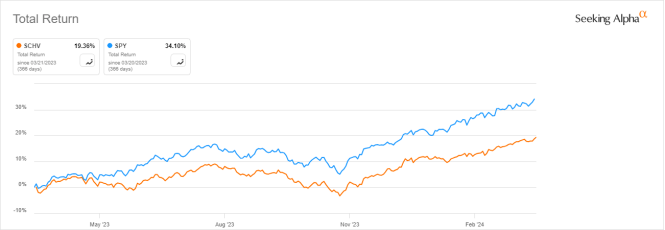
The annual sum of distributions has increased from $0.89 per share in 2013 to $1.69 in 2023. This 90% growth rate in 10 years is far ahead of the cumulative inflation, which has been about 31% in the same time (based on CPI).
SCHV distribution history (Seeking Alpha)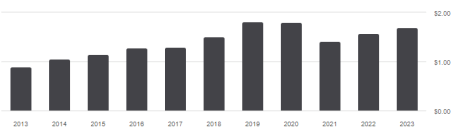
The next table compares characteristics of SCHV and five value-style ETFs:
SCHV | VTV | IWD | VLUE | IVE | DFAT | |
Inception | 12/11/2009 | 1/26/2004 | 5/22/2000 | 4/16/2013 | 5/22/2000 | 12/11/1998 |
Expense Ratio | 0.04% | 0.04% | 0.19% | 0.15% | 0.18% | 0.28% |
AUM | $10.86B | $162.66B | $55.57B | $7.25B | $33.28B | $9.76B |
Avg Daily Volume | $33.66M | $391.13M | $407.24M | $40.62M | $197.69M | $13.74M |
Yield TTM | 2.28% | 2.28% | 1.89% | 2.52% | 1.56% | 1.28% |
Holdings | 506 | 353 | 850 | 155 | 446 | 1529 |
Top 10 | 18.70% | 22.66% | 17.32% | 34.35% | 18.68% | 5.61% |
Turnover | 6.00% | 10.00% | 15.00% | 23.00% | 29.00% | 3.00% |
SCHV has the cheapest fee, on par with VTV. The next chart plots total returns, starting on 6/14/2021 to match all inception dates. SCHV is the second worst performer, only ahead of VLUE and close behind IWD. IVE is leading the pack.
SCHV vs. Competitors since 6/14/2021 (Seeking Alpha)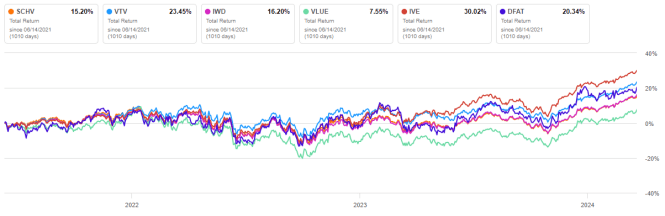
The Dashboard List is a list of 60 to 80 stocks in the S&P 1500 index, updated every month based on a simple quantitative methodology. All stocks in the Dashboard List are cheaper than their respective industry median in Price/Earnings, Price/Sales and Price/Free Cash Flow. An exception in utilities: the Price/Free Cash Flow is not taken into account to avoid some inconsistencies. Then, the 10 eligible companies with the highest Return on Equity in every sector are kept in the list. Some sectors are grouped together: energy with materials, communication with technology. Real estate is excluded because these valuation metrics don't work well in this sector. I have been updating the Dashboard List every month on Seeking Alpha since December 2015, first in free-access articles, then in Quantitative Risk & Value.
The next table compares SCHV performance since 1/1/2010 with the Dashboard List model, with a tweak: here the Dashboard List is rebalanced annually to make it comparable with a passive index.
since 1/1/2010 | Total Return | Annual Return | Drawdown |
SCHV | 326.08% | 10.73% | -37.08% |
Dashboard List | 418.42% | 12.27% | -40.67% |
Past performance is not a guarantee of future returns. Data Source: Portfolio123.
The Dashboard List beats SCHV by 1.5% in annualized return. However, the fund’s performance is real and the list is simulated.
I like the idea of mixing various ratios to rank value stocks. However, I think most value indexes doing so have two weaknesses, and SCHV is no exception. The first one is to classify all stocks on the same criteria. My monthly dashboard here shows how valuation and quality metrics may vary across sectors. A consequence is to overweight sectors where valuation ratios are naturally cheaper. It explains why financials are heavy in SCHV, and why technology is underweight. Technology is a sector with large intangible assets (especially massive R&D and large user databases), which are not correctly reflected by valuation ratios.
The second weakness comes from the price/book ratio (P/B), which adds some risk in the strategy. Historical data show that a large group of companies with low P/B has a higher volatility and deeper drawdowns than a same-size group with low price/earnings, price/sales or price/free cash flow. The next table shows the return and risk metrics of the cheapest quarter of the S&P 500 (i.e. 125 stocks) measured in price/book, price/earnings, price/sales and price/free cash flow. The sets are reconstituted annually between 1/1/2000 and 1/1/2024 with elements in equal weight.
Annual Return | Drawdown | Sharpe ratio | Volatility | |
Cheapest quarter in P/B | 9.86% | -73.88% | 0.47 | 23.25% |
Cheapest quarter in P/E | 10.63% | -63.06% | 0.55 | 19.88% |
Cheapest quarter in P/S | 11.60% | -68.78% | 0.54 | 22.70% |
Cheapest quarter in P/FCF | 12.65% | -64.24% | 0.62 | 20.63% |
Equal Weight Index (RSP) | 9.16% | -59.92% | 0.5 | 17.55% |
Data calculated with Portfolio123.
This explains my choice of not using P/B in my Dashboard List model.
Schwab U.S. Large-Cap Value ETF™ (SCHV) holds over 500 stocks with value characteristics based on forward P/E, price-to-book and dividend yield. It is well-diversified across sectors and holdings, but quite heavy in financials. SCHV has lagged the S&P 500 since 2010, and several other value funds since 2021. This period has been very unfavorable to the value investing style and may not be representative of the fund’s potential on the long term. Anyway, I see two weaknesses in the underlying index: it ranks stocks regardless of their industries, and relies too much on the price/book ratio.