
metamorworks/iStock via Getty Images
metamorworks/iStock via Getty Images
It's often overlooked in the news, but India is fourth globally in installed renewable energy capacity (fourth wind power, fifth solar power). Last year was one to miss as India installed just 13.5 GW of renewable capacity, but with a goal of 500 GW non-fossil fuel-based energy production capacity by 2030 it looks interesting. There's a long way to go and some areas are poorly developed (eg rooftop solar, just 3.5 GW added from January through November in 2023). Here I look briefly at the background to renewable energy investment globally. Then I focus in on India. Finally in this article I consider why ReNew Energy Global (NASDAQ:RNW) is an interesting vehicle for investors wishing to benefit from major expansion of renewable energy investment in India. This is a neglected but interesting investment opportunity.
In January 2024 I wrote an article about Vestas Wind Systems (OTCPK:VWDRY) and I summarized three events/reports concerning plans to dramatically increase renewable energy capacity by 2030. The first concerned the IEA the second the September 2023 G20 meeting in New Delhi and the third the November 2023 COP28 climate meeting in Dubai.
Each of these reports/events addressed the urgent need to address global warming and indicated the scale of investment in renewables by 2030 to achieve the goal to limit warming to 1.5C by 2050 (which is a really big task).
Last week Climate Analytics released a further report "Tripling renewables by 2030: interpreting the global goal at the regional level." This report started with the COP28 agreement by 120 governments to triple renewable energy capacity and double the increase in energy efficiency by 2030. The aim of the Climate Analytics report is to break down what needs to be done in different regions of the world. The overall change needed is to increase renewable capacity to 11.5 TW by 2030, which is up 3.4x on 2022 levels. The funds required amount to $12 trillion ($2 trillion annually from 2024). Note that the $12 trillion needed by 2030 involves $8 trillion for installing renewables and $4 trillion for grid and storage infrastructure to support renewables. Modernized, flexible and expanded grids are a key part of tripling renewable power. Note that in 2023 renewable investment and grid expansion amounted to $1 trillion of new spending, approximately 50% of that needed annually from 2024. It's interesting that current estimates for planned renewables developments in the period 2024-2030 suggest that $6.6 trillion already is committed for renewables and grids. More than 90% of new renewable capacity is expected to come from solar PV and wind power additions.
So the shortfall is $5.4 trillion. The interesting statistic is that under current policies the world will invest more than $6 trillion on fossil fuels in the period 2024-2030. So the problem isn’t the level of investment in energy, it's that fossil fuels still command half of the investment. The Climate Analytics report emphasizes that emissions will only fall if fossil fuels stop being exploited. The report covers a lot of detail including what has to happen in different parts of the world. Here I focus on Asia in general and India in particular.
In the above-mentioned Climate Analytics report, Asia takes a leading role, providing 47% (3.85 TW) of the additional 8.1 TW of renewable capacity envisaged by 2030. Indeed the report makes clear that Asia is “the only region which is broadly on track to triple renewables in line with 1.5C by 2030.” The existing massive investment in renewables is largely driven by China and India (90% of renewable capacity in the Asian region), which is compensating for laggards like South Korea whose renewables are growing at half the rate of the region as a whole.
The caveat is China and India’s recent concurrent (along with renewable investment) expansion of coal fired power plant construction, because either this will lead to waste through stranded assets or capping to 1.5C temperature increase might be jeopardized.
Note that while the report focuses on the period to 2030, if 1.5C is to be held to, the need for more renewables accelerates after 2030. For example Asia needs 6.7 TW of additional renewable capacity between 2023 and 2035.
There are some green shoots in the Indian renewables story. For example, India already has made a good start on electrifying the small end of its transport system with last year more than 50% of new 3-wheeler sales being fully electric with year on year growth up 66%.
Compared with reporting on European and US renewable developments, it isn’t easy to get a sense of the opportunity, or companies likely to benefit, from the Indian scene. There are some reports of big players, like Adani which is making much of its renewables growth activities, but a lot of the reporting covers very neglected stocks.
The India Brand Equity Foundation showcases a small group of companies, including Tata Power Solar, wind power group Suzlon Energy and ReNew Energy Global.
I’ve followed ReNew Energy previously because this Indian company is Nasdaq listed and this means that core features required for international investment are addressed by this company. Not all Indian companies have this comfort level for investors. It has a been a slow ride as an investor in RNW, but this is changing although RNW is up just 16.6% year on year.
Above I’ve provided more detail than usual about the big picture, because I think we are at a pivotal moment in the transition from fossil fuels to renewables and that India (and China) are key markets to watch. The 2024 Q3 results for RNW were released yesterday. Here I indicate that there are signs at the individual company level of huge change in the Indian market in the latest quarter reporting.
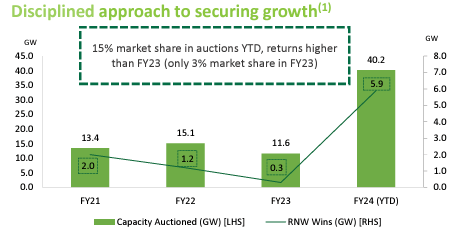
I don’t usually reproduce slides from quarterly earnings because readers have access to this information themselves, but a striking image from the earnings presentation is sufficiently noteworthy to reproduce here (see below). Investors wishing for more can see a lot of detail in the 2024 Q3 earnings presentation. The accompanying 2024 Q3 Earnings Call transcript is (as is often the case) a goldmine for details about specific aspects of the business, with an excellent summary concerning ReNew Energy’s solar business. There's also a clear explanation of delays in commissioning projects, which has benefited ReNew Energy’s competitive position. There are interesting opportunities to pre-sell power pending final commissioning.
I’ve been tracking RNW for some time and it has become clear that this is not a company that pursues growth regardless of its profitability. The image below makes a couple of points. Firstly, the change in capacity auctions in India in FY24 is hugely increased from auctions in the past three years, up from 11.6 GW in FY23 to 40.2 GW year to date FY24 (with a further 70 GW of auctions expected to be complete in coming months). Secondly, RNW’s share in success at these capacity auctions has shifted dramatically from 3% market share in FY23 to 15% in FY 24. A significant reason for this is that the number of large and complex projects is increasing rapidly, from 8% last year to ~38% this year. These kinds of opportunities require special skills that few competitors have. An added advantage that ReNew brings is that it has its own transmission business capable of building its own interconnection transmission hubs. These hubs have become a “pinch point” for development of India’s renewables capacity. ReNew Energy commissioned 276 km of transmission during 2024 Q3. ReNew Energy’s JV with Fluence (FLNC) brings integration of solar PV, wind and battery storage.
The company has an excellent balance between its wind and solar projects, both in terms of commissioned projects (~8.7 GW, being 4.4 GW wind, 4.2 GW solar and 99 MW hydro) and committed projects (~5.1 GW, being solar 3.3 GW and wind 1.8 G).
Seeking Alpha/ReNew Energy
Source : ReNew Energy 2024 Q3 earnings report
Complementing ReNew Energy’s technical capacity is their ability to access domestic debt on attractive terms. An example is that ReNew Energy refinanced a $325 million bond 3 months early on attractive terms. ReNew Energy has secured $1.9 billion of financing FY24 year-to-date. ReNew Energy has stabilized its debt financing at a time of rising interest rates. The company also uses capital recycling to enhance returns. There is a lot of detail in the 2024 Q3 earnings report.
As often happens with stocks focused on markets outside of the US, there's very little Seeking Alpha author interest in ReNew Energy Global. Indeed the company has not been covered by Seeking Alpha authors in the past 90 days. However reflecting smart global interest there are seven Wall Street ratings that are highly positive, with four “strong buy” and three “buy” ratings. I don’t confess to understand the intricacies of how Seeking Alpha’s Quant rating works. The ratings by Quant are generally positive, with A- (Momentum), B+ (Revisions) and B- (Valuation, Growth). The single negative is Profitability (D-) and ReNew Energy ends up with a “hold” rating. Quant works brilliantly for a lot of companies, but it isn’t a good guide to a lot of the companies (involved with dramatic change) that I cover. I’m with Wall Street on this one.
This article takes seriously that the world needs to exit fossil fuels and looks at how this might be achieved. The way forward is staggering with renewables to be trebled by 2030. Climate Analytics acknowledges in another report that the fossil fuel industry seeks to derail the actions considered by more than 120 countries, with obfuscation such as CCS (Carbon Capture and Storage), which doesn’t work.
Here I’ve stayed with the Climate Analytics analysis for India as I think about the consequences of going down the path to trebling renewables by 2030. It's interesting that after a modest 2023, the latest quarterly reporting by RNW shows signs of the massive scale up needed. It's starting to become clear in India, which is a key emerging market. The scale of expansion of RNW capacity building is huge. I suspect that those paying attention to quarterly reporting might suddenly pay attention to ReNew Energy Global. I take these actions seriously because I’m convinced the cost to humanity of not addressing these issues will result in much bigger costs if indeed humanity can cope with a world 3C hotter than today.
For me and a group of Wall Street analysts paying attention, I think that ReNew Energy is interesting because it sits squarely in the middle of an opportunity that is starting to take off in a big way. I think the company has done the hard yards and it is ready to benefit.
I acknowledge that it's hard to get one’s head around what is happening, but given that recent growth of renewables already is significantly down the path of dramatic renewables expansion, it's worth paying attention to. My ReNew Energy investment is up a modest 9% but I’m not a seller.
I'm not a financial advisor but I follow closely the dramatic changes underway as the world begins to decarbonize power and transport. I hope that my comments are useful as you and your financial advisor think about how to benefit from the changes that are happening in markets beyond the US.
Editor's Note: This article discusses one or more securities that do not trade on a major U.S. exchange. Please be aware of the risks associated with these stocks.