
bymuratdeniz/iStock via Getty Images
bymuratdeniz/iStock via Getty Images
The Schwab U.S. Dividend Equity ETF™ (NYSEARCA:SCHD) executed its annual reconstitution this morning at the market open. Those who follow the exchange-traded fund ("ETF") closely may remember that the original announcement of what stocks would be added and deleted from SCHD at the beginning of March was botched, and the company had to issue a list of corrections on March 7. I hunted in vain for the complete list of stocks to be added and deleted at that time, but couldn't find it. The announcement of the corrections told us that Schwab's clients were being informed of the correction. It is only now that it is clear to the general public which stocks are being added and deleted.
Unlike last year, the changes to SCHD's holdings are major this year. Almost a quarter of SCHD's stocks were eliminated, 23 out of the full 100 stock holdings. And also, unlike the case of last year when the additions and deletions had a minor effect on the composition of SCHD as a whole as most of the holdings affected were held in tiny quantities, this year's changes make a great deal of difference in the ETF's composition.
Most notably, the reconstitution eliminated two of what had been the SCHD's top 10 largest holding, Broadcom (AVGO) and Merck (MRK), which together made up 9.44% of the entire value of SCHD, back on March 1, 2024 when Schwab Asset Management first announced the stocks affected by its upcoming reconstitution.
Note that I saved the portfolio data on March 1 so as to be able to compare it to any changes in SCHD's holdings. There were no additions or deletions since March 1 until today, March 18, though the percentage each stock made up of the ETF changed from day to day as individual stock prices rose and fell.
Below you can see the list of the stocks eliminated in this reconstitution along with their weight in SCHD on March 1 and their Trailing 12 Month Dividend as reported by Seeking Alpha's Portfolio function.
Data from Schwab Assset Management and Seeking Alpha Table by Author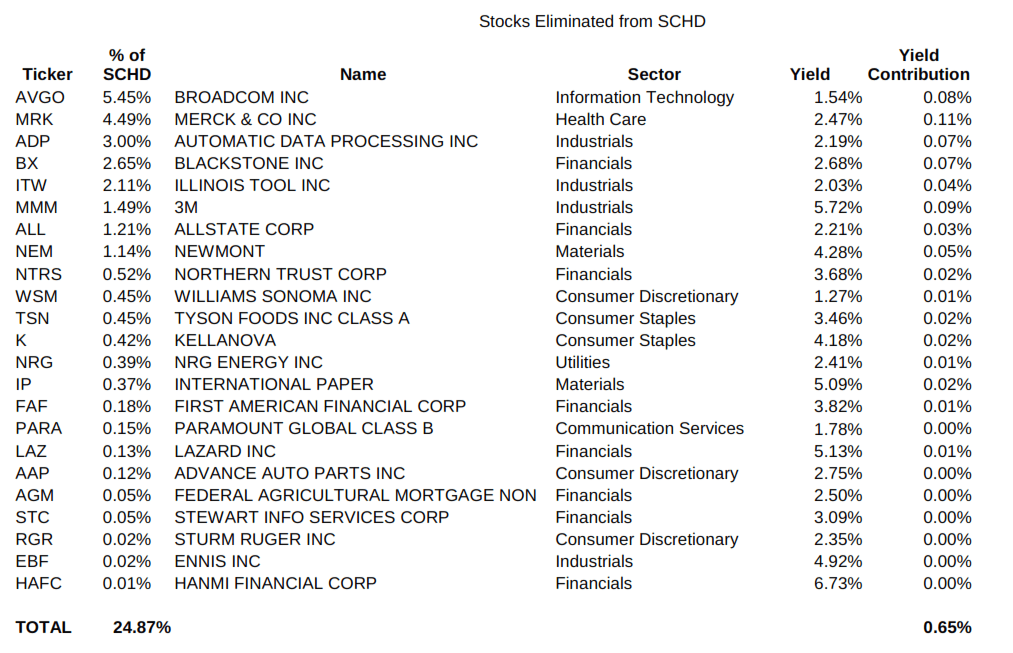
Those three were Sturm Ruger (RGR) and Hanmi Financial Cor (HAFC), which made up an insignificant amount of SCHD's total value, and First American Financial (FAF), which contributed .18% of that value. Hanmi had an outsized dividend, at 6.73%, while the other two stocks' dividends were more modest.
Below you can see how the Seeking Alpha Quant Rating System rated the eliminated stocks' dividend growth and consistency.
Seeking Alpha's Quant Rankings of the Dividends offered by the stocks eliminated from SCHD is shown below.
Schwab Asset Management, Seeking Alpha, Table by Author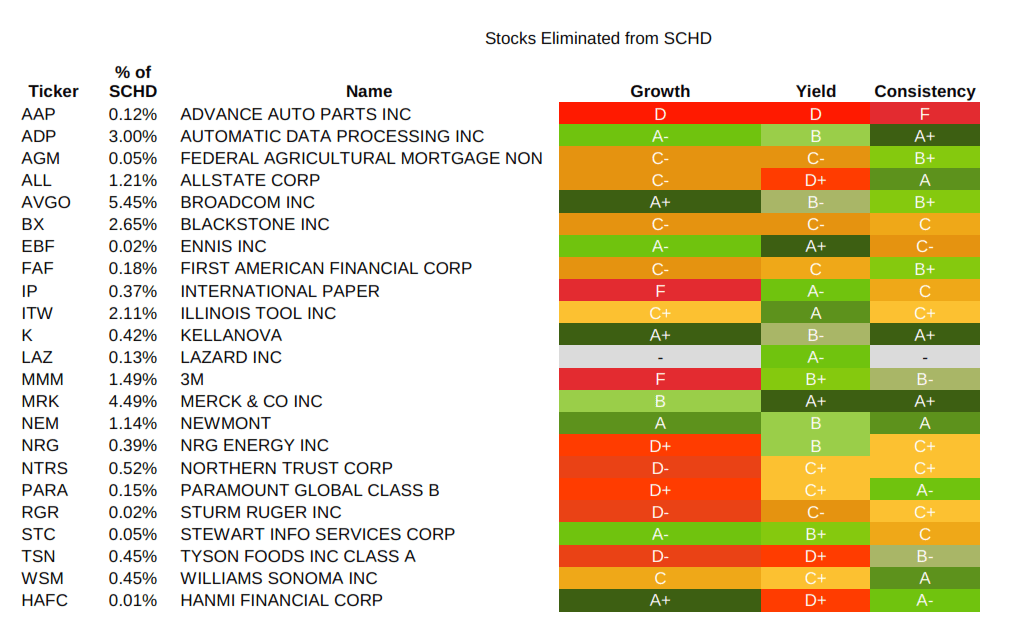
As you can see, three of these eliminated stocks currently rank highly on all three Quant measures, Dividend Growth, Yield, and Consistency. They are Automatic Data Processing (ADP), Merck (MRK), and Newmont (NEM). Nevertheless, they have been eliminated.
Several of the eliminated stocks ranked very poorly, especially Advance Auto Parts (AAP), Tyson Foods (TSN), Paramount Global (PARA) and Northern Trust (NTRS).
As you can see from the table above, the dividends paid by eliminated stocks when weighted by the amount the stock paying that dividend made up of the whole, made up .65% of SCHD's total 3.38% Trailing 12 Month Yield. That means that the stocks that have just been cut contributed 19.2% of SCHD's yield over the past 12 months.
Below you can see the list of stocks that are entering SCHD as of market open March 18, 2024. Schwab Asset management has reported these stocks as part of SCHD's holdings in the Portfolio section of SCHD's product page. No weight is given for these stocks yet, but they appear to be ranked in size order.
Schwab Asset Management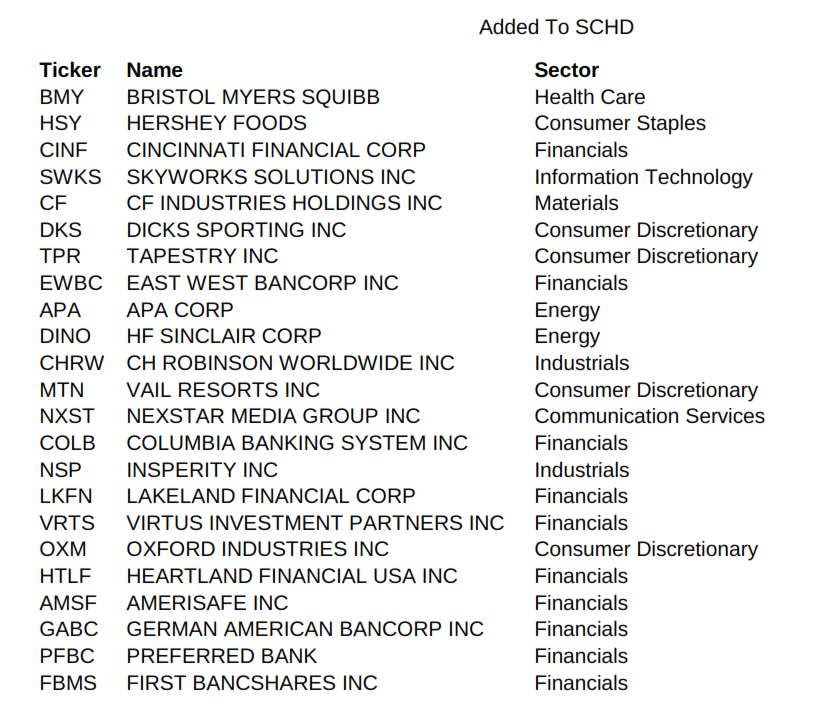
The Dividends Paid By These Added Stocks are given in the table you will see in the next section. We won't know until March 19 how much they make up of the total value of SCHD and whether the expected yield of SCHD going forward will rise or drop as a result of these changes.
Those stocks are Heartland Financial (HTLF), Insperity (NSP), Columbia Banking System (COLB) and First Bancshares (FBMS). Three of these are financials, and as they appear in the bottom half of the listing, will probably be held in very small amounts, as SCHD typically concentrates most of its value in its top 25 stocks.
It is very interesting to see such a great divide between the Seeking Alpha Quant's system's rankings and the algorithm used by SCHD's index.
Below you can see information extracted from the Dividend Tab Seeking Alpha's Portfolio View of the 23 stocks just added to SCHD.
Seeking Alpha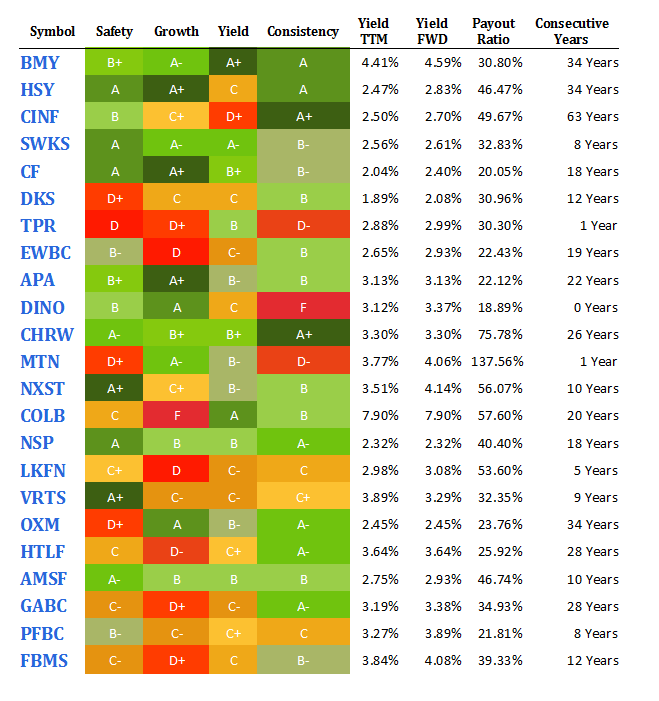
As you can see, only four of the added stocks rank highly for Dividend Safety, Dividend Growth, Dividend Yield and Dividend Consistency. Those stocks are Bristol Myers (BMY), Hershey (HSY), Skyworks (SWKS), Insperity (NSP) and Amerisafe (AMSF).
But wait! Didn't we just see that Insperity is among the stocks that Seeking Alpha's Quant rankings flags as being at high risk of doing badly?
The reasons for this most likely have to do with how the index that SCHD follows selects stocks.
Both the algorithm that SCHD's index uses to select and eliminate stocks from its holdings and Seeking Alpha Quant system use back testing that is applied to the information published in each stock's quarterly reports to draw their conclusions. But Seeking Alpha's Quant system uses far more data to draw its conclusions, and it updates that data frequently, while SCHD's index relies on a snapshot that is, as we will see, drawn from stale data.
This discrepancy may points to a major weakness in the way that SCHD's index's algorithm chooses stocks: it looks only at a few, mostly dividend-related metrics to assign quality rankings to the stocks it evaluates, rather than at the balance sheet as a whole.
Exactly how SCHD's index, the Dow Jones Dividend 100, selects stocks is discussed fully in my previous articles, most recently in the article discussing last year's reconstitution. The methodology document that describes this process in detail can be found here.
I will repeat the most salient factors that may explain the divergence between the Quant rankings and SCHD's choices here for the convenience of my readers.
All SCHD's stocks are chosen from a list of U.S. stocks that have a 10 year history of paying a dividend. Note that those dividends did not have to have grown each year of the past 10 years. The index these stocks were selected from included stocks of all sizes, excluding REITs.
The stocks in this group of dividend-paying stocks were then ranked against each other on each of the following factors:
Note that dividend growth does not have to grow every year, it is only the average that is used in the index's calculations.
The values used for the rankings SCHD's index uses to rank dividend paying stocks in order to select the "best" ones are the values as of the last business day of the previous December.
There have been a lot of changes since December 31, 2023. Most important of which is that the hopes raised by the December Dot Plot published by the Federal Reserve have been dashed. At the end of December, investors believed that the Fed was going to cut rates 6 times over the coming year, starting in March. This had a very positive effect on stocks that were particularly sensitive to interest rates, most notably Financials, but also companies carrying heavy debt loads taken on at very low interest rates that would have to be refinanced in the coming year or two.
That has changed with the persistence of inflation. Expectations now are that the Fed's next dot plot, due on Wednesday March 20, will indicate 3 interest rate cuts for 2024, beginning in June or July. And that estimate, of course, can be changed at any time if the data continues to come in showing inflation stubbornly persisting. Some members of the FOMC board have even suggested that another rise in rates is not completely off the table.
SCHD's algorithm knows nothing about this. Which probably explains the persistence of so many Financials in its holdings and its addition of more, several of them at risk of performing poorly according to Seeking Alpha's Quant ratings.
The rules that SCHD's index follows prescribe that no stock can make up more than 4% of the total holdings of SCHD. Right now, these are the current weights of the Top 3 Stocks in SCHD.
| Symbol | Percent of Assets | Name |
| (ABBV) | 4.69 | ABBVIE INC |
| (HD) | 4.38 | HOME DEPOT INC |
| (TXN) | 4.12 | TEXAS INSTRUMENT INC |
You should expect to see these percentages cut to 4% or less by March 19, 2024.
Over the almost 4 years I have been covering SCHD, I have been continually surprised by how many investors who comment on my articles assume that the stocks that make up SCHD are selected by experts who are looking for the best valued stocks to add to SCHD, rather than as is, in fact, the case: being chosen by a rigid computer algorithm that only massages a limited set of numbers stripped from stocks' quarterly reports.
I urge all investors in ETFs to read the methodology documents that describe how the indexes are created that their ETF tracks. The only stocks that will ever be held by a passive ETF like SCHD are those that are selected mechanically by these algorithms. They know nothing about such important factors as investor sentiment, the impact of macro economic factors like inflation or international conflict, changes in management, or the like.
SCHD has performed quite poorly since inflation has picked up, as I have demonstrated in a recent article. The dividends it has paid have barely covered the drop in share price that has resulted from the dramatic impact inflation has had on interest rates starting in early 2022.
SCHD's longer term record looks wonderful only because for its first 11 years, until 2022, it had only operated in an environment where fixed income offered yields near 0%. Once inflation became a factor again it has not been competitive with safe fixed income rates especially Treasuries and CDs that have been paying 4-5%. Though SCHD does pay a steady dividend, that under 4% dividend is not close to matching inflation, and the potential for share price deterioration can severely damage shareholder's buying power going forward. This is a particularly severe threat to retirees.
If you must invest for dividends, buy individual stocks whose business you understand and follow their quarterly reports carefully, including the "risks" section, to ensure that their businesses are holding up as conditions change.
Or buy short term treasuries and enjoy the over-5% yields you can get that are guaranteed to be paid at maturity with no loss of principal.
Editor's Note: This article discusses one or more securities that do not trade on a major U.S. exchange. Please be aware of the risks associated with these stocks.