bari paramarta/iStock Editorial via Getty Images
bari paramarta/iStock Editorial via Getty Images
I've yet to meet someone who isn't aware of the brand that is Ferrari N.V. (NYSE:RACE), which puts the company in a unique basket of brands whose names transcend their industries. Coupled with Ferrari's exciting developments and record-breaking financial performance, that leads me to have high conviction in RACE despite an expensive valuation.
It's my view that there is still significant upside for this company, and the unique blend of branding power and growth avenues has me bullish. Today, Ferrari has a market cap of $79 billion. But as I break down the different moving parts of the business and their position within growing markets, I have high conviction that the coming years will see Ferrari's value reach between $115-139 billion. This implies a 45-75% upside from today's share price.
It should be noted that between the investment community, two out of three relevant parties support my view. That is, both Seeking Alpha and Wall Street analysts have issued a buy recommendation while the Quants suggest a hold.
Seeking Alpha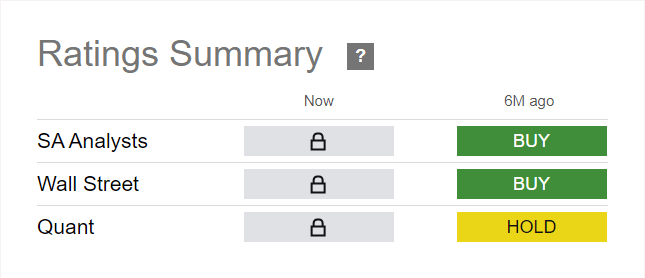
In 2014, Ferrari was spun off from Fiat, and in the time since, they've delivered over 670% to shareholders, averaging over 20% a year. These impressive returns are even more stellar when you consider that Ferrari only sells about 10,000 cars a year on average.
This method of artificially restricting supply has profound psychological impacts and can increase demand even more, which appears to be the case for Ferrari.
As of today, Ferrari has a 24-month waiting list to buy a car. In addition, of these 10,000 units sold, about 2/3 or 66% are repeat customers, which means only about 3,000 individuals get to call themselves a new Ferrari owner every year. Repeat customers are an attractive feature for any business.
For most automobile companies, you can take the car off the lot the same day you enter. This couldn't be further from the truth with RACE. There are only 200 dealerships in the world that sell this car, and the application process to be approved involves a lengthy vetting process. Ferrari is extremely meticulous in managing their brand perception and considers the quality of a prospective owner by looking into their past and how they intend to treat the car going forward.
For instance, in 2014, Ferrari served famous DJ Deadmau5 a cease and desist letter for modifying and wrapping the car in a cartoonish theme. Ferrari is especially mindful of mods that the company deems distasteful or against the spirit of the car in the first place. It's the same reason the company will never, ever sell a pink Ferrari.
Some may see this as a brazen move on Ferrari's part, but is there any company out there that approaches the sale of automobiles in a similar fashion?
Ferrari commands a respectable and growing slice of the luxury car market. As the total addressable market for luxury cars grows, one can make the case that they can up production and unit sales without diluting the brand, which is a key concern for them.
The late Enzo Ferrari himself once stated:
Ferrari will always deliver one car less than the market demands.
Put another way, status is in the company's DNA, and this exclusive club is one that countless affluent individuals are desperate to be part of. In addition, the number of wealthy individuals is growing. In 2012, there were an estimated 25.6 millionaires across the globe. That figure has doubled to 51.5 million. Going forward, by 2026, the number of millionaires is expected to rise in most countries.
Bloomberg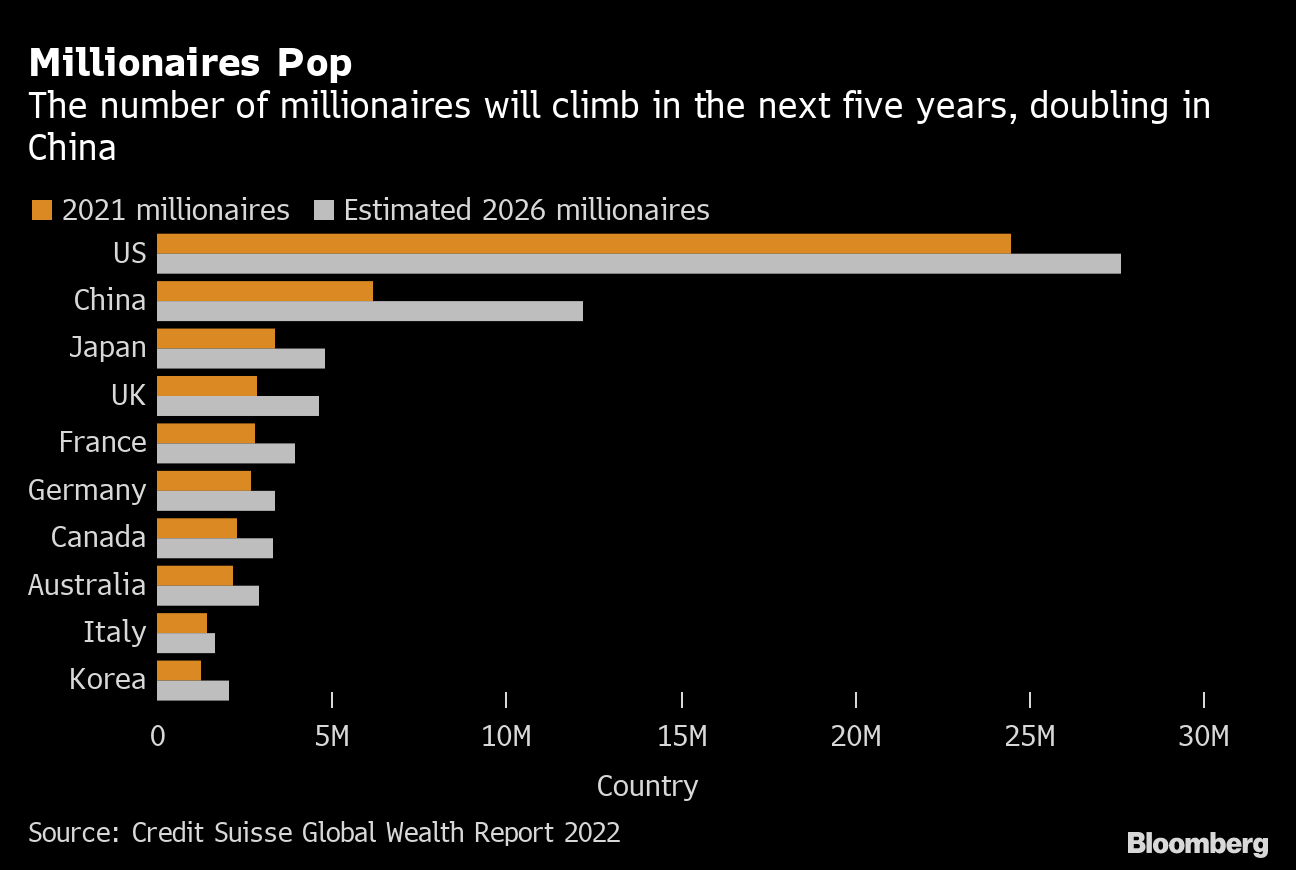
If I had to estimate, at least a billion people (if not more) are aware of the Ferrari brand. There are 51.5 millionaires who may afford it, and only 10-11k units that the rich are vying for. All things equal, this implies Ferrari has strong pricing power and can pull on this lever if need be. If this prestige wasn't exceptional already, consider that they recently signed F1 superstar Lewis Hamilton for 2025. For those unfamiliar with F1, this is the equivalent to signing LeBron James or Cristiano Ronaldo to your team. We'll go further into this deal and what it means in the section on growth and opportunities.
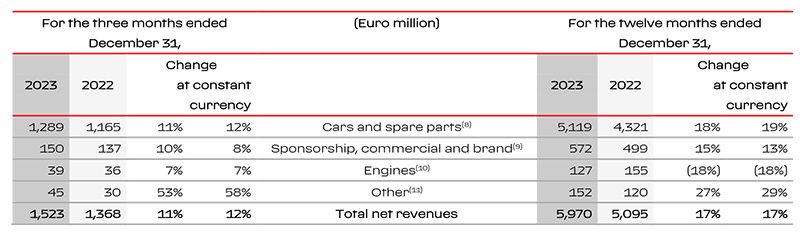
The business breaks down into four segments. But there are two that I would like to be the main focus of this article, for they make up the bulk of the performance. The first in their 10-K is categorized as "cars and spare parts." This is the part of the business most associated with Ferrari. It's the elite automobile and engines they create in the heart of Italy. And it generated $5.5 billion (€5.1B) in 2023 and grew 18% from the year prior. In this category, Ferrari has tremendous pricing power and can up their production, as they have been.
The next I'd like to dive deeper into is their "sponsorship, commercial, and brand" line item. This includes their business in F1, their new and growing apparel venture as well as other commercial and sponsorship deals. For example, their F1 business and the signing of superstar Lewis Hamilton are all associated with this line item. This produced $619 million (€572M) and grew 15% from the previous year. I will go into greater detail regarding these line items in the coming sections.
There are other attractive components of the business that some may not be aware of. For example, the company operates Ferrari museums in Modena and Maranello; Il Cavallino restaurant in Maranello; and theme parks in Abu Dhabi and Spain. These may not be massive revenue generators, but they foster a certain culture that seeps into the human psyche regarding how the brand is perceived.
Their CEO, Benedetto Vigna, has only been at the helm since September 2021, and in this short time, has seen the stock effectively double. He comes from a physics and engineering background and has instilled a certain confidence in the company since his tenure began.
There's no ignoring it. Ferrari has an expensive valuation. But this is often the case with ultra-premium brands, especially those with attractive margins and stellar brand value.
As per their most recent filings, Ferrari is worth roughly $70 billion, has a top line revenue of $6.1 billion and a net income of $1.2 billion on a trailing-twelve-month (TTM) basis. Let's keep in mind that these are record-breaking numbers. Revenue is up 12% from December 2022, while profits are up 24% during the same period.
Ferrari Corporate Documents
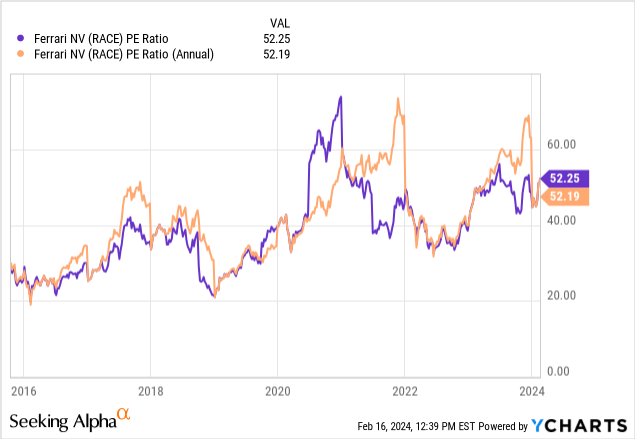
In other words, the market is rewarding Ferrari for these upward trending numbers and deals with a pricey valuation. But when looking at where their historical valuations are, we can see that this is rather normal, as Ferrari has brushed up against P/E ratios in the upper 60s range.
From a margin perspective, Ferrari does not seem like a car company. With gross margins of 50% and operating margins consistently in the 20% range, these figures look more like software and asset-light business models. This speaks to the wide economic moat that Ferrari holds. We can see how these super margins (4th row) compare to the rather lackluster figures the bulk of the automobile industry adheres to.
Fiat Group World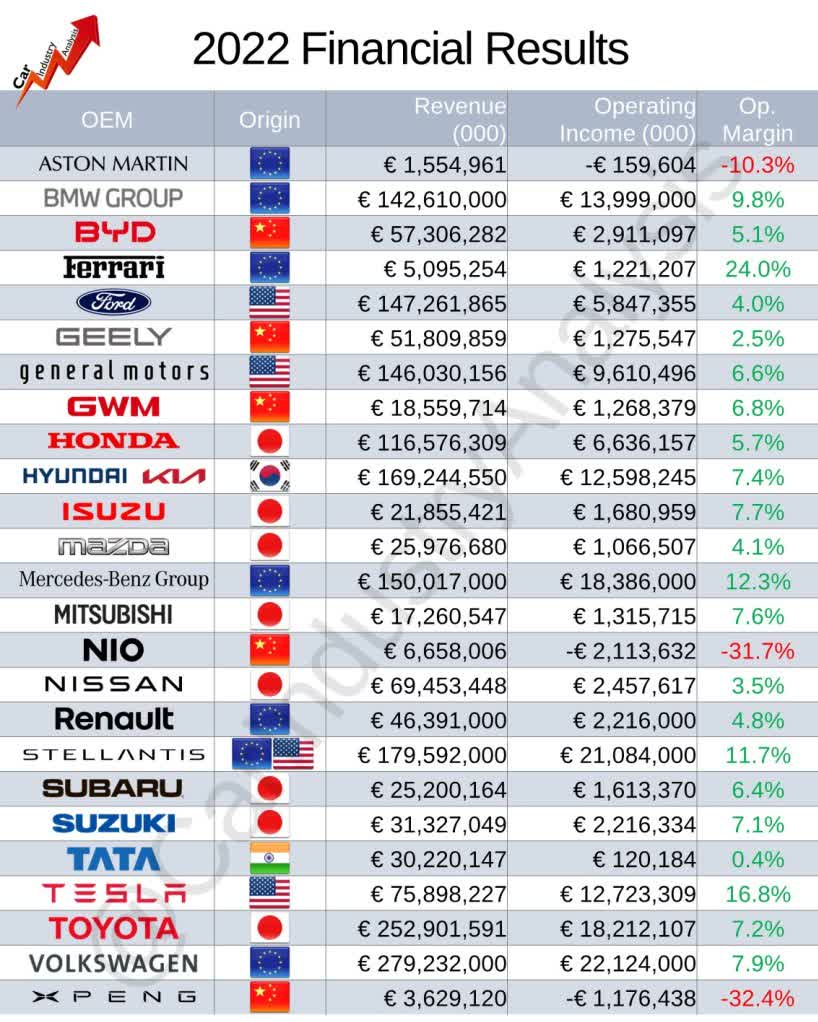
Their balance sheet is also impressive for a company that spends a lot on R&D and other capital-intensive projects. As it stands, Ferrari's $8.3 billion in assets far exceeds their $5.3 billion in total liabilities, of which only $1.4 billion are short-term.
In addition, some of Ferrari's liabilities come from financing options and loans for buyers which consists of dealerships and individuals. This form of debt is hardly cause for concern considering the deep pockets customers typically have.
One factor one needs to consider is the lagging of free cash flow before the launch of a new model. This is normal and to be expected. Prior to launching, a new model will lead to inventory build-up and additional engineering and manufacturing expenses. But with about $20 billion worth of cars sold in the last four years, it's fair to say a temporary decline in these metrics is justified.
While the company has already experienced abundant success, I see that there's still quite a lot to be excited about when it comes to the future of Ferrari. Here are three factors I'd like to highlight in particular.
As stated earlier, Ferrari historically only sold around 10,000 units a year. This is an extremely small number compared to automotive giants like Toyota who sell in the millions, and even a fraction of other luxury groups like Porsche. This is all part of Ferrari's broader strategy and management of their brand perception. But as the number of affluential individuals increases, Ferrari can also proportionally increase these numbers without experiencing the brand dilution they're aiming to avoid. This has already been occurring with shipments rising to 13,221 in 2022 compared to 11,155 in 2021. The release of the Ferrari SUV will add a unique mix to their current offerings. In addition to unit increases, the growing wait list just to be considered suggests there are opportunities to increase the price tag for each car, which will translate into a higher top and bottom line.
Since 2010, worldwide Google search queries for the term "F1" have risen, and reached all-time highs in late 2022. F1 also found itself on Netflix. Anecdotally, I've had a boatload of friends take an interest in F1, many of whom have had no prior interest in sports. As the growth of the sport increases, this will translate into greater interest for the Ferrari brand, as well as sponsor deals and the media limelight.
By the numbers, F1 is said to be the fastest-growing sports league on social media. And according to Forbes, has garnered a global TV audience of 1.5 billion people. As it stands, Ferrari is the most valuable team within this fast-growing total addressable market.
Axios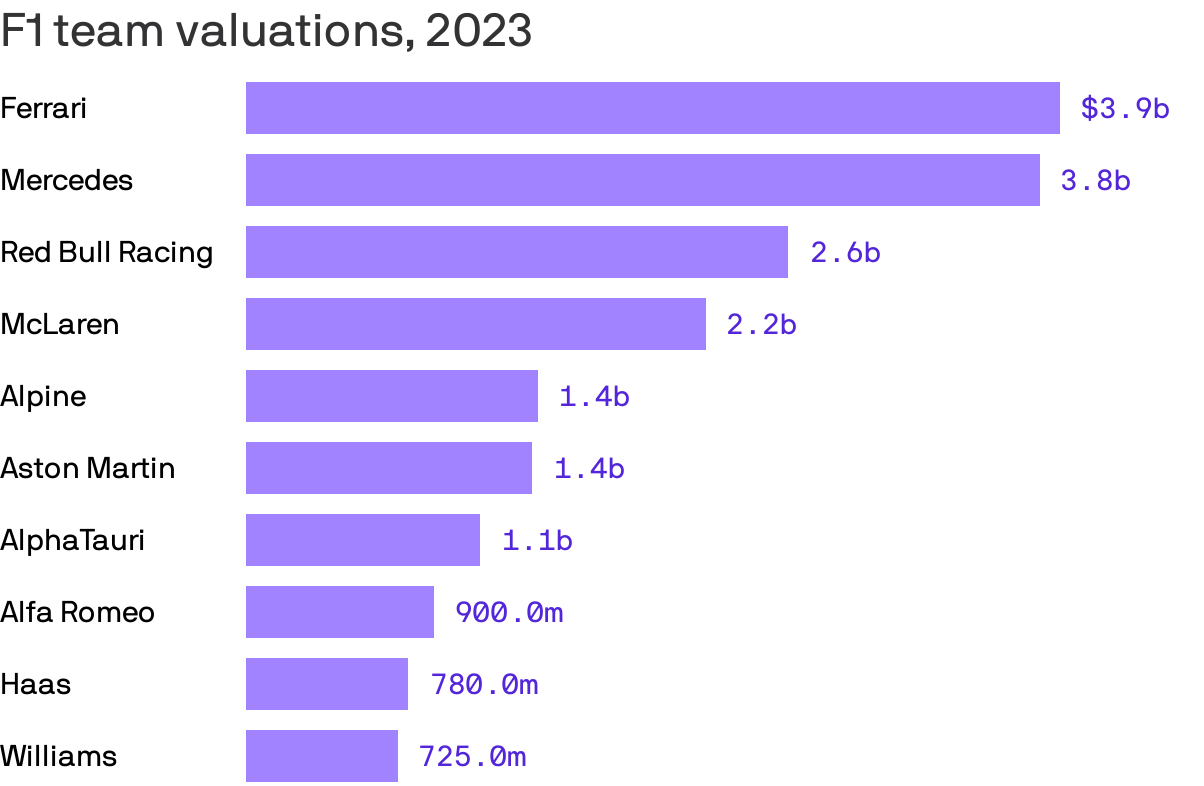
No other F1 brand has the fandom and prestige that Ferrari does. They do all the little things right to take care of their image. For example, both F1 Ferrari drivers are from Southern Europe and look like male models in their own right. These subtle little details matter a lot.
OverSteer 48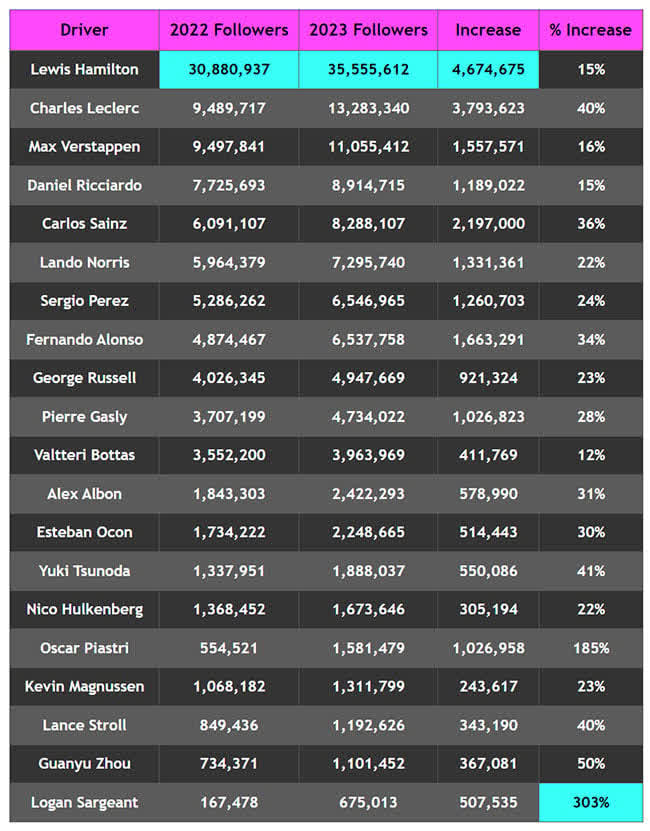
From a social media perspective, there are no F1 drivers who match Lewis Hamilton, who has over 35 million followers across the various apps and gains millions more per year. The promise around signing Hamilton can be gauged by the market reaction, where shares surged 9% in a single day.
One area to keep an eye on is Ferrari's apparel and merchandise business. Like their automotives, Ferrari's strategy here follows a similar approach, in that they target the luxury market. On their site today, you'll find many items in the four-figure price point range. Under Ferrari's financials, clothing and apparel fall under the "Sponsorship, commercial, and brand" category which in 2023 produced $618 million (€572M). This might be deemed impressive considering it's only been a few years since apparel has launched, but given the size of the luxury market, it would be fair to assume Ferrari has their sights set on achieving much more.
Ferrari Corporate Documents
The luxury market is estimated to be a $1.5 trillion dollar market. From this perspective, the figures Ferrari's merchandise brings in is only scratching the surface. When considering the growth in other areas (i.e., F1 and car unit sales), it stands to reason that their merchandise figures can swell past what they've been achieving.
Their clothing line is still a relatively new endeavor which only surfaced in June 2021. There are possibly many prospective customers who are interested but are simply unaware of the Ferrari clothing line. Fortunately, industry juggernauts have been recruited to run the apparel business, like former Armani designer Rocco Iannone. If they can up the competition with other European luxury heavyweights, we may see a future where the majority of sales come from apparel and not their cars. This is an attractive prospect for its investors and makes for an exciting time to hold shares.
When establishing a bull case thesis for this asset, there are a few valuation assumptions to state. The brand will grow at a top line of 15% a year and will expand their EBIT margins from 24% to 30% in the next 5 years. This will be fueled by the higher margins that come with apparel, the enhanced brand perception from Lewis Hamilton and their F1 affiliation, as well as the higher price points they can assign to future transactions.
The rationale for higher margins to come is based on the trend of increasingly higher price points over the years, which has coincided with increased units sold and a growing wait list/repeat customers.
Chit Chat Money
Based on the top line growth and margin expansion mentioned, this can produce roughly $3.5 billion in annual EBIT by 2027-28. Keeping in mind where valuations have traded historically, investor risk appetite, and the company developments occurring, we can imply a 30-35x EBIT multiple going forward (based on historic valuations and multiple expansion), which by 2027-2028, will result in Ferrari's market cap reaching between $115-139 billion. This implies a 45-75% upside from today's share price. I break down the inputs below and provide three scenarios ranging from bearish to bullish.
| Revenue Today (USD) | $6,591 | $6,591 | $6,591 |
| Implied 15% Annual Growth Rate Until 2028 | $13,256 | $13,256 | $13,256 |
| EBIT Margins (Implies Margin Expansion) | 24% | 27% | 30% |
| Projected EBIT | $3,181 | $3,579 | $3,976 |
| 30-35X EBIT Multiple | 30X | 32.5X | 35X |
| Market Cap | $95B | $116B | $139B |
Note that these valuation inputs represent various bull case scenarios and would require Ferrari to excel regarding the various moving parts that make up the business today.
But let's not forget that Ferrari is tested against recession and has proved to weather challenging economic storms. One reason for this is their affluential customer base which is much less influenced by economic forces or a changing rate environment.
No investment is without its set of risks. In the case of Ferrari, there are a few I'd like to mention. First, Ferrari has a lofty valuation. And expensive valuations mean that high expectations are embedded in the stock. If Ferrari fails to adhere to the level of growth and operational performance that is expected in any of the coming quarters, share prices may suffer. In addition, Ferrari's apparel business is still fairly new and untested. While some might be optimistic about their entrance into this space, there are no guarantees, and should the venture fail to make an impact, investors may conclude that their capital is better allocated elsewhere. Lastly, we are still unsure where Ferrari stands in a world heading towards EVs. While Ferrari can certainly pivot, uncertainty still looms regarding their place within this broader societal trend.
Ferrari is an elite brand that is probably impossible to replicate in that there's so much racing and cultural heritage. The movie Ford vs. Ferrari exemplified this. People across the globe will always associate Ferrari with Italian craftsmanship. And this gives them an edge that can last forever and reflect strong financial performance for the years and possibly decades to come.