
da-kuk
da-kuk
This article explains why I recommend investors avoid the Invesco Nasdaq Next Gen 100 ETF (NASDAQ:QQQJ). Since February 2021, QQQJ has been the second-worst-performing mid-cap fund and still trades at 26.26x forward earnings, making it one of the most expensive in its category. Furthermore, its estimated earnings growth rate is nearly 6% less than the Invesco QQQ ETF (QQQ), and factor-based ETFs like XMHQ and XMVM have proved far superior, outperforming by 50% over the last three years. Below, you'll find two tables comparing the total returns of 69 mid-cap ETFs, and I'm confident after reviewing these results and QQQJ's fundamentals in closer detail, you'll agree that it has no place in your portfolio. I hope you enjoy the read.
QQQJ tracks the NASDAQ Next Generation 100 Index, selecting the 101-200 largest non-financial companies on the NASDAQ-100 Index. Invesco suggests the portfolio "may be concentrated in mid-capitalization stocks," and the fund's current composition provides confirmation. QQQJ's weighted market cap is $18.5 billion, or slightly above the $14.2 billion category average based on 69 ETFs in my database.
The Index launched on August 24, 2020, with QQQJ launching shortly after that on October 12, 2020. The Index follows a modified market-cap-weighting scheme with no security weight above 4% at each quarterly rebalancing (March, June, September, December) and annual reconstitution (December). QQQJ's expense ratio is 0.15%, and its AUM is $675 million.
QQQJ overweights Technology stocks at 37%, followed by Health Care (21%) and Consumer Discretionary (17%). It's only slightly better diversified than QQQ, but since its top three sectors comprise 75% of the portfolio, it's a high-risk play if those sectors fall out of favor.
The Sunday Investor
The sector diversification score presented above is a metric I created to evaluate the cost of diversification. The score is calculated on a ten-point scale and compares an ETF's sector allocations against diversified (i.e., equal-weight-by-sector) and undiversified (i.e., single-sector) portfolios. The value of this information is that you can better understand how an ETF achieves its features. For example, creating a high-growth portfolio is easy if you only focus on tech stocks. As I'll demonstrate later, QQQJ's top three sectors have excellent growth rates but don't score well on other metrics like value.
QQQJ's top ten holdings are next, totaling 17.52% of the portfolio. They include Super Micro Computer (SMCI), Monolithic Power Systems (MPWR), and Tractor Supply (TSCO). These ten companies have market caps above $20 billion, but the Index includes many under $10 billion, like C.H. Robinson Worldwide (CHRW) and Etsy (ETSY). There are also a few foreign stocks like BioNTech SE (BNTX), whose ADR is listed on the Nasdaq.
Invesco
Based on its weighted average market cap, Invesco's description, and how Morningstar classifies it, I have slotted QQQJ in the mid-cap category along with 68 other ETFs in my database. In total, 53 ETFs have a three-year track record, and I'd like to present each ETF's total returns (in descending order) to show how QQQJ performed against its peers.
The Sunday Investor Portfolio Visualizer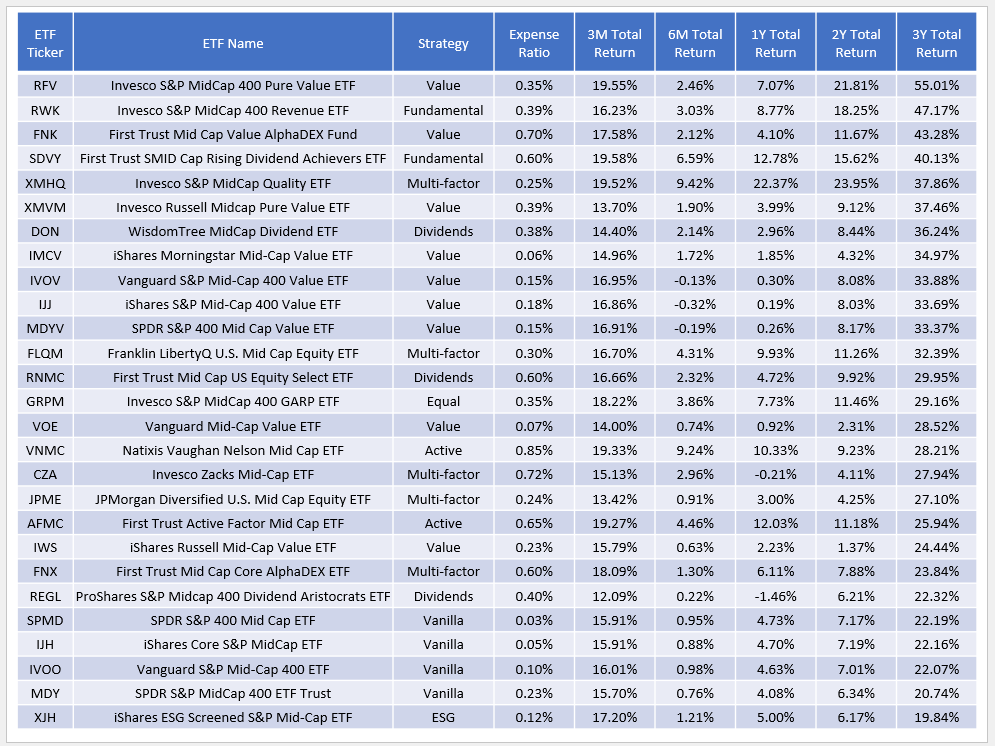
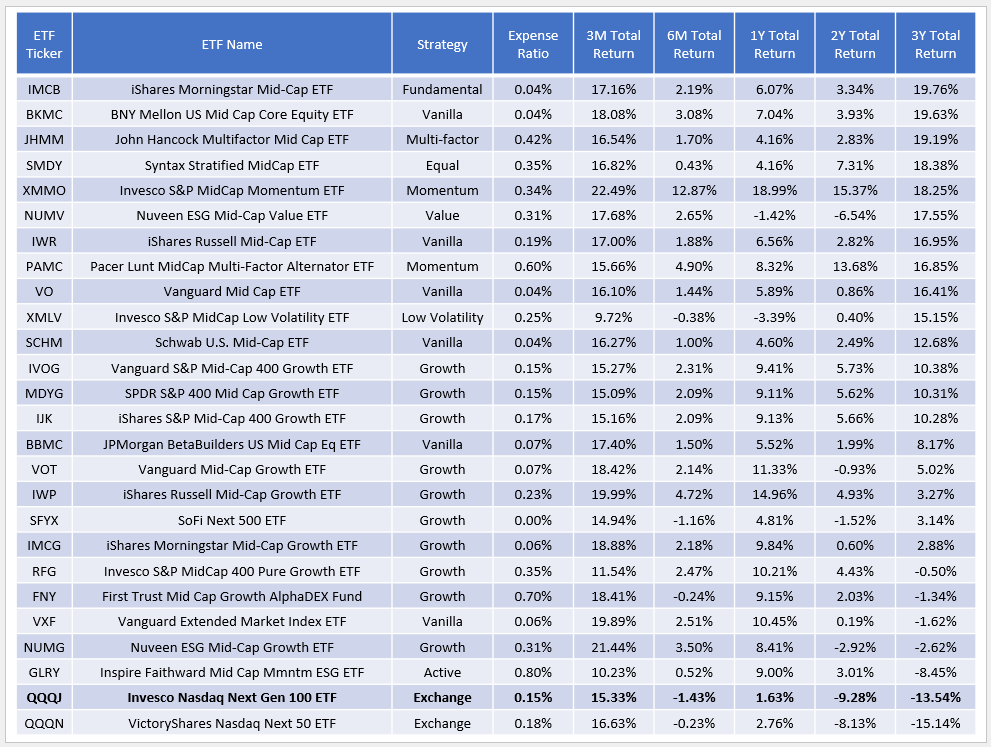
In the second table, I've bolded QQQJ's -13.54% three-year total return, highlighting how it was the second-worst performer behind the VictoryShares Nasdaq Next 50 ETF (QQQN), which is simply a more concentrated version.
Pay particular attention to the "Strategy" column, which provides evidence that the growth strategy has not worked nearly as well for mid-cap stocks as it has for large-cap stocks over the last three years. Instead, you'll find the top performers are value and quality-oriented, with some taking a comprehensive or multi-factor approach to stock selection. For this size segment, these approaches are the way to go, so with that said, let's look at how QQQJ currently matches up fundamentally.
I want to highlight how QQQJ ranks against its mid-cap peers on the five Seeking Alpha Factor Grades used for stocks. Please note these are not official rankings from Seeking Alpha, but I derived them by calculating weighted-average scores for each fund to get an idea of what factors QQQJ emphasizes.
Based on these metrics, QQQJ offers good growth potential with highly profitable stocks, but its valuation and momentum scores are well below average. On the plus side, its 6.38/10 EPS Revision score is excellent and could indicate a short-term trading opportunity.
The following table highlights selected fundamental metrics for QQQJ's top 25 sub-industries, which total 87.88% of the portfolio. I've also included summary metrics for XMHQ, XMVM, the SPDR S&P 400 Mid Cap ETF (SPMD), and QQQ.
The Sunday Investor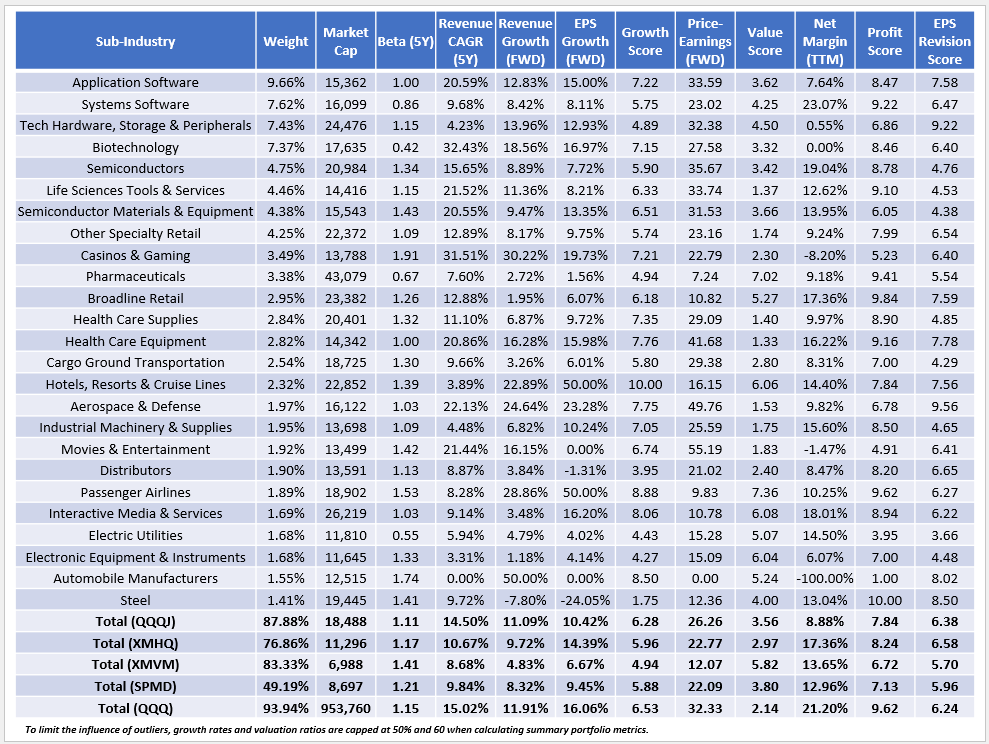
I have four observations:
1. QQQJ has a 1.11 five-year beta, slightly lower than XMHQ and SPMD. However, it hasn't necessarily been less volatile than these funds since it launched. The table below lists its annualized standard deviation at 21.89% and, importantly, a substantial 35.93% drawdown between November 2021 and September 2022.
Portfolio Visualizer
For those expecting a strong recovery, QQQJ disappointed. Since October 2022, it has only delivered an annualized 15.63% gain compared to 34.79%, 19.88%, and 18.74% for XMHQ, XMVM, and SPMD, respectively. The Sharpe and Sortino Ratios in both tables highlight how poor QQQJ performed from a risk-adjusted returns perspective.
Portfolio Visualizer
2. One of QQQJ's best features is its 6.28/10 growth score, supported by 10-11% estimated sales and earnings per share growth rates. However, these growth rates are no better than what QQQ offers, and the difference in quality is enormous, as QQQJ's holdings have nearly 13% lower net margins. The quality factor tends to outperform in slowdowns, so even though QQQ's 32.33x forward P/E is expensive, it's likely a much safer ETF in the long run.
Besides, XMHQ features comparable estimated sales growth (9.72% vs. 11.09%) and 4% higher estimated earnings growth (14.39% vs. 10.42%), and doesn't sacrifice quality or diversification to do so. As a bonus, it trades at just 22.77x forward earnings, so it looks like a stronger ETF across the board. The graph below shows how well it held up in 2022 and also managed an impressive 29.50% gain in 2023.
Portfolio Visualizer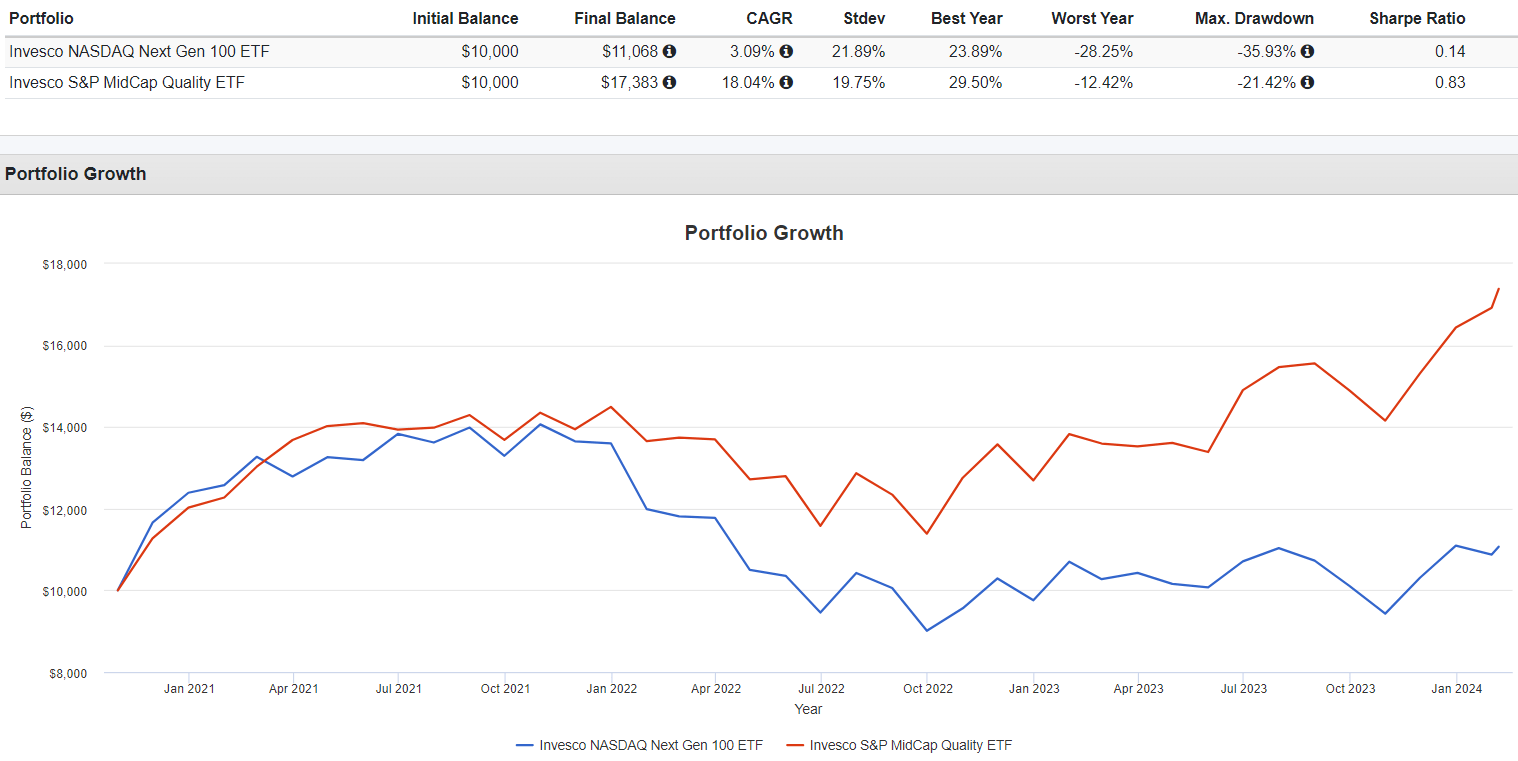
3. The performance statistics presented earlier suggest the value factor works well for mid-cap stocks. XMVM trades at just 12.07x forward earnings, or about 50% cheaper than QQQJ, and its 5.82/10 value score is the second-best in the category behind the Invesco S&P MidCap 400 Pure Value ETF (RFV). It's impressive, but I'm hesitant with these deep-value ETFs because they tend to be highly volatile. XMVM's holdings have a weighted average 1.41 five-year beta, and since it began tracking its current Index on June 21, 2019, XMVM has realized a higher standard deviation and maximum drawdown than SPMD. For this reason, I wouldn't buy it, but it might be appropriate for more aggressive investors.
Portfolio Visualizer
4. QQQJ might be a good short-term opportunity based on its 6.38/10 EPS Revision Score. This score indicates Wall Street analysts are turning bullish on QQQJ's holdings, and I'm encouraged that strong quarterly earnings results support these higher earnings revisions.
The Sunday Investor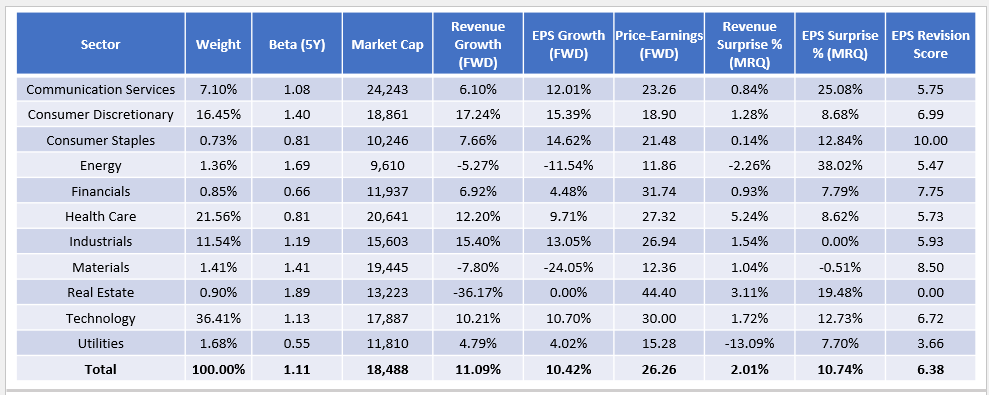
The table above shows an average 10.74% earnings surprise for each stock's most recent quarter, which is 3% better than what QQQ features. Given the disparity in one-month price returns (5.75% vs. 9.19%), I don't believe these results are fully reflected in price, so I wouldn't be surprised if QQQJ outperforms in the near term. However, even if that prediction proves correct, knowing when to exit will be difficult. Based on its past performance, lower growth rates, and lower profitability features, I believe it's only a matter of time before QQQJ lags again.
Even though a short-term opportunity might exist, QQQJ is a high-risk play I don't recommend. Unfortunately, it's been the second-worst mid-cap ETF over the last three years and has yet to recover from its 36% drawdown that ended in September 2022. Furthermore, my analysis reveals an expensive 26.26x forward earnings valuation and an earnings growth rate weaker than QQQ, so I'm not sure of its benefits other than diversifying, which investors can do with any mid-cap ETF.
Instead, mid-cap funds emphasizing value and quality are better bets. XMHQ and XMVM have excellent track records and superior fundamentals, and even low-cost vanilla funds like SPMD outperformed by 36% over the last three years. Given the many alternatives, I feel a "sell" rating is most appropriate, and I urge investors to avoid QQQJ. Thank you for reading, and I look forward to your comments below.