
DisobeyArt/iStock via Getty Images
DisobeyArt/iStock via Getty Images
I am reiterating my Buy rating for ProShares Short QQQ (NYSEARCA:PSQ), used as a counterweight against longs in your brokerage account. In a November article here, I talked about the interesting and unique ability of this inverse ETF to hedge the oversized Big Tech gains of 2023 in portfolio designs.
As I have noted in a variety of articles since the summertime, I see Big Tech names as incredibly overvalued, and believe that gigantic price risk is now on the table. If you are worried about an approaching slide or crash in the winning technology sector on either the unexpected outcome of higher interest rates or a deep recession in 2024, why not consider hedging yourself?
The main advantage of PSQ is its huge cash position. Basically, with a market capitalization for the trust around $600 million at the close on March 19th, $625 million in cash earning roughly 5% in interest yields annually was offset by -$25 million in swap agreement losses. As each swap agreement has a different time period in existence with varying expiration dates and capital sizing to meet PSQ's inverse 1x goal on QQQ movements, actual gains/losses on them are taken on a rolling basis.
The good news of holding better than 100% of the stock value in Treasuries (with some bills earning closer to 5.5%) is the total dividend yield on a trailing 52-week basis has risen to 6.37% (where a sliding ETF value also translated into higher quarterly payouts 9-12 months ago)! This number runs circles around the current long QQQ yield of just 0.6%.
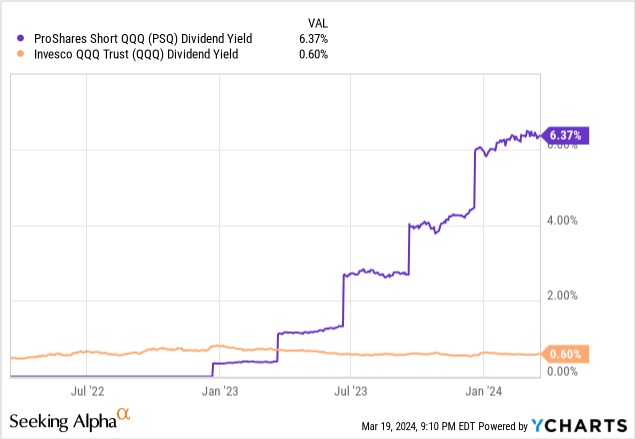
YCharts - PSQ vs. QQQ, Trailing Dividend Yield, 2 Years
In the end, this investment vehicle serves a dual purpose in today's high-rate world, where you can both be short the Big Tech and Magnificent 7 names, through the Invesco NASDAQ 100 ETF (QQQ), and sit on cash earning income. If/when the stock market decides to decline, it may be possible to profit in excess of the original 1x inverse design, if the decline is in a steady trending fashion.
Future performance of PSQ will depend on the level of interest rates, premium expense to enter swap agreements, and the level of volatility in markets. Oscillations in the underlying index, QQQ, can drive significant value erosion (~beta slippage) in daily rebalancing derivative ETFs such as this product. Trending markets should serve this ETF better, and in either direction if PSQ is used as a hedge.
For conceptualizing the idea, after subtracting a little less than 1% yearly for management expense, a flat market each day over the next 52 weeks (which won't happen) should deliver a better than +4% total return (all other variables remaining the same including Treasury rates).
If QQQ stocks drop rapidly later in 2024, without much oscillation up and down, the daily rebalance feature of the ETF may allow owners to achieve something akin to a pyramiding short position (with cash interest income reinvested over time helping out the positive compounding of ETF swap gains). For example, with the high cash yields available today, you might be able to capture a projected +25% to +30% gain on investment when the NASDAQ 100 index drops -20% in price.
However, the risks of a "normalized" trading environment, namely lower interest rates and price volatility (both up/down) have traditionally translated into a sliding price trend on daily rebalancing and compounding for derivative ETFs like PSQ. During some past spans of time since inception, PSQ has experienced subpar performance vs. its 1:1 goal, and potential subpar performance can be accentuated when holding the product for longer terms (weeks or months).
The ProShares website here describes some of the risks/rewards and reasons to own PSQ in your portfolio.
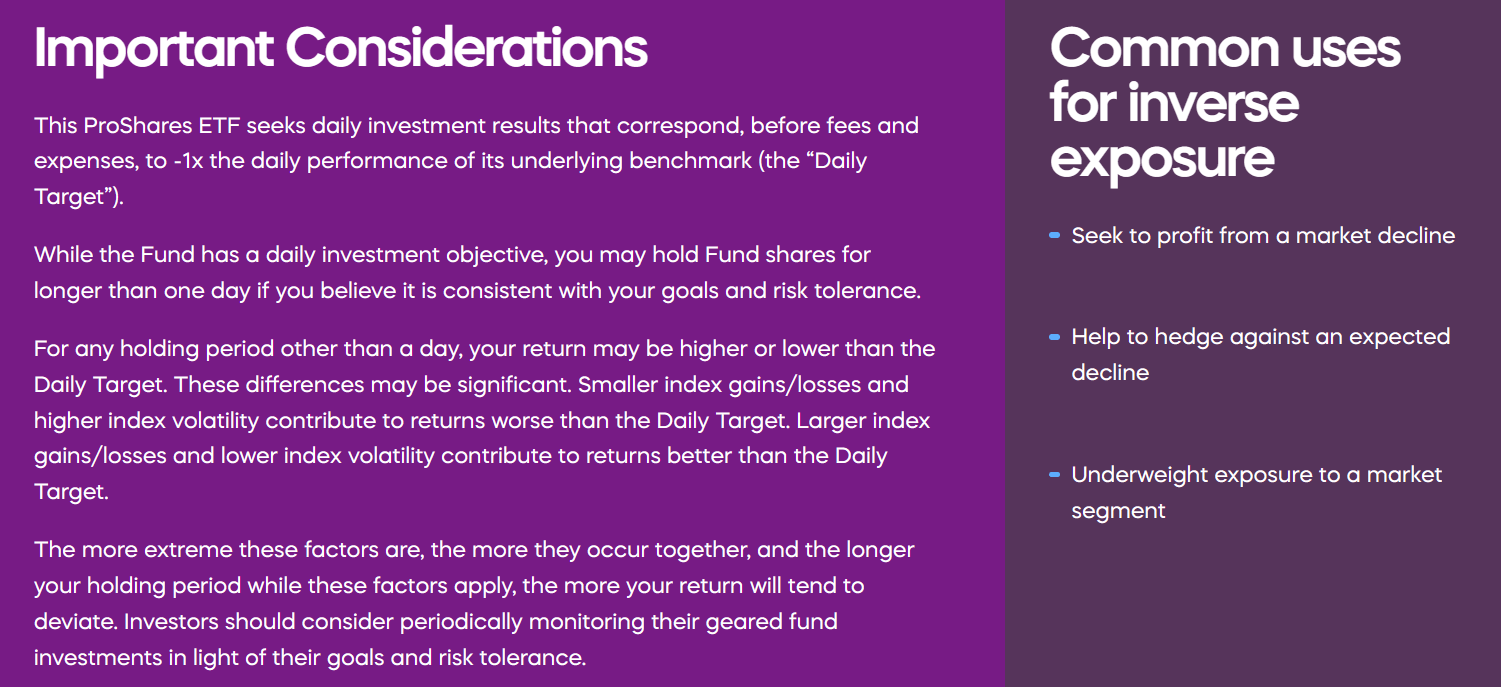
ProShares Website - PSQ Disclaimer
You will notice on the list of total cash and swap holdings from March 19th, 2024, PSQ mostly owns cash reserves through short-duration Treasury bills. Its net 100% inverse position is a function of swap contract agreements with Wall Street's main money-center banks, that fluctuate in the opposite direction of QQQ price changes. The fund is not required to put much upfront capital into each agreement to create the swaps. The counterparty banks are OK with this setup because of the monster PSQ cash position to back up each agreement, and slight profit premiums attained for entering the transactions.
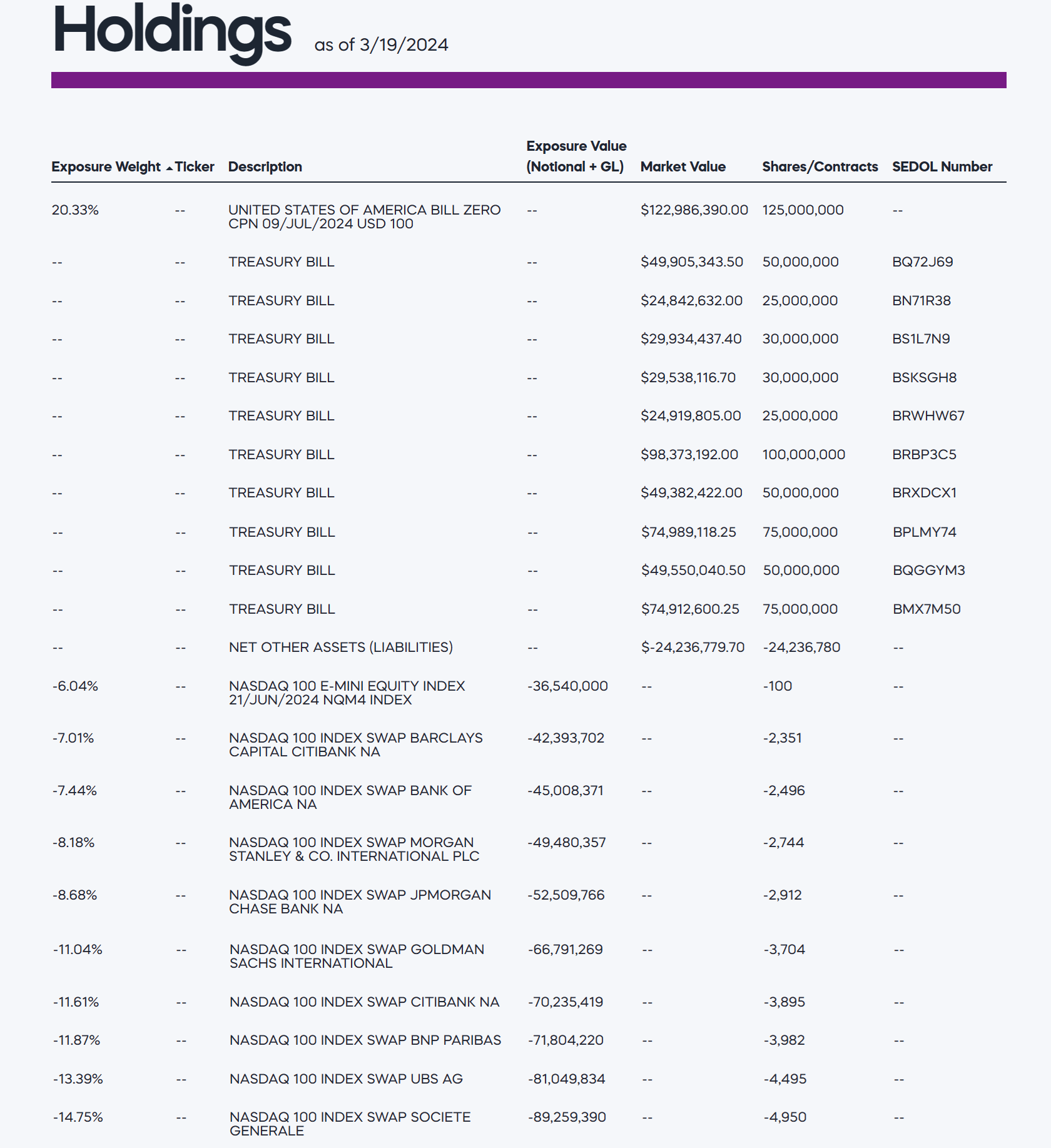
ProShares Website - PSQ Holdings, March 19th, 2024
The best way to illustrate how PSQ has fared for investors in relation to QQQ price movements is to review performance results, including dividends, over the latest 12 months. You will see PSQ has performed far better over each period than a 1:1 hedge product would suggest, mostly because of the high cash yields available today (and to a lesser extent the daily rebalance feature on steady price declines). I would caution, however, lower interest rates and wider market price swings in the future could result in a less beneficial hedge proposition, including underperformance vs. its inverse 1x goal.
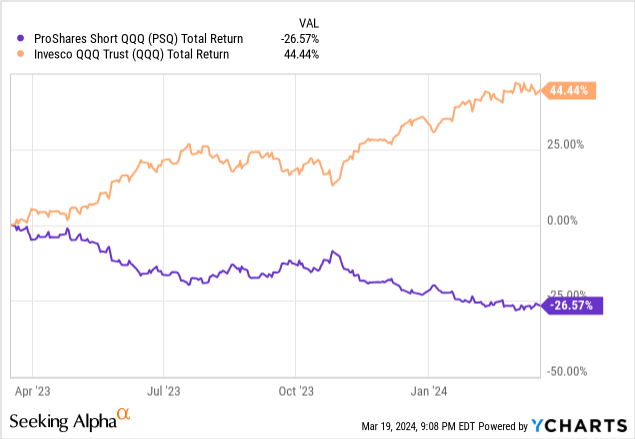
YCharts - PSQ vs. QQQ, Total Returns, 12 Months
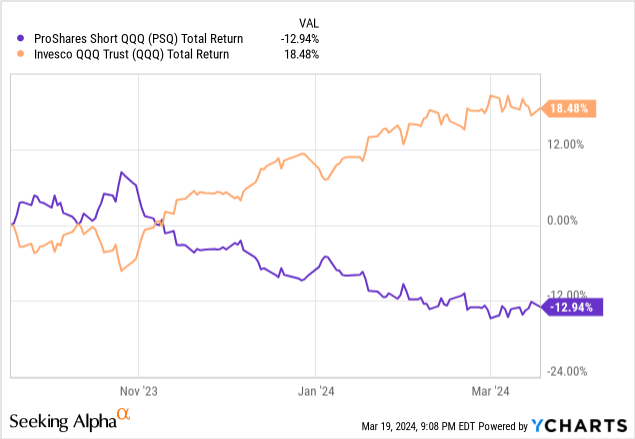
YCharts - PSQ vs. QQQ, Total Returns, 6 Months
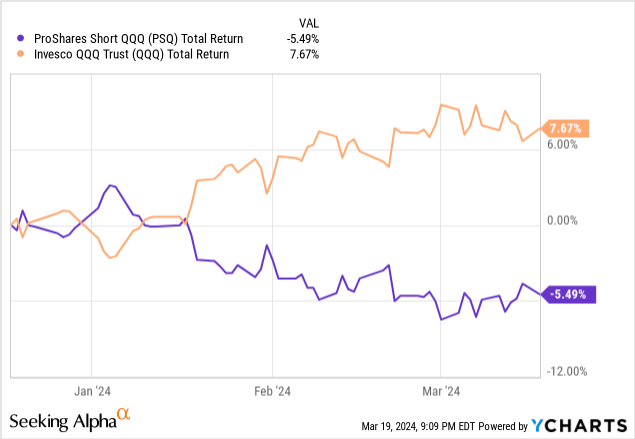
YCharts - PSQ vs. QQQ, Total Returns, 3 Months
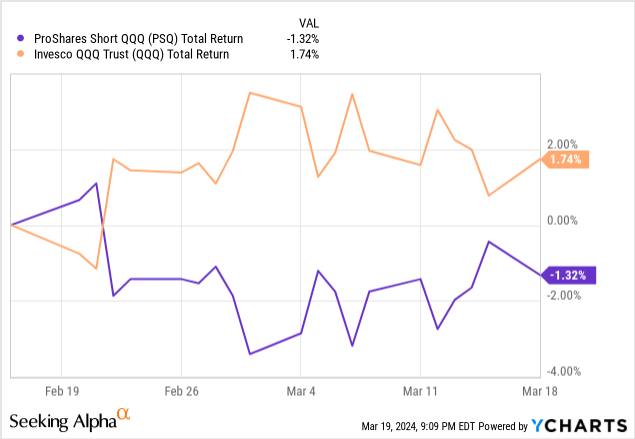
YCharts - PSQ vs. QQQ, Total Returns, 1 Month
Below I have drawn a 12-month price graph of daily changes, with dividend adjustments, for the Invesco QQQ ETF. The first thing you will notice is the spectacular move higher in price of greater than +44% including dividends, which I personally view as a bubble.
However, underlying momentum indicators have been weakening since January. Relative strength of the Big Tech names vs. the overall S&P 500 index of blue chips has actually turned lower since late January (blue circle), while On Balance Volume peaked in early February (second blue circle). OBV had been very supportive of price gains, confirming the move until six weeks ago. In addition, the 20-day Chaikin Money Flow calculation had been super strong until this past week. It is now trying to turn negative for the first time since October's correction in the market.
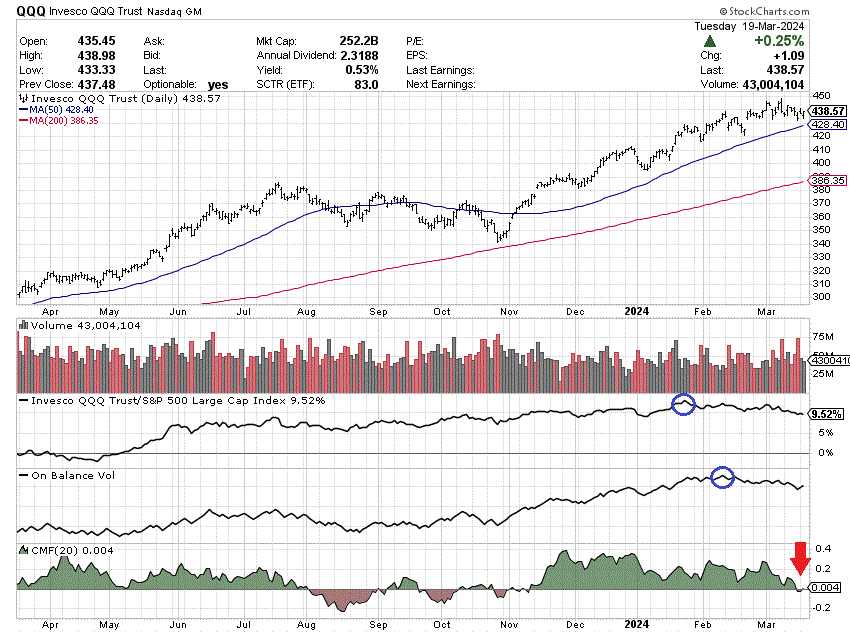
StockCharts.com - QQQ, 12 Months of Daily Price & Volume Changes, Author Reference Points
On the dividend-adjusted chart of daily trading activity over the last year, you can easily see PSQ is performing in the opposite manner of QQQ during early 2024. Essentially, underlying upside momentum and buying strength is the story of its emerging pattern. On Balance Volume bottomed in late January (blue circle) and the 20-day Chaikin Money Flow reading (green arrow) is trying to turn positive for the first time since late October.
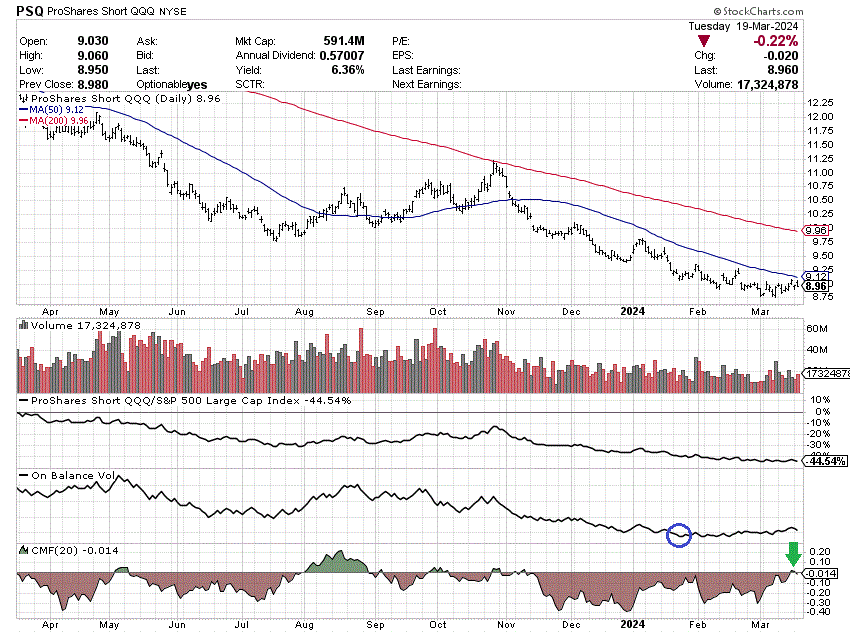
StockCharts.com - PSQ, 12 Months of Daily Price & Volume Changes, Author Reference Points
PSQ has a recent history of declining far less than a 1:1 design would imply vs. the QQQ ETF, although that's not guaranteed. I am projecting PSQ will rise faster in percentage terms than any equivalent drop in the NASDAQ 100 index, due to high cash investment yields, my expectation that a market decline will be a strongly trending one, and how the swap agreements are designed/priced. Facing the decision to own PSQ right now, I believe it's a win-win as a hedge, which is incredibly rare, and wouldn't exist in a low interest-rate environment.
For many investors, you can use PSQ inside tax-free IRA and 401(k) accounts. While index put options, direct short selling, and extra-leveraged products like 2x or 3x inverse ETFs may not be allowed by your plan or brokerage provider, ProShares Short QQQ is often a choice you can include in your portfolio.
Offsetting potential losses in a major bear market or crash scenario, I view PSQ as perhaps the single hedge proposition with the best risk/reward setup for the average investor. Don't kid yourself, the odds of a nasty downturn are quickly growing under the current AI, Big Tech boom regime. Remember, booms eventually bust. When that day comes (and it will), PSQ could morph into a major counter-trend winner.
Might PSQ continue lower, as the technology bubble grows ever larger? Sure, that's why I refer to the product as a hedge. It's a way to add "insurance" against a bear market to your portfolio cleanly and quickly. Yet, if cash investment yields remain high, your losses holding QQQ may not be substantial, mimicking the past year of performance.
Another reason to own this inverse ETF is it can be used to hold onto your Big Tech gains of 2023-24 in a regular taxable account, without having to create a huge capital gains tax liability or being required to play the options market. One complaint I get is, readers don't want to take the capital gains tax hit selling shares owned for years or even decades. While I fully appreciate this excuse, you can buy and hold PSQ to offset or "lock-in" your hefty profits elsewhere without liquidating original shares directly. If the sizable gains on your longs disappear in a monster bear market the rest of 2024, you can generate new profits on PSQ to counterbalance any downward shift on Wall Street.
I would caution, PSQ has a horrible long-term performance history as a buy-and-hold standalone idea (beyond most any period you draw longer than 12 months). I absolutely suggest you use it only as a hedge against longs. Owning it as a huge percentage of your portfolio, for speculation on a bear market move is a difficult if not impossible proposition. Your timing has to be spot on, and the losses/headaches of being wrong will not be easy to swallow.
In terms of possible compounding upside with its daily rebalance feature and decent cash yields, I have drawn two of the stronger periods to own PSQ, the summer and fall of 2008, plus the first half of 2022.
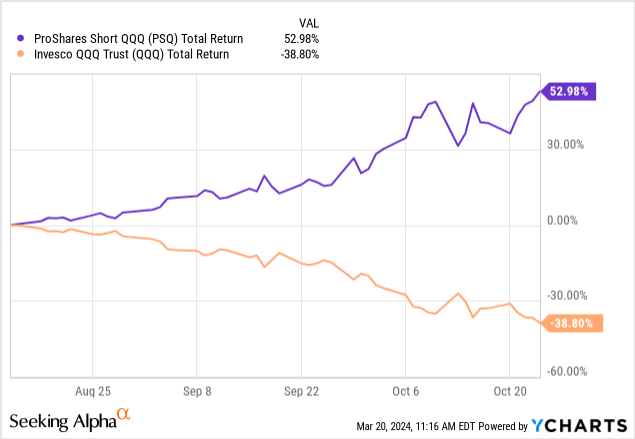
YCharts - PSQ vs. QQQ, Total Returns, August to October 2008
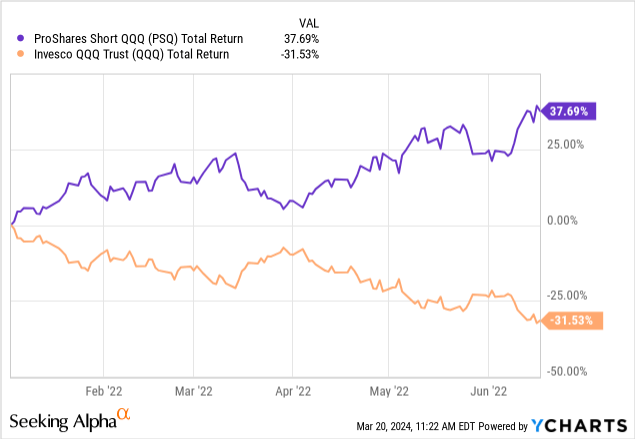
YCharts - PSQ vs. QQQ, Total Returns, January to June 2022
I rate PSQ a Buy for those wanting to hedge portfolio gains. I am holding it in my brokerage account to offset equity longs and reduce my net-long exposure to the market's general price direction this year. Note: ProShares Short QQQ is one of numerous positions I am using to reduce net-long exposure, including other inverse ETFs and out-of-the-money index put options (as crash insurance).
Thanks for reading. Please consider this article a first step in your due diligence process. Consulting with a registered and experienced investment advisor is recommended before making any trade.