
Jeremy Poland
Jeremy Poland
Investing in the right sector is critical to outperforming over time, but within that, so too is considering whether you want large or small-cap exposure within that sector. When it comes to energy exchange-traded funds, or ETFs, the Invesco S&P SmallCap Energy ETF (NASDAQ:PSCE) stands out due to its unique focus on small-capitalization U.S. energy companies. PSCE is structured around the S&P SmallCap 600® Capped Energy Index. The fund typically invests a minimum of 90% of its total assets in securities belonging to small-capitalization U.S. energy firms that form this index. The index itself is specifically designed to measure the performance of common stocks of U.S. energy companies.
These corporations are primarily involved in the production, distribution, or service provision of energy-related commodities, such as oil and gas exploration, production, refining, oil services, and pipelines. The index is a subset of the S&P SmallCap 600® Index, which represents the U.S. small-cap market. Both the fund and the index are rebalanced and reconstituted quarterly.
If you're bullish on Energy, and bullish on small-caps outperforming large-caps, this is a fund worth considering.
PSCE is listed on the NASDAQ and has a weighted market capitalization of $2.7 billion. The ETF has an annual management fee of 0.29% and a total expense ratio of 0.29%. The fund had a price-to-book (P/B) ratio of 1.33 and a price-to-earnings (P/E) ratio of 8.33. This is fundamentally a very cheap part of the marketplace.
The fund only has 30 holdings, making it fairly concentrated.
invesco.com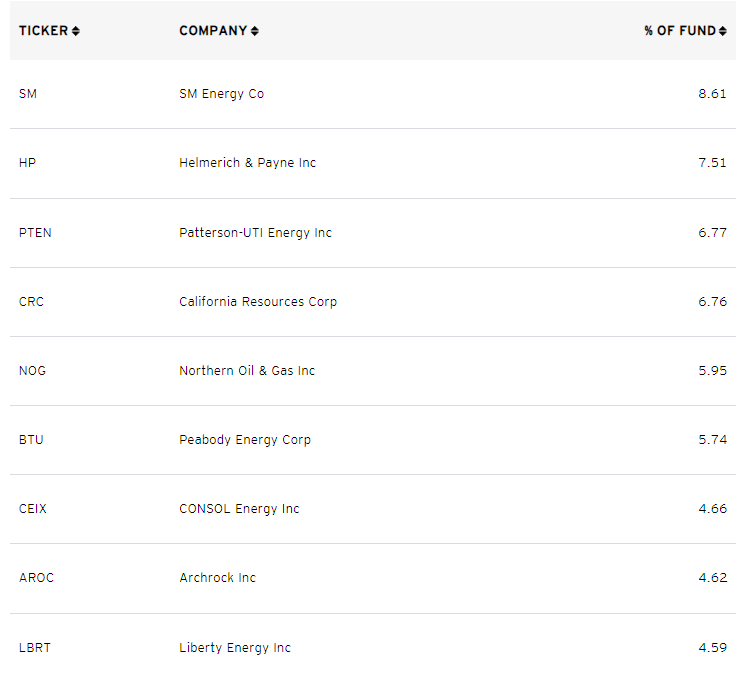
The ETF is primarily invested in the US energy sector, with 100% of its holdings being in this sector. Within the energy sector, the fund is distributed among various sub-sectors:
invesco.com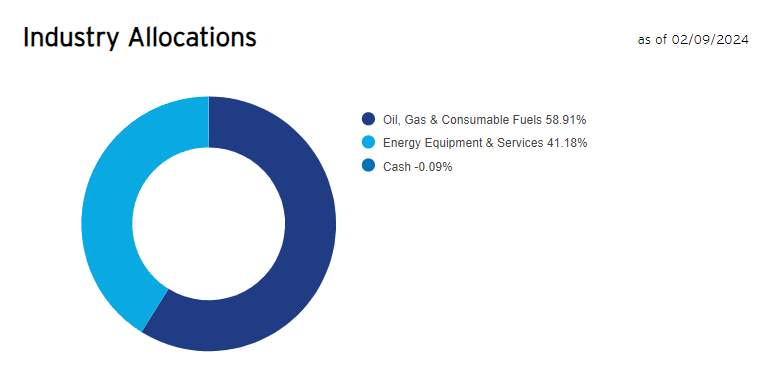
There aren't really any pure play direct small-cap Energy ETFs out there. We can compare it to the behemoth large-cap ETF Energy Select Sector SPDR® Fund ETF (XLE), though. Both PSCE and XLE focus on different segments of the market and have distinct characteristics. XLE, managed by State Street, tracks the Energy Select Sector Index, comprising companies from the energy sector within the S&P 500, thus focusing on larger, more established energy companies. It was launched much earlier, on December 16, 1998, and like PSCE, it is also passively managed with the objective of mirroring its benchmark index's performance.
When it comes to their financial metrics, PSCE and XLE display differences in expense ratios, volatility, and performance metrics, which could influence an investor's decision based on their risk tolerance and investment goals. PSCE has a higher expense ratio of 0.29% compared to XLE's more cost-efficient 0.09%, indicating that it is more expensive to hold PSCE than XLE in terms of annual operating expenses.
Additionally, PSCE exhibits a higher volatility rate, suggesting that PSCE's price experiences larger fluctuations and is considered riskier than XLE. This, of course, makes sense given the small-cap focus. When we look at the price ratio of PSCE to XLE, we can see it's still in a downtrend but might be due for reversal, suggesting outperformance ahead.
stockcharts.com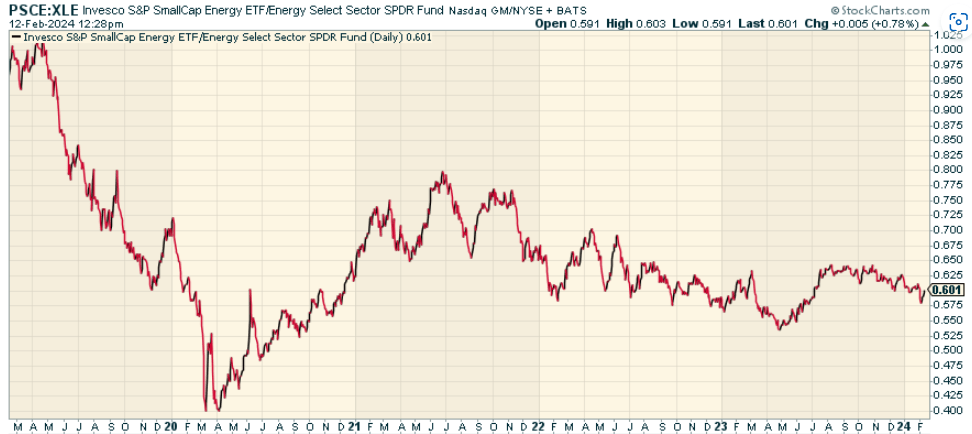
Like with any investment, there are pros and cons to investing in the Invesco S&P SmallCap Energy ETF. One of the advantages is the fund's exposure to small-capitalization U.S. energy companies, which can offer substantial growth potential. Additionally, the fund's focus on companies within the energy sector allows investors to benefit from industry-specific trends and developments.
However, there are also risks to consider. Small-capitalization companies are often more vulnerable to adverse developments and may be more volatile than larger companies. Furthermore, investments in a particular sector, such as energy, are subject to industry-specific risks and are more susceptible to market volatility than more diversified investments.
I like both energy stocks and small-cap tilts here. I think Invesco S&P SmallCap Energy ETF is a product worth considering, just be mindful of volatility. It's a cheap part of the marketplace fundamentally, and whenever AI mania dies down, I suspect undervalued parts of the marketplace finally will get some love.