
apomares
apomares
The Invesco Dynamic Pharmaceuticals ETF (NYSEARCA:PJP), is a passively managed exchange traded fund. It seeks to track the investment performance of the Dynamic Pharmaceutical Intellidex Index by investing at least 90% of its assets in the index’s constituents. The fund provides exposure to various types of pharmaceutical companies across the market capitalization spectrum, including big, specialty and general pharmaceutical firms. The operations of these firms will include drug research and development, manufacturing, and distribution.
In our view, investing in the pharmaceutical industry is particularly difficult, as having a background in biology, chemistry and medicine can be necessary to properly evaluate business models and understand specific products firms are hoping will be successful. Additionally, pharmaceutical industry returns have lagged the overall market, not providing an adequate return on investment when considering the difficulty in understanding the industry. The industry faces macro headwinds as well, and an increasingly competitive environment. Lastly, compared to its competitors, PJP is overvalued, has lower expected earnings growth, and is more expensive.
Pharmaceuticals face one, somewhat, unique headwind compared to other industries. Rising inflation is increasing costs for businesses throughout the economy, and many businesses have raised their prices in response, and some have increased their margins. However, with the implementation of the Inflation Reduction Act coming this year, Medicare will now be able to negotiate drug prices, meaning that prices for some of the most widely used drugs are poised to fall, which will squeeze margins for these firms.
Additionally, more companies and products are fighting over the same spaces. Very difficult decisions must be made over which types of therapies companies pursue. Putting R&D dollars into a specialized area can allow a firm to take over that market once they pass trials, but also can have much smaller pools of patients. Going into a larger and more validated market presents less up-front risk, but the abundance of competition also lowers returns. Predicting which companies have the right management in place to make these decisions is extremely difficult. Below shows some of the most competitive spaces within the industry.
PwC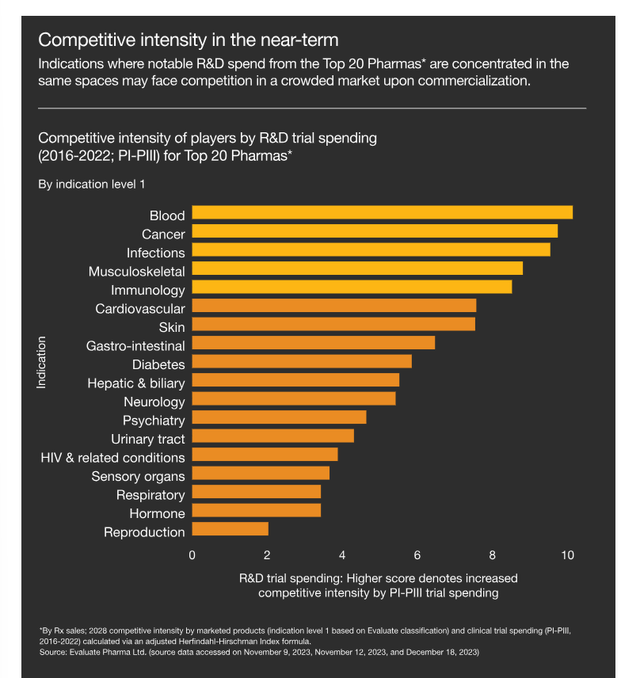
Pharmaceutical returns have lagged the market significantly over the last several years, despite breakthroughs in new technology. We feel investing directly in this space when considering the amount of product and business knowledge required may not be worth it.
Ycharts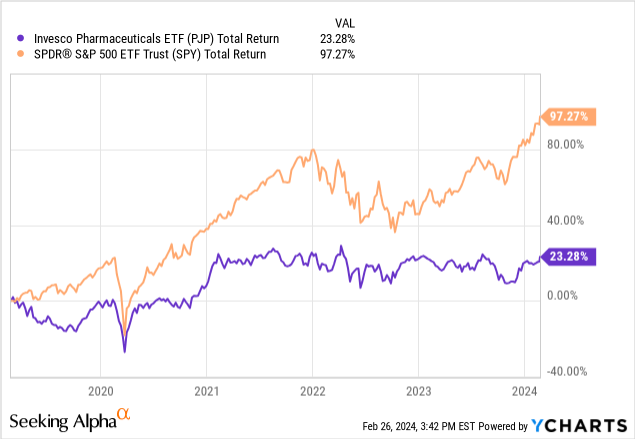
Name | Weight (%) |
Eli Lilly & Co | 6.563 |
AbbVie Inc | 6.562 |
Merck & Co Inc | 6.425 |
Abbott Laboratories | 6.016 |
Amgen Inc | 5.554 |
Johnson & Johnson | 5.502 |
Gilead Sciences Inc | 4.932 |
Pfizer Inc | 4.719 |
Ligand Pharmaceuticals Inc | 3.992 |
Bausch Health Cos Inc | 3.987 |
Eli Lilly (LLY) is a 145-year-old firm that came to prominence due to its clinical depression treatment drugs such a Prozac and is currently the largest pharmaceutical company in the world by market cap. The firm has a TTM P/E ratio of 135, which is 5.7x higher than the industry average, according to Ycharts data. The firm’s robust drug pipeline, particularly with obesity and cardiovascular drugs, has helped lift it to extreme valuations. AbbVie Inc (ABBV) is the 5th largest pharmaceutical firm in the world, its primary product is Humira, which has been approved to treat a variety of autoimmune diseases. Humira has seen a recent hit to its sales due to similar products becoming available, however the firm has continued increasing in value due to two newer, faster growing products.
Symbol | PPH | IHE | PJP |
Name | VanEck Pharmaceutical ETF | iShares US Pharmaceuticals ETF | Invesco Pharmaceuticals ETF |
Inception Date | 12/20/2011 | 5/1/2006 | 6/23/2005 |
Total Assets Under Management | $516,011,793 | $683,073,122 | $273,571,434 |
Weighted Average PE Ratio | 25.8 | 28.8 | 33.2 |
Forecasted 5 Year Earnings Growth | 8.90% | 9.60% | 7.60% |
Forecasted Dividend Yield | 2.30% | 2.10% | 1.50% |
Dividend Frequency | Quarterly | Quarterly | Quarterly |
Net Expense Ratio | 0.36% | 0.40% | 0.57% |
We can see that PJP fares worse on multiple metrics compared to the VanEck Pharmaceutical ETF (PPH) and the iShares US Pharmaceuticals ETF (IHE). PJP has a significantly higher valuation, while also having lower forecasted earnings, a lower dividend yield, less assets, and higher fees.
Lack of industry knowledge is one of the biggest risks when it comes to pharmaceuticals investing. Scientific expertise is important to understanding whether certain products will be successful in getting through clinical trials and regulators, and differentiating levels of quality between similar products. Business knowledge is also important, which includes understanding patent law and how companies should choose what segments and diseases they should create treatments for.
Regulatory risk also plays a big role. In the U.S. the Food and Drug Administration is extremely powerful and have the responsibility of ensuring that drugs are not only safe, but also effective. This can pose a high bar for getting new drugs approved, and cause firms to invest billions of dollars into a new product before ever receiving revenue from it, and there is still a risk the drug is never approved. Recent studies found that development costs now exceed $2 billion for new therapies. This steep cost can create significant barriers to entry that can make it difficult for smaller and more innovative firms that lack cash to be successful.
Due to the difficulty investing in the pharmaceutical industry, the industry’s persistent underperformance compared to the overall market, and current headwinds, we see investing in industry ETFs as risky. When it comes to PJP in particular, the various metrics that we looked at indicate that we do not want to invest in the fund if we were to try our hand at an industry ETF. We rate PJP a sell.