
tum3123
tum3123
Originally posted on March 19, 2024
The VanEck Emerging Markets Bond Fund (the Fund) was up 0.2% in February in line with its benchmark, the 50% J.P. Morgan Government Bond Index-Emerging Markets (GBI-EM) Global Diversified and 50% J.P. Morgan Emerging Markets Bond Index (EMBI). Year to date, the Fund is outperforming its benchmark by around 30 basis points (bps). From a country perspective, Zambia and Ecuador were winners, Egypt (not owning it) was a loser. We increased exposure to local currency (due to increases in Brazil and the Philippines) and increased duration (via hard-currency bonds), in line with the market now pricing out a lot of the Fed’s cuts. We end February with carry of 7.1%, yield to worst of 8.6%, duration of 5.5, and 50% of the Fund in local currency. Our biggest exposures are Brazil (local), Mexico (local and hard), Indonesia (local), Colombia (local), and Poland (local).
| Average Annual Total Returns* (%) as of February 29, 2024 | |||||||
| 1 Month | 3 Month | YTD | 1 Year | 3 Year | 5 Year | 10 Year | |
| Class A: NAV (Inception 07/09/12) | 0.07 | 2.88 | -0.96 | 7.63 | -0.60 | 2.86 | 1.57 |
| Class A: Maximum 5.75% load | -5.69 | -3.03 | -6.66 | 1.44 | -2.54 | 1.65 | 0.97 |
| Class I: NAV (Inception 07/09/12) | 0.06 | 2.99 | -0.78 | 8.09 | -0.26 | 3.18 | 1.88 |
| Class Y: NAV (Inception 07/09/12) | 0.25 | 2.99 | -0.78 | 7.95 | -0.33 | 3.12 | 1.81 |
| 50% GBI-EM/50% EMBI | 0.20 | 2.86 | -1.07 | 9.72 | -2.45 | 0.28 | 1.52 |
| Average Annual Total Returns* (%) as of December 31, 2023 | |||||||
| 1 Month | 3 Month | YTD | 1 Year | 3 Year | 5 Year | 10 Year | |
| Class A: NAV (Inception 07/09/12) | 3.88 | 8.36 | 10.91 | 10.91 | -0.79 | 4.14 | 1.80 |
| Class A: Maximum 5.75% load | -2.09 | 2.13 | 4.53 | 4.53 | -2.73 | 2.92 | 1.20 |
| Class I: NAV (Inception 07/09/12) | 3.81 | 8.43 | 10.97 | 10.97 | -0.49 | 4.46 | 2.10 |
| Class Y: NAV (Inception 07/09/12) | 3.80 | 8.40 | 11.03 | 11.03 | -0.57 | 4.39 | 2.03 |
| 50% GBI-EM/50% EMBI | 3.97 | 8.63 | 11.95 | 11.95 | -3.31 | 1.46 | 1.71 |
| * Returns less than one year are not annualized. Expenses: Class A: Gross 2.55%, Net 1.22%; Class I: Gross 2.51%, Net 0.87%; Class Y: Gross 2.91%, Net 0.97%. Expenses are capped contractually until 05/01/24 at 1.25% for Class A, 0.95% for Class I, 1.00% for Class Y. Caps excluding acquired fund fees and expenses, interest, trading, dividends, and interest payments of securities sold short, taxes, and extraordinary expenses. The performance data quoted represents past performance. Past performance is not a guarantee of future results. Investment return and principal value of an investment will fluctuate so that an investor’s shares, when redeemed, may be worth more or less than their original cost. Performance may be lower or higher than performance data quoted. Please call 800.826.2333 or visit vaneck.com for performance current to the most recent month ended. The “Net Asset Value” (NAV) of a Fund is determined at the close of each business day, and represents the dollar value of one share of the fund; it is calculated by taking the total assets of the fund, subtracting total liabilities, and dividing by the total number of shares outstanding. The NAV is not necessarily the same as the ETF’s intraday trading value. Investors should not expect to buy or sell shares at NAV. |
Fun with the Fed Funicular. At the start of this year, the market priced in 6 Fed rate cuts in 2024, which has now reverted to back to the original consensus of 3 cuts. The market has been back and forth between 3 and 6 cuts, just like a funicular. One extremely simple implication for a funicular with only two stops is that, with the current station being 3 cuts, there’s now room to go back to 6! A more interesting and complex implication, though, is that it takes time for this funicular to go back-and-forth, and while it is doing so, it increases the risk that inflation base-effects fade and nascent inflation and inflation expectations creep into Fed thinking (there are wars and tariffs about). The odds of a new stop on the funicular have logically risen. Moving forward, though, this also logically means that the odds of a mistaken rate cut (too early or too large) have risen. This is a bit cute and arguably time-inconsistent. Our only point is that while we see the upside risks to emerging markets (EM) currencies and EM bonds from the start of a Fed rate cutting cycle and are positioned appropriately, everyone else also sees it, so you have to be aware of each step on the path. Navigating the path is often the best one can do. Obviously, this all needs to fit into a formal process, but lucky us, Bayes exists for exactly these purposes. Rather than getting into Bayes, we’ll say that we’re worried about a contingent probability. Getting very specific, we think the implications are as follows:
Holy debt-debasement thesis-confirmation, Batman! We’ve been pounding the table for many years now about how “fiscal dominance” is driving everything in markets. We even finally wrote a stand-alone white paper on it. The thesis was that the dollar was entering new territory, which created even greater alpha opportunities in EM bonds. I assume it is obvious to our readers that new record prices for gold and bitcoin smack of debt-debasement, too, also noted in the piece. It’s on, and EM debt has winners in the form of government bonds with high real yields backed by strong fiscal policy. It’s not just gold and bitcoin which are winners! Central banks are not just buying gold, they are buying EM local-currency government bonds (wouldn’t you, especially if the alternative was lower-yielding Treasuries?). By the way, did you know that the CBO projects no recession for the next 10 years and assumes 10-year Treasuries will have lower yields than currently?
Still not allowed to talk at cocktail parties. War and politics are important facts that markets try to ignore. This is wrong – these are analyzable events for which there may be appropriate portfolio responses. You need a central case, but you also need to do scenario analysis, whether you like the stories or not. War is inflationary, and US politics look likely to generate inflation risks. You may not get joy discussing these at a cocktail party, but markets don’t ignore reality. The conclusions are often simple and easily optimized. It just takes courage, not brains. For example, such a concern as ours above translates into caution on duration, clearly, and ours is currently right on top of our benchmark’s duration. In addition, Chinese corporate bonds are highly illiquid and thus subject to top-down geopolitical risk headlines…so we’ve largely taken profit on these this past month. These are random examples, but the point is that rarely do major portfolio constraints arise from these scenarios, just challenges and opportunities. Anyway, our key point on geopolitics remains that is the developed market (DM) economies that are suffering from war, while many EMs are winners because of commodity exports, low debt, independent central banks that pay high real rates, and good economic structure. EM also doesn’t sanction each other’s savings, making their bonds that much safer. Other central banks noticed and are putting EM local currency bonds on their balance sheets (as with gold), as we noted in many of our previous commentaries. US politics are an even more sensitive topic at cocktail parties, but last I checked tariffs are an inflationary tax, and last I checked both parties were essentially out-doing each other on this front. The election is this year; there’s no reason to be “surprised” when those telegraphed outcomes materialize.
Foreign Exchange Holdings in U.S. Dollars, % of allocated reserves
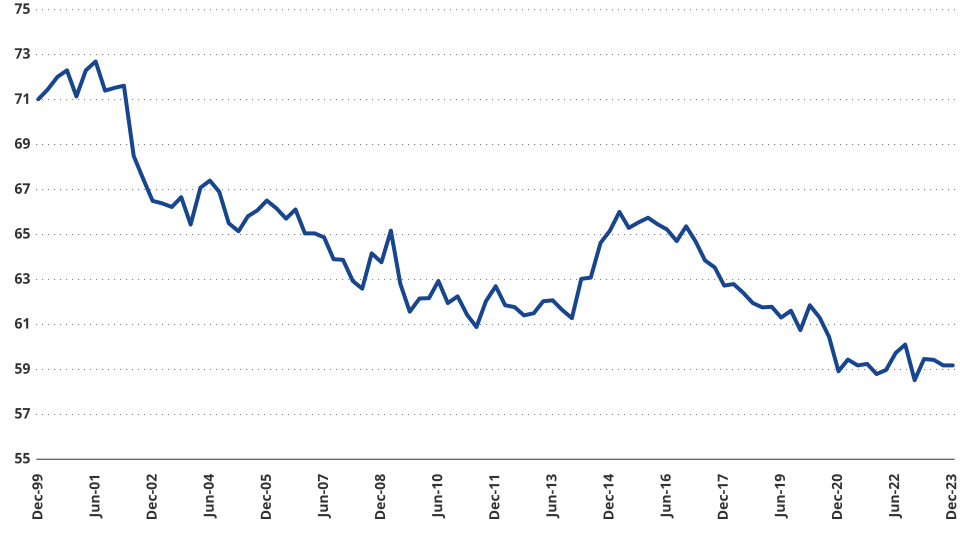
Source: Bloomberg LP; Data as of December 2023.
The changes to our top positions are summarized below. Our largest positions in February were Brazil, Mexico, China, Indonesia, and Colombia:
Disclosures
This is not an offer to buy or sell, or a recommendation to buy or sell any of the securities, financial instruments or digital assets mentioned herein. The information presented does not involve the rendering of personalized investment, financial, legal, tax advice, or any call to action. Certain statements contained herein may constitute projections, forecasts and other forward-looking statements, which do not reflect actual results, are for illustrative purposes only, are valid as of the date of this communication, and are subject to change without notice. Actual future performance of any assets or industries mentioned are unknown. Information provided by third party sources are believed to be reliable and have not been independently verified for accuracy or completeness and cannot be guaranteed. VanEck does not guarantee the accuracy of third party data. The information herein represents the opinion of the author(s), but not necessarily those of VanEck or its other employees.
Duration measures a bond’s sensitivity to interest rate changes that reflects the change in a bond’s price given a change in yield. This duration measure is appropriate for bonds with embedded options. Carry is the benefit or cost for owning an asset. Yield to worst is a measure of the lowest possible yield that can be received on a bond with an early retirement provision. Averages are market weighted. The yields presented do not represent the performance of the Fund. These statistics do not take into account fees and expenses associated with investments of the Fund.
All indices are unmanaged and include the reinvestment of all dividends, but do not reflect the payment of transaction costs, advisory fees or expenses that are associated with an investment in the Fund. Certain indices may take into account withholding taxes. An index’s performance is not illustrative of the Fund’s performance. Indices are not securities in which investments can be made.
The Fund’s benchmark index (50% GBI-EM/50% EMBI) is a blended index consisting of 50% J.P. Morgan Government Bond Index-Emerging Markets (GBI-EM) Global Diversified and 50% J.P. Morgan Emerging Markets Bond Index (EMBI). The J.P. Morgan GBI-EM Global Diversified tracks local currency bonds issued by Emerging Markets governments. The J.P. Morgan EMBI Global Diversified tracks returns for actively traded external debt instruments in emerging markets, and is also J.P. Morgan’s most liquid U.S dollar emerging markets debt benchmark.
Information has been obtained from sources believed to be reliable but J.P. Morgan does not warrant its completeness or accuracy. The Index is used with permission. The index may not be copied, used or distributed without J.P. Morgan’s written approval. Copyright 2023, J.P. Morgan Chase & Co. All rights reserved.
J.P. Morgan GBI-EM Global Diversified Index tracks local currency denominated EM government debt. The index weighting methodology limits the weight of countries with larger debt stocks, with a maximum of 10%.
J.P. Morgan EMBI Global Diversified Index is comprised of U.S. dollar-denominated Brady bonds, Eurobonds, and traded loans issued by emerging markets sovereign and quasi-sovereign entities. The index weighting methodology limits the weight of countries with larger debt stocks.
ICE BofA US Treasury Index racks the performance of EUR denominated sovereign debt publicly issued by the German government in the German domestic or eurobond market.
ICE BofA German Government Index tracks the performance of EUR denominated sovereign debt publicly issued by the German government in the German domestic or eurobond market.
ICE BofA Global Broad Market Index tracks the performance of investment grade debt publicly issued in the major domestic and eurobond markets, including sovereign, quasi-government, corporate, securitized and collateralized securities.
ICE BofA Japan Government Index tracks the performance of JPY denominated sovereign debt publicly issued by the Japanese government in its domestic market.
ICE BofA UK Gilt Index tracks the performance of JPY denominated sovereign debt publicly issued by the Japanese government in its domestic market.
You can lose money by investing in the Fund. Any investment in the Fund should be part of an overall investment program, not a complete program. The Fund is subject to risks which may include, but are not limited to, risks associated with active management, credit, credit-linked notes, currency management strategies, derivatives, emerging market issuers, energy sector, ESG investing strategy, foreign currency, foreign securities, hedging, high portfolio turnover, high yield securities, interest rate, LIBOR replacement, market, non-diversified, operational, restricted securities, investing in other funds, sovereign bond, and special risk considerations of investing in Latin American issuers, all of which may adversely affect the Fund. Emerging market issuers and foreign securities may be subject to securities markets, political and economic, investment and repatriation restrictions, different rules and regulations, less publicly available financial information, foreign currency and exchange rates, operational and settlement, and corporate and securities laws risks. Derivatives may involve certain costs and risks such as liquidity, interest rate, and the risk that a position could not be closed when most advantageous.
ESG integration is the practice of incorporating material environmental, social and governance (ESG) information or insights alongside traditional measures into the investment decision process to improve long term financial outcomes of portfolios. Unless otherwise stated within an active investment strategy’s investment objective, inclusion of this statement does not imply that an active investment strategy has an ESG-aligned investment objective, but rather describes how ESG information may be integrated into the overall investment process.
Investors should consider the Fund’s investment objective, risks, charges, and expenses of the investment company carefully before investing. Bond and bond funds will decrease in value as interest rates rise. The prospectus and summary prospectus contain this and other information. Please read them carefully before investing. Please call 800.826.2333 or visit vaneck.com for performance information current to the most recent month end and for a free prospectus and summary prospectus.
No part of this material may be reproduced in any form, or referred to in any other publication, without express written permission of Van Eck Securities Corporation.
© 2024 Van Eck Securities Corporation, Distributor, a wholly-owned subsidiary of Van Eck Associates Corporation.
Editor's Note: The summary bullets for this article were chosen by Seeking Alpha editors.
Editor's Note: This article discusses one or more securities that do not trade on a major U.S. exchange. Please be aware of the risks associated with these stocks.