
your_photo
your_photo
Cambium Networks Corporation (NASDAQ:CMBM) is active in the telecom industry, where it offers fixed wireless and WiFi services. Cambium is a former division of Motorola, from which it was spun off in 2011. Cambium was one of the high-flying stocks of 2021 on surging demand, but in the past year in particular, it has had a terrible run on the stock exchange with a price decline in excess of 70 %:
Google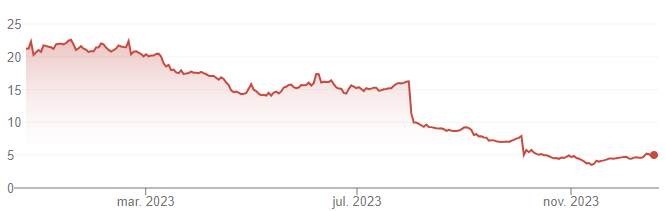
In this analysis, I examine what caused Cambium's poor performance, and I take a look at some quantitative factors pointing to future outperformance. I also evaluate steps management has taken to address the issues.
Based on my findings as outlined below, I'm issuing a Buy rating for Cambium.
Data consumption is growing worldwide, and companies providing the necessary network infrastructure to support this secular trend like Cambium generally benefit in the process. The data consumption which grew through the COVID pandemic benefitted Cambium, and the share price advanced rapidly during the first half of that year.
Things have turned on Cambium recently, though. In early August 2023, Cambium was down ~35 % in a single day as J. P. Morgan downgraded the issue from "Neutral" to "Underweight". This came as the company cut its full-year outlook, appointed a new CEO, and as Q2 results missed consensus estimates.
In October 2023, the company disappointed again: the Q3 2023 outlook was lowered substantially, underpinning a decline in demand from previous highs. The market reacted promptly and hammered the stock another 20 %. Since then, shares have sat more or less idle on the exchange. In summary, it appears that much of Cambium's drop can be attributed to slowing demand, perhaps in part for purely cyclical reasons, and a subsequent "turn" against the issue by the market.
With even the most bullish analysts on Seeking Alpha having turned against Cambium and with the market fire selling the stock, perhaps now is the time to take a serious look into buying.
Some numbers that I watch would suggest it.
Cambium currently trades at an enterprise value (EV) to revenue (R) ratio of 0.54. The EV/R ratio expresses the amount that a buyer for control would have to pay for full ownership of all assets "cleared" of other equity holders and bondholders, relative to the revenue produced by the enterprise. I'm using the EV/R ratio because more traditional metrics - such as price-to-earnings (P/E) or price-to-free cash flow (PFCF) often isn't meaningful when analyzing distressed enterprises.
As seen, Cambium's revenue is almost double the price a buyer for control would have to pay - and that makes Cambium's EV/R ratio well below certain of its peers, including PCTEL, Inc. (PCTI) at an EV/R of 1.22 and Sangoma Technologies Corporation (SANG) at an EV/R of 0.80, although Cambium's EV/R ratio is above certain other of its competitors, including Silicom Ltd. (SILC) at an EV/R ratio of 0.49.
What's more, Cambium is a small-cap company. I believe small-caps are more likely to be overdiscounted - statistically, and seen as a group - by the market in a downturn as the one that has occurred to Cambium.
Cambium's new CEO, Morgan Kurk, delivered an honest statement on the most recent earnings call with investors. Speaking on his view of Cambium's past, he said:
... I've concluded we often try to do too much, spreading ourselves too thin, so I am implementing a "focus and simplify" strategy where we build core platforms that can be used to create multiple solutions. - Morgan Kurk, Cambium Networks CEO
Talking about what this new strategy involved, the CEO added:
This strategy improves efficiency in engineering, reduces time to market, and lowers product and support costs. Focus is the key to success and requires the strength to decide what to do and what not to do. - Morgan Kurk, Cambium Networks CEO
So it appears that management's overall objective going forward - in response to the poor Q3 2023 results that led to the most recent share price drop - is to focus on pricing and simplifying product lines.
In the news release presenting the disappointing Q3 2023 results, the company pointed to (i.a.) delayed government defense orders (due to budgetary timing issues) as a major contributor to the performance issues. The company also said that they now saw the delays affecting the defense contracts to now be resolving in Q4 2023 (the upcoming quarter). Management also pointed to inventory build-up, which it also said it expected to resolve in the first half of 2024.
Going forward, management seems intent on expanding its footprint in the hospitality sector: In the Caribbean and Latin America region, Cambium posted two important wins during the past quarter. A hotel in Puerto Rico, The Fairfield Luquillo Beach, started implementing Cambium's Wi-Fi 6 and switching solution, and Cambium was selected for the AC Santiago in the Dominican Republic.
With management's focus on simplifying the business, pricing services right for the market, a resolve to work through the issues that caused recent poor performance, and a strengthening focus on the hospitality sector, it appears management is on track to turn things around. That doesn't necessarily mean returning to the kind of demand we saw during the COVID pandemic, however.
The important thing to note is that management's actions appear to support the quantitative factors signaling a buying opportunity.
I see two main business related risks that could get in the way of a satisfactory investment result from Cambium: First of all the competitive environment, and secondly the negative cash flow the company produces.
In terms of competition, Cambium has several competitors that do more or less the same thing as Cambium, including the ones mentioned earlier. This creates an environment where pricing is key - as acknowledged by the management. It keeps a pressure on margins.
For FY2022 and for the past trailing twelve months (TTM), Cambium has produced negative cash flow. This comes after having produced almost $25 million of free cash flow in 2021 and more than $50 million in 2020. If the negative cash flow continues, it could hamper Cambium's ability to make the necessary adjustments that management has outlined - whereas if Cambium returns to making the kind of free cash flow it did a couple of years ago, then against a market cap of ~$137 million it's clearly very cheaply priced.
With an issue like Cambium, I would always diversify to manage risk. When buying a distressed issue very cheaply, there's a huge potential upside - but also a downside risk that should be managed. To handle the risk, I would hold Cambium in a well-diversified portfolio that includes several other opportunities similar to Cambium.
Cambium is one of the high flyers of COVID that has since turned sour. The stock price is down more than 70 % in the past year.
But Cambium is a small cap company, and the market can easily overreact with these issues. Certainly, with an EV/R ratio of ~0.5, a buyer for control could cheaply scoop of this enterprise. I'm not speculating that someone will, but the stock is cheap on a statistical level and individual investors could benefit from buying at this price.
Management is aware of the challenges that Cambium faces, and it appears ready to tackle the issues. There's a focus on pricing, bringing down inventory and expansions within hospitality.
To manage the risk that any individual distressed security entails, I suggest buying it for a well-diversified portfolio that contains similar issues.