Maxxa_Satori
Maxxa_Satori
Impinj (NASDAQ:PI), a provider of RFID hardware and software solutions, struggled for much of 2023 with the stock suffering major losses, but PI has been able to recoup most of the losses with a powerful rally that has seen the stock more than double in value. However, the rally stalled in recent weeks with resistance in the way. PI needed a catalyst to break through and that is what it appears to have gotten with a favorable legal settlement. Why will be covered next.
A previous article from July 2023 rated PI a hold after concluding that even though the stock price had already been cut in half in the preceding months, there were several reasons why the bottom was not likely to be in. PI, for instance, was likely to experience further pressure on the top and the bottom line. In turn, non-existent growth goes against the very notion of why a stock like PI is bought, which is for its potential growth.
Source: Thinkorswim app
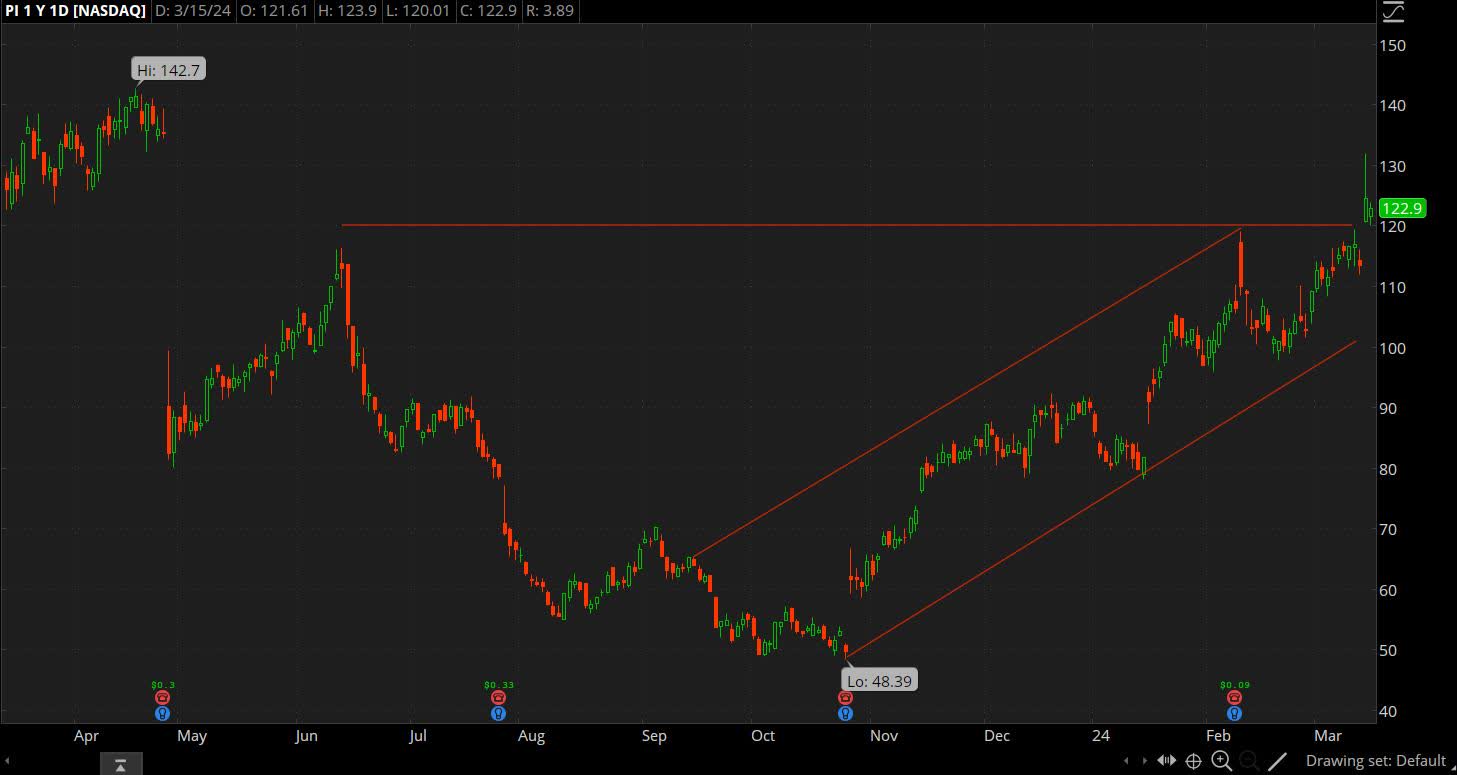
The chart above shows how the stock continued to hit new 52-week lows for the next three months or so until it bottomed at $48.39 on October 25, 2023. PI released its Q3 FY2023 report on this day and the report was able to put recent market concerns to rest with an upbeat outlook. The stock rose almost 24% on October 26, setting off a rally that continued into 2024.
The stock has more than doubled in value during the ongoing rally. However, the stock struggled to go higher in recent weeks. The rally managed to get the stock to a high of $119.40 on March 12, a month after it got to $119.11 on February 9, but the stock struggled to get past the $115-120 region as shown in the previous chart. Note how the $115-120 region is also where the stock encountered problems in 2023.
There is a reason for this. The repeated topping out in the same region points to the presence of resistance. It’s thus worth pointing out that PI fell from a high of $142.70 in April 2023 to a low of $48.39 in October 2023. The 76.4% Fibonacci retracement of this downtrend is $120.44, which could help explain why PI encountered resistance where it did.
PI found itself in a stalemate and it needed something to power it past resistance. PI got this on March 13 when PI announced a legal settlement with NXP Semiconductor (NXPI) regarding patent litigation. According to the terms of the agreement, which will last 10 years, PI will receive a one-time payment of $45M from NXPI as detailed in a Form 8-K from PI. In addition, PI will receive annual license payments of at least $15M starting on April 1, 2024, which will increase in each subsequent year depending on various conditions.
The stock jumped as much as 16% on March 14 to $132, which is well above resistance at $115-120. Still, the stock needs to stay above resistance for multiple days to confirm resistance has indeed been broken, especially since the stock has pulled back. The stock closed off the highs on the 14th and it fell further on March 15 when the stock closed at $122.90.
What happens in the following days could make a big difference in determining what the stock does next. If the stock stays above the previously identified resistance level, or better yet, bounces off past resistance, then the path looks clear for a run higher, possibly to the $140-145 region, which is where the stock peaked in early 2023.
As mentioned previously, PI is a stock bought for its potential for growth. PI is a vendor of RFID hardware and related services and since the RFID market has the potential to be enormous, PI is seen as having vast growth potential, much of it still untapped. However, the growth story took a big hit in the past year when PI was confronted with a drop in demand, which led to all sorts of adverse consequences like excess inventories and a drop in the top and the bottom line at PI.
But the numbers suggest PI is past the trough and that was before the latest settlement with NXPI. In Q4, revenue declined by 7.8% YoY, but it also increased by 8.7% QoQ to $70.7M. Similarly, non-GAAP EPS was still way down YoY, but up QoQ to $2.5M or $0.09 per share. In terms of GAAP, PI finished Q4 with a net loss of $15.2M or $0.56 a share. The main difference between the GAAP and non-GAAP number is stock-compensation expense in the amount of $12.3M, which GAAP includes, but non-GAAP does not.
PI finished with $281.86M of long-term debt on the balance sheet, slightly up from $280.24M a year ago, and partially offset by cash, cash equivalents and short-term investments of $113.23M. Also worth noting is $463.9M of paid-in capital and $430.15M of accumulated deficit on the balance sheet. The table below shows how the numbers for Q4 FY2023 appear to be recovering from the downturn.
(Unit: $1000, except EPS, margins and shares) | |||||
(GAAP) | Q4 FY2023 | Q3 FY2023 | Q4 FY2022 | QoQ | YoY |
Revenue | 70,651 | 65,005 | 76,590 | 8.69% | (7.75%) |
Gross margin | 47.9% | 47.3% | 52.4% | 60bps | (450bps) |
Income (loss) from operations | (14,839) | (15,834) | 56 | - | - |
Net income (loss) | (15,180) | (15,762) | (118) | - | - |
EPS | (0.56) | (0.59) | (0.00) | - | - |
Weighted-average # shares | 27,089K | 26,920K | 26,005K | 0.63% | 4.17% |
(Non-GAAP) | |||||
Gross margin | 50.9% | 50.5% | 53.8% | 40bps | (290bps) |
Adjusted EBITDA | 2,953 | 257 | 11,755 | 1049.03% | (74.88%) |
Net income | 2,502 | 122 | 10,492 | 1950.82% | (76.15%) |
EPS | 0.09 | 0.00 | 0.37 | - | (75.68%) |
Weighted-average # shares | 28,344K | 28,116K | 28,152K | 0.81% | 0.68% |
Source: PI Form 8-K
The early part of FY2023 was much better since the downturn reared its head as the year was already well underway. This made it possible for FY2023 to finish with record revenue of $307.5M, which includes $85.9M in Q1 and $86M in Q2, up 19.3% YoY despite the downturn. On the other hand, non-GAAP EPS declined by 19.5% YoY to $0.70 and PI ended up with a bigger GAAP loss of $43.5M or $1.62 per share in FY2023. Note also how the number of outstanding shares rose YoY.
(Unit: $1000, except EPS, margins and shares) | |||
(GAAP) | FY2023 | FY2022 | YoY |
Revenue | 307,539 | 257,800 | 19.29% |
Gross margin | 49.4% | 53.5% | (410bps) |
Income (loss) from operations | (43,484) | (19,479) | - |
Net income (loss) | (43,366) | (24,301) | - |
EPS | (1.62) | (0.95) | - |
Weighted-average # shares | 26,752K | 25,539K | 4.75% |
(Non-GAAP) | |||
Gross margin | 51.9% | 55.5% | (360bps) |
Adjusted EBITDA | 21,785 | 28,906 | (24.64%) |
Net income | 19,803 | 23,842 | (16.94%) |
EPS | 0.70 | 0.87 | (19.54%) |
Weighted-average # shares | 28,384K | 27,477K | 3.30% |
Source: PI Form 10-K
Guidance calls for Q1 FY2024 revenue of $72-75M, a decline of 14.4% YoY at the midpoint. The forecast calls for non-GAAP EPS of $0.08-0.13, a decline of 65% YoY at the midpoint, and a GAAP loss of $0.53-0.59 per share in Q1 FY2024. up from a loss of $0.17 in Q1 FY2023. Note that PI is going up again tough comps in Q1 FY2023, which will continue in Q2 FY2023.
(GAAP) | Q1 FY2024 (guidance) | Q1 FY2023 | YoY (midpoint) |
Revenue | $72.0-75.0M | $85.9M | (14.44%) |
Net income (loss) | ($14.5-16.0M) | ($4.4M) | - |
EPS | ($0.53-0.59) | ($0.17) | - |
Weighted-average # shares | 27.2-27.4M | 26.3M | 3.80% |
(Non-GAAP) | |||
Adjusted EBITDA | $3.0-4.5M | $8.6M | (56.40%) |
Net income (loss) | $2.2-3.7M | $8.7M | (66.09%) |
EPS | $0.08-0.13 | $0.30 | (65.00%) |
Weighted-average # shares | 28.4-28.6M | 28.6M | (0.35%) |
Source: PI Form 8-K
Keep in mind that this guidance preceded the legal settlement with NXPI. The one-time payment from NXPI should raise Q1 GAAP income by $45M, which means PI could break even, if not a small loss or profit. The $15M license payment will not affect Q1.
Management added some color to the latest guidance. PI sees demand getting better, but it is too early to say the downturn is over. From the Q4 earnings call:
“So, we guide one quarter at a time as you know, and making predictions at this point in time relative to overall 2024 is quite difficult.
You've probably heard some of our partners talk about 2024 overall. I'd say they potentially see some macro pickup in the back half of the year. If that macro improvement actually happens, then we see strength in the back half of the year as well and the potential for gains as we have seen in other years. But a lot depends on what happens in the macro environment.
I'm not willing to call yet that we're going to see that pick up in the back half of the year because, as I said in my prepared remarks, it's a bit too early for us to call the downturn over, but I'm guardedly optimistic for the back half of the year. And if it picks up, we're going to see it in the endpoint IC volumes.
And as I said, you know green shoots -- green shoots look greener. So let's hope those green shoots continue growing.”
Source: PI earnings call
Nonetheless, earnings are expected to improve in FY2024 versus FY2023, especially with the recent settlement. Assuming PI continues to work its way out of the recent downturn and the quarterly results improve sequentially throughout FY2024, then FY2024 revenue is estimated to grow by 7-8% YoY to about $330M.
Such a top line would have led to another GAAP loss, but with PI set to receive a total of $60M from NXPI in FY2024, PI is very likely to end FY2024 with its first GAAP profit since it went public in July 2016 with an estimated $0.75 a share. Keep in mind there are many factors that could affect the final number, including if PI decides to raise additional capital by selling shares.
The impact of the legal settlement in terms of non-GAAP is more tricky because each company can differ in its interpretation of what non-GAAP constitutes, unlike GAAP which is strictly regulated. Still, assuming PI leaves out the $45M from NXPI because it is a one-time payment, but includes the $15M recurring payment, non-GAAP EPS is estimated to come in at around $1.50 in FY2024, or slightly below $1.00 without the $15M from NXPI.
This translates to a non-GAAP forward P/E ratio of 81.9x with the stock closing at $122.90 on March 15 and EPS of $1.50, which most people will probably agree is on the high side. Keep in mind the multiple would have been even higher without the income boost from NXPI. Other methods of valuations are up there as well. For example, PI has a book value of $34,131K with total assets of $359,409K and total liabilities of $325,278K.
This translates to a book value of $1.26 a share with 27.1M shares outstanding, which means PI trades at a price-to-book of 97.5x with a stock price of $122.90 or a market cap of $3.34B. In comparison, the median in the sector is valued at just 3 times book value. PI has immense potential for growth, but to tap into that potential, one has to pay a very steep price not everyone is likely to be keen on.
PI was in the minority among chip stocks by ending 2023 below where it started the year. Yet a strong rally toward the end of the year carried over into 2024. The stock had some problems getting past a resistance level, which caused a temporary pause in the rally, but a settlement with NXPI has pushed the stock above this resistance.
The settlement is in essence an earnings boost for PI. PI can expect a $45M one-time payment and another $15M license payment from NXPI in 2024. PI can expect additional $15M payments in each of the next nine years, which are subject to small increases to be determined at a later time. PI is almost certain to post its first annual GAAP profit in FY2024 with these two payments from NXPI.
Assuming the stock stays above resistance, the path looks clear to getting back to the all-time high of $144.90 in early 2023 before a downtrend in demand caused a collapse in the stock. It’s true the stock has retreated after the initial jump following the settlement, but this is likely due to profit taking, especially with all the recent gains. As long as the stock remains above resistance, the stock is most likely heading higher.
However, there is something to be said of the steep asking price for PI. Multiples for PI are in lofty territory, which may be tough to swallow, considering recent growth issues. The RFID market is intriguing due its potential size, but PI has yet to convert this potential into real profits. PI is not a profitable company, judging by its accumulated deficit of $430.15M on the most recent balance sheet. FY2024 will end with a GAAP profit due to a one-time boost, but more needs to happen or FY2025 will be back in the red.
While there are those who will be long PI with momentum and trend on its side after the NXPI settlement, I am going with neutral on PI. PI is an intriguing stock, but it is just too expensive right now. Still, if multiples are no problem, then long PI certainly is worth considering, especially since the stock looks primed to get back to the highs of early last year.