
SOPA Images/LightRocket via Getty Images
SOPA Images/LightRocket via Getty Images
I've been covering Pacific Biosciences (NASDAQ:PACB) for some time now. The core thesis previously put forth centered on the company's capacity to effectively scale its HiFi long reads products and services. By this measure, PacBio has shown a degree of proficiency.
Seeking Alpha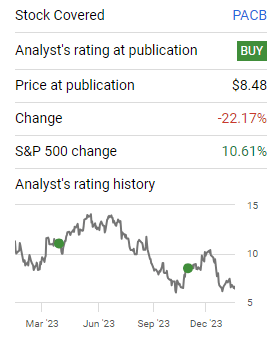
However, this operational success has not translated into the anticipated stock market performance, particularly when assessed against the backdrop of expected revenue growth dynamics. A critical lens on this discrepancy suggests that the broader market's response to the issuance of convertible notes, a strategy similarly pursued by PacBio and notably mired in controversy in the case of Invitae, could be instrumental in understanding PacBio's lackluster performance. I am now downgrading to a Hold. Let's explore it in detail.
In the latest preliminary report from January 8th, PacBio has disclosed a marked uptick in its financial performance, both for the fourth quarter and the entirety of 2023. The company's revenue for Q4 stood at $58.4 million, culminating in an annual total of $200.5 million. These numbers reflect a substantial growth trajectory of 113% for the fourth quarter and 56% for the year, in comparison to the previous periods.
This financial growth appears to be directly linked to the launch of two key products in their portfolio:
Revio: This product is a new entrant in the market, designed to facilitate scalable and precise long-read sequencing. Its introduction suggests an expansion in PacBio's technological capabilities, targeting a niche yet growing segment within genomic research.
Onso: Distinguished by its unparalleled accuracy, this short-read sequencer represents a significant advancement in the field. Its launch indicates PacBio's commitment to innovation and precision in genomic analysis.
PacBio's financial performance in the latest quarter has shown a pronounced increase in instrument revenue, reaching approximately $35.1 million, a substantial rise from $6.1 million in Q4 2022. This spike is indicative of a strong market reception to the company's offerings, particularly the Revio systems, whose installed base of 173 units is expected to generate increasing recurring revenue through consumable sales in subsequent quarters. However, consumables revenue saw a modest increase to approximately $18.9 million from $16.7 million in the same period last year, suggesting a steady demand for these products. Service and other revenues experienced a slight decrease to approximately $4.4 million from $4.6 million in Q4 2022, indicating minor fluctuations in this revenue stream. By the end of December 2023, PacBio's financial reserves, encompassing cash, cash equivalents, and investments, were robust at approximately $631 million.
This financial health supports the company's ambitious guidance, projecting a compound annual revenue growth of 40% to 50% through 2026 from a 2022 revenue base of $128.3 million. Such targets suggest a strategic optimism towards achieving a revenue milestone of over $500 million by 2026, reflecting a positive outlook on the company's growth trajectory.
Seeking Alpha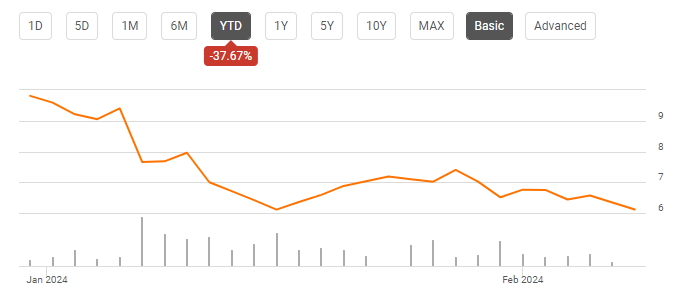
Despite the ostensibly strong report and growth prospects, a nuanced analysis reveals underlying challenges. The company's operational model appears to still be incurring a substantial cash burn, estimated at $200 million annually. This factor, coupled with a tightening market for refinancing-exemplified by the struggles of peers such as Invitae (OTC:NVTA)-paints a more complex picture.
PacBio, akin to Invitae, is navigating the complexities of substantial cash consumption while managing significant debt levels, primarily through convertible notes, which introduces a nuanced layer of risk.
PacBio
At a first glance we might feel comfortable with the fact that this is a convertible issue, but, as always, the devil is in the details. Let's break it down.
The issuance of $900 million in aggregate principal amount of 1.50% Convertible Senior Notes on February 9, 2021, in partnership with SB Northstar LP, marks a no turning back event. These notes, with a maturity date set for February 15, 2028, present a convertible option that allows holders to convert their debt into common stock, subject to specific conditions and at a predefined conversion rate. The initial conversion rate established was 22.9885 shares of common stock per $1,000 principal amount of notes, setting an initial conversion price at $43.50 per share. This conversion mechanism is designed with flexibility, allowing adjustments under certain scenarios.
The financial mechanics and strategic implications of these convertible notes become increasingly significant if the company's stock price were to substantially deviate from the initial conversion price, particularly in a downward trajectory to, for example, $6 per share. Under such circumstances, the attractiveness and viability of converting the debt into equity would be drastically altered, potentially leading to a preference among note holders to seek repurchase at par value, thus imposing a significant cash outlay obligation on PacBio.
This situation necessitates PacBio to earmark substantial liquidity for the redemption of the $900 million principal amount, a task compounded by potential operational or financial challenges mirrored in the depressed stock price.
The repayment obligation, while straightforward in principle, underscores a critical liquidity challenge for PacBio. Given the current cash-burn, the company might face difficulties in generating sufficient cash flows or accessing alternative financing options at the maturity date. This scenario might necessitate exploring strategic alternatives to manage or restructure the debt obligations to mitigate the impact on the company's financial health.
Negotiations for restructuring the convertible notes could take various forms, aiming to align the repayment or conversion terms more closely with the company's current financial reality. Potential restructuring strategies might include extending the maturity dates, reducing the payable interest rates, or adjusting the conversion mechanism to reflect a more realistic stock valuation, potentially making conversion more palatable to note holders or less financially burdensome for the company.
Another avenue could be proposing an exchange offer, where the company offers new securities with modified terms to the note holders. These new terms could feature a longer maturity period, different interest rates, or altered conversion rights, designed to provide PacBio with more manageable financial obligations while offering note holders value retention or recovery prospects.
However, the success of such negotiations heavily depends on the willingness of note holders to accept revised terms, which might involve assuming further risks or accepting losses. The disposition of note holders towards such adjustments will likely vary. In this delicate balance, the company's negotiation leverage and the outcome of these discussions will critically hinge on its ability to present a convincing case for its future growth and financial stability, alongside the intrinsic value and potential upside of accepting the restructured terms. What we know is that these type of situations do not tend to be good for most investors.
The refinancing risk emerges as the principal factor influencing the stock's current trajectory. Despite the company's notable progress in escalating sales, the underlying issue lies in its convertible debt, which reflects a history of questionable financial management and decisions, rendering the firm vulnerable to the mercy of creditors.
Contrary to the relative indifference surrounding Invitae, PacBio seems to garner significant interest from various stakeholders, especially their customers. This interest is largely due to the company's advancements in long-read sequencing technologies, which not only deliver superior outcomes but also promise reducing costs. These developments hold considerable appeal across the industry. Furthermore, PacBio's business growth trajectory enhances its prospects for securing financing, typically more accessible during phases of expansion.
Under normal circumstances, this scenario might prompt an increase in my investment stake. However, the complexities introduced by the convertible debt obscure future financial visibility, compelling a more cautious stance. Despite maintaining a long position, I am inclined to withhold further investment until a more transparent strategy for refinancing the existing debt is evident, thereby mitigating the current uncertainty surrounding the company's financial outlook.
In our analysis of PacBio, we consistently apply a framework incorporating both bullish and bearish projections to offer a balanced perspective on potential stock performance. However, it's crucial to address a significant risk factor: the issuance of convertible notes could trigger a cascading effect of market sell-off. This concern stems from the possibility that investor apprehension regarding dilution from these notes-compounded by the fear of the stock price plummeting below $1 and the consequent risk of delisting-may lead to accelerated selling. Such a scenario elevates the risk of bankruptcy from a mere theoretical extreme to a tangible outcome under certain conditions. While our intention with the bull and bear cases is to delineate probable paths rather than outlier events, it is imperative to recognize that the dynamic introduced by the convertible notes could significantly alter the risk profile, pushing the company towards outcomes previously considered less likely.
Author's computations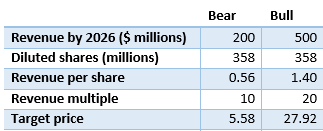
Our current valuation of the stock remains unchanged from my November article, affirming our decision not to divest at this juncture. However, it's important to acknowledge the strategic focus of sophisticated short sellers on companies characterized by significant cash burn and the presence of convertible notes on their balance sheets. This highlights an urgent need for proactive management action to address these vulnerabilities before they exacerbate. The board's immediate attention to this matter is critical, even if it entails accepting the short-term discomfort of considerable dilution. Such decisive action is necessary to mitigate the risks associated with these financial instruments and to steer the company away from reliance on fortuitous outcomes. Successfully navigating this challenge could pave the way for future share price appreciation. Moving forward, our analysis will closely track the management team's communications and actions concerning these convertible notes, as these will be indicative of the company's strategic direction and its potential impact on shareholder value.
Editor's Note: This article discusses one or more securities that do not trade on a major U.S. exchange. Please be aware of the risks associated with these stocks.