
We Are
We Are
Momentum continues to favor large-caps over mid and small overall, but growth large-caps look tired. Tech stocks have diverged so dramatically from nearly everything else that I suspect sector rotation is in order. If I'm right, that inherently also means value gets some reallocation out of growth. If I'm right, and you're still bullish on large-caps eating the world, the Vanguard Mega Cap Value ETF (NYSEARCA:MGV) is likely the fund for you.
MGV was initiated on 12/17/2007 by Vanguard, one of the largest asset management companies globally. The fund has amassed over $7 billion in assets under management, gaining a steady foothold in the large-cap value investment space. MGV's primary goal is to mirror the performance of the CRSP US Mega Cap Value Index, which comprises the largest U.S. value stocks. The fund's approach is to invest all or substantially all of its assets in the stocks that make up the index, maintaining each stock in roughly the same proportion as its weighting in the index.
As of the latest data, MGV has a total of 141 stocks in its portfolio, with the top five holdings constituting a solid portion of the fund's total net assets. These holdings provide a snapshot of the fund's investment strategy and its focus on large-cap value stocks.
Berkshire Hathaway Inc. (BRK.B): With a 4.11% weightage in the fund, Berkshire Hathaway is MGV's largest holding. The multinational conglomerate, headed by the legendary investor Warren Buffett, has a diverse portfolio of businesses and investments.
Broadcom Inc. (AVGO): Broadcom, a leading semiconductor and infrastructure software company, is the second-largest holding in MGV's portfolio with a 3.72% weightage.
JPMorgan Chase & Co. (JPM): As one of the largest banking institutions in the U.S., JPMorgan Chase constitutes 3.47% of MGV's holdings.
UnitedHealth Group Inc. (UNH): This diversified health care company holds a 2.95% weightage in MGV’s portfolio.
Exxon Mobil Corp. (XOM): One of the world's largest publicly-traded oil and gas companies, Exxon Mobil, makes up 2.70% of the fund's holdings.
I like the makeup here, as it avoids the "Magnificent 7" with blue chip companies that are stable in their business operations and which are priced more attractively overall.
MGV's portfolio is well-diversified across various sectors, with the highest exposure to the Healthcare, Financials, and Industrials sectors.
Healthcare (19.90%): This sector includes companies involved in the production and delivery of medicine and healthcare-related goods and services.
Financials (20.70%): This sector comprises companies involved in banking, insurance, investment, and real estate.
Industrials (14.30%): This sector includes companies involved in the manufacturing and distribution of goods.
Consumer Discretionary (6.30%): This sector includes companies that sell non-essential goods and services.
Consumer Staples (10.60%): This sector consists of companies that produce essential goods like food and beverages.
Tech makes up just 10.5% of the fund - another plus in my view relative to sectors that haven't done anywhere near as well and which may benefit from sector rotation.
When comparing MGV's performance to similar ETFs in the large-cap value space, it's essential to consider factors like expense ratio, yield, and returns. MGV boasts a low expense ratio of 0.07% and an attractive yield of 2.31%, making it a cost-efficient choice for investors. However, the fund's performance may vary compared to other similar ETFs. For instance, the Schwab U.S. Large-Cap Value ETF (SCHV) and the Invesco Dynamic Large Cap Value ETF (PWV) have shown different performance patterns over the years. MGV overall has fared very well by comparison.
stockcharts.com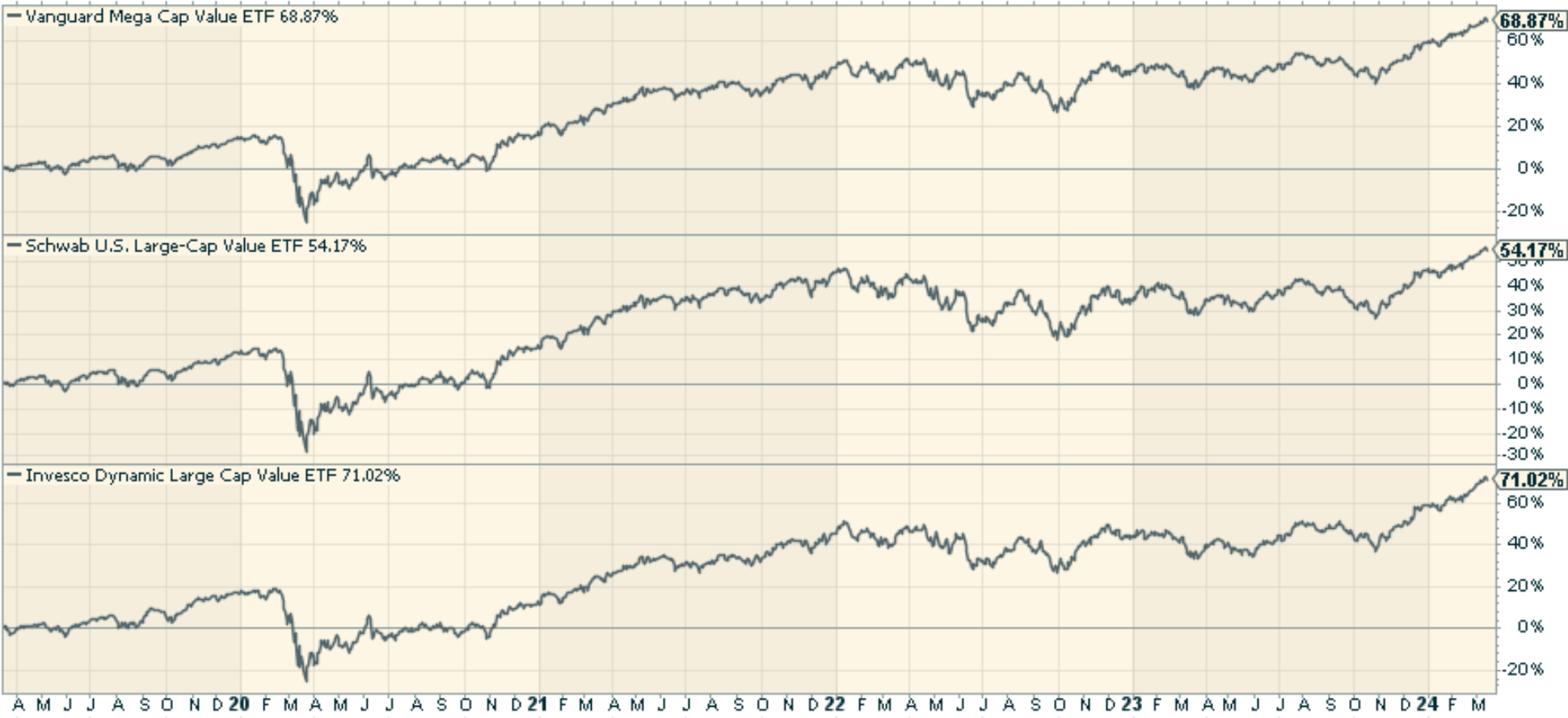
Investing in MGV comes with its share of advantages and potential drawbacks. On the plus side, MGV offers exposure to large-cap value stocks that are typically more stable and less risky than smaller-cap stocks. Moreover, these companies often have strong balance sheets and consistent cash flows, making them attractive to conservative investors.
However, the fund's performance is susceptible to market fluctuations and changes in interest rates. Additionally, while value stocks may offer lower valuations, they may also underperform growth stocks during strong bull markets.
Investing in MGV can be attractive for those seeking exposure to large-cap value stocks. The fund offers a diversified portfolio, low expense ratio, and an attractive yield. However, potential investors should be aware of the inherent risks associated with equity investments and market volatility. I much prefer this over large-cap core and large-cap growth at this point in the cycle.