
champpixs
champpixs
In the context of valuing companies, and sharing those valuations, I do get suggestions from readers on companies that I should value next. While I don't have the time or the bandwidth to value all of the suggested companies, a reader from Iceland, a couple of weeks ago, made a suggestion on a company to value that I found intriguing. He suggested Blue Lagoon, a well-regarded Icelandic Spa with a history of profitability, that was finding its existence under threat, as a result of volcanic activity in Southwest Iceland. In another story that made the rounds in recent weeks, 23andMe (ME), a genetic testing company that offers its customers genetic and health information, based upon saliva sample, found itself facing the brink, after a hacker claimed to have hacked the site and accessed the genetic information of millions of its customers. Stepping back a bit, one claim that climate change advocates have made not just about fossil fuel companies, but about all businesses, is that investors are underestimating the effects that climate change will have on economic systems and on value. These are three very different stories, but what they share in common is a fear, imminent or expected, of a catastrophic event that may put a company's business at risk.
While we may use statistical measures like volatility or correlation to measure risk in practice, risk is not a statistical abstraction. Its impact is not just financial, but emotional and physical, and it predates markets. The risks that our ancestors faced, in the early stages of humanity, were physical, coming from natural disasters and predators, and physical risks remained the dominant form of risk that humans were exposed to, almost until the Middle Ages. In fact, the separation of risk into physical and financial risk took form just a few hundred years ago, when trade between Europe and Asia required ships to survive storms, disease and pirates to make it to their destinations; shipowners, ensconced in London and Lisbon, bore the financial risk, but the sailors bore the physical risk. It is no coincidence that the insurance business, as we know it, traces its history back to those days as well.
I have no particular insights to offer on physical risk, other than to note that while taking on physical risks for some has become a leisure activity; I have no desire to climb Mount Everest or jump out of an aircraft. Much of the risk that I think about is related to risks that businesses face, how that risk affects their decision-making and how much it affects their value. If you start enumerating every risk a business is exposed to, you will find yourself being overwhelmed by that list, and it is for that reason that I categorize risk into the groupings that I described in an earlier post on risk. I want to focus in this post on the third distinction I drew on risk, where I grouped risk into discrete risk and continuous risk, with the latter affecting businesses all the time and the former showing up infrequently, but often having much larger impact. Another, albeit closely related, distinction is between incremental risk, i.e., risk that can change earnings, growth, and thus value, by material amounts, and catastrophic risk, which is risk that can put a company's survival at risk, or alter its trajectory dramatically.
There are a multitude of factors that can give rise to catastrophic risk, and it is worth highlighting them and examining the variations that you will observe across different catastrophic risks. Put simply, a volcanic eruption, a global pandemic, a hack of a company's database and the death of a key CEO are all catastrophic events, but they differ on three dimensions:
Business owners can try to insulate themselves from catastrophic risk, but as we will see in the next sections, those protections may not exist, and even if they do, they may not be complete. In fact, as the probabilities of catastrophic risk increases, it will become more and more difficult to protect yourself against the risk.
Dealing with catastrophic risk
It is undeniable that catastrophic risk affects the values of businesses, and their market pricing, and it is worth examining how it plays out in each domain. I will start this section with what, at least for me, I am familiar ground, and look at how to incorporate the presence of catastrophic risk, when valuing businesses and markets. I will close the section by looking at the equally interesting question of how markets price catastrophic risk, and why pricing and value can diverge (again).
Much as we like to dress up intrinsic value with models and inputs, the truth is that intrinsic valuation at its core is built around a simple proposition: The value of an asset or business is the present value of the expected cash flows on it:
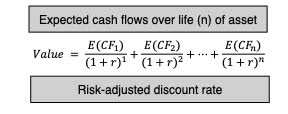
That equation gives rise to what I term the "It Proposition", which is that for "it" to have value, "it" has to affect either the expected cashflows or the risk of an asset or business. This simplistic proposition has served me well when looking at everything from the value of intangibles, as you can see in this post that I had on Birkenstock, to the emptiness at the heart of the claim that ESG is good for value, in this post. Using that framework to analyze catastrophic risk, in all of its forms, its effects can show in almost every input into intrinsic value:
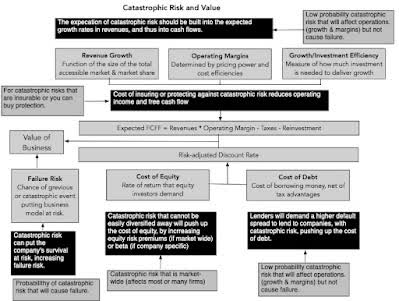
Looking at this picture, your first reaction might be confusion, since the practical question you will face when you value Blue Lagoon, in the face of a volcanic eruption, and 23andMe, after a data hack, is which of the different paths to incorporating catastrophic risks into value you should adopt. To address this, I created a flowchart that looks at catastrophic risk on two dimensions, with the first built around whether you can buy insurance or protection that insulates the company against its impact and the other around whether it is risk that is specific to a business or one that can spill over and affect many businesses.
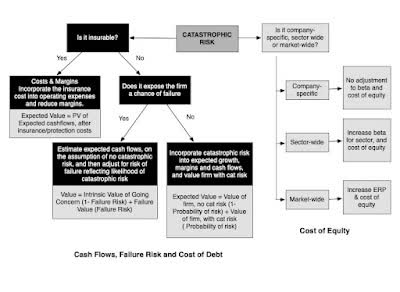
As you can see from this flowchart, your adjustments to intrinsic value, to reflect catastrophic risk will vary, depending upon the risk in question, whether it is insurable and whether it will affect one/few companies or many/all companies.
A. Insurable Risk: Some catastrophic risks can be insured against, and even if firms choose not to avail themselves of that insurance, the presence of the insurance option can ease the intrinsic valuation process.
2. Uninsurable Risk, Going-concern, Company-specific: When a catastrophic risk is uninsurable, the follow-up questions may lead us to decide that while the risk will do substantial damage, the injured firms will continue in existence. In addition, if the risk affects only one or a few firms, rather than wide swathes of the market, there are intrinsic value implications.
Intrinsic Value Effect: If the catastrophic risk is not insurable, but the business will survive its occurrence even in a vastly diminished state, you should consider doing two going-concern valuations, one with the assumption that there is no catastrophe and one without, and then attaching a probability to the catastrophic event occurring.
Expected Value with Catastrophe = Value without Catastrophe (1 - Probability of Catastrophe) + Value with Catastrophe (Probability of Catastrophe)In these intrinsic valuations, much of the change created by the catastrophe will be in the cash flows, with little or no change to costs of capital, at least in companies where investors are well diversified.
3. Uninsurable Risk. Failure Risk, Company-specific: When a risk is uninsurable and its manifestation can cause a company to fail, it poses a challenge for intrinsic value, which is, at its core, designed to value going concerns. Attempts to increase the discount rate, to bring in catastrophic risk, or applying an arbitrary discount on value almost never work.
Intrinsic Value Effect: If the catastrophic risk is not insurable, and the business will not survive, if the risk unfolds, the approach parallels the previous one, with the difference being that the failure value of the business, i.e, what you will generate in cash flows, if it fails, replaces the intrinsic valuation, with catastrophic risk built in:
Expected Value with Catastrophe = Value without Catastrophe (1 - Probability of Catastrophe) + Failure Value (Probability of Catastrophe)
The failure value will come from liquidation of the assets, or what is left of them, after the catastrophe.
4 & 5 Uninsurable Risk. Going Concern or Failure, Market or Sector wide: If a risk can affect many or most firms, it does have a secondary impact on the returns investors expect to make, pushing up costs of capital.
The intrinsic value approach assumes that we, as business owners and investors, look at catastrophic risk rationally, and make our assessments based upon how it will play out in cashflows, growth and risk. In truth, it is worth remembering key insights from psychology, on how we, as human beings, deal with threats (financial and physical) that we view as existential.
When looking at how the market prices in the expectation of a catastrophe occurring and its consequences, both these human emotions play out, as the overpricing of businesses that face catastrophic risk, when it is low probability and distant, and the underpricing of these same businesses when catastrophic risk looms large.
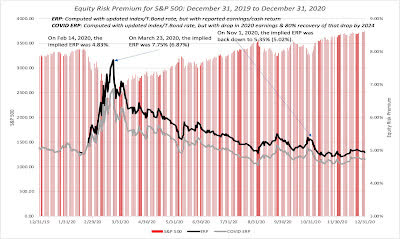
To see this process at work, consider again how the market initially reacted to the COVID crisis in terms of repricing companies that were at the heart of the crisis. Between February 14, 2020, and March 23, 2020, when fear peaked, the sectors most exposed to the pandemic (hospitality, airlines) saw a decimation in their market prices, during that period:
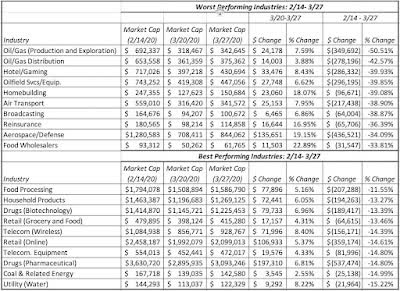
With catastrophic risks that are company-specific, you see the same phenomenon play out. The market capitalization of many young pharmaceutical companies has been wiped out by the failure of blockbuster drugs in trials. PG&E (PCG), the utility company that provides power to large portions of California, saw its stock price halved after wildfires swept through California, and investors worried about the culpability of the company in starting them.
The most fascinating twist on how markets deal with risks that are existential is their pricing of fossil fuel companies over the last two decades, as concerns about climate change have taken center stage, with fossil fuels becoming the arch-villain. The expectation that many impact investors had, at least early in this game, was that relentless pressure from regulators and backlash from consumers and investors would reduce the demand for oil, reducing the profitability and expected lives of fossil fuel companies. To examine whether markets reflect this view, I looked at the pricing of fossil fuel stocks in the aggregate, starting in 2000 and going through 2023:
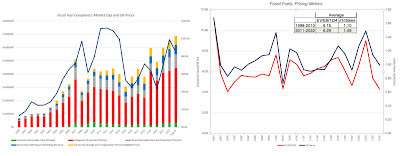
In the graph to the left, I chart out the total market value for all fossil fuel companies, and note a not unsurprising link to oil prices. In fact, the one surprise is that fossil fuel stocks did not see surges in market capitalization between 2011 and 2014, even as oil prices surged. While fossil fuel pricing multiples have gone up and down, I have computed the average on both in the 2000-2010 period and again in the 2011-2023 period. If the latter period is the one of enlightenment, at least on climate change, with warnings of climate change accompanied by trillions of dollars invested in combating it, it is striking how little impact it has had on how markets, and investors in the aggregate, view fossil fuel companies. In fact, there is evidence that the business pressure on fossil fuel companies has become less over time, with fossil fuel stocks rebounding in the last three years, and fossil fuel companies increasing investments and acquisitions in the fossil fuel space.
Impact investors would point to this as evidence of the market being in denial, and they may be right, but market participants may point back at impact investing, and argue that the markets may be reflecting an unpleasant reality, which is that despite all of the talk of climate change being an existential problem, we are just as dependent on fossil fuels today, as we were a decade or two decades ago:
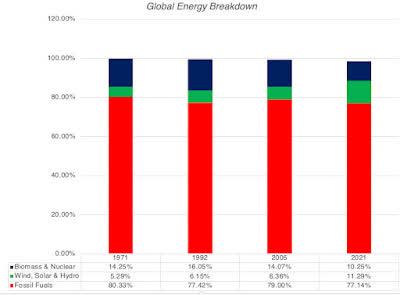
Don't get me wrong! It is possible, perhaps even likely, that investors are not pricing in climate change not just in fossil fuel stocks, and that there is pain awaiting them down the road. It is also possible that, at least in this case, that the market's assessment that doomsday is not imminent and that humanity will survive climate change, as it has other existential crises in the past.
The question posed about fossil fuel investors and whether they are pricing in the risks of climate change can be generalized to a whole host of other questions about investor behavior. Should buyers be paying hundreds of millions of dollars for a Manhattan office building, when all of New York may be underwater in a few decades? Last, I am accused of pointing fingers, what will happen to the value of my house that is currently two blocks from the beach, given the prediction of rising oceans. The painful truth is that if doomsday events (nuclear war, mega asteroid hitting the earth, the earth getting too hot for human existence) manifest, it is survival that becomes front and center, not how much money you have in your portfolio. Thus, ignoring Armageddon scenarios when valuing businesses and assets may be completely rational, and taking investors to task for not pricing assets correctly will do little to alter their trajectory!
On a different note, you probably know that I am deeply skeptical about sustainability, at least as preached from the Harvard Business School pulpit. It remains ill-defined, morphing into whatever its proponents want it to mean. The catastrophic risk discussion presents perhaps a version of sustainability that is defensible. To the extent that all businesses are exposed to catastrophic risks, some company-level and some having broader effects, there are actions that businesses can take to, if not protect themselves, at least cushion the impact of these risks. A personal-service business, headed by an aging key person, will be well served by designing a succession plan for someone to step in when the key person leaves (by his or her choice or an act of God). No global company was ready for COVID in 2020, but some were able to adapt much faster than others because they were built to be adaptable. Embedded in this discussion are also the limits to sustainability, since the notion of sustainability at any cost is absurd. Building in adaptability and safeguards against catastrophic risk makes sense only if the costs of doing so are less than the potential benefits, a simple but powerful lesson that many sustainability advocates seem to ignore, when they make grandiose prescriptions for what businesses should and should not do to avoid the apocalypse.
Editor's Note: The summary bullets for this article were chosen by Seeking Alpha editors.