
CHUNYIP WONG
CHUNYIP WONG
Today's article focuses on the Invesco KBW Bank ETF (NASDAQ:KBWB), a banking ETF that provides investors with exposure to systematically driven returns.
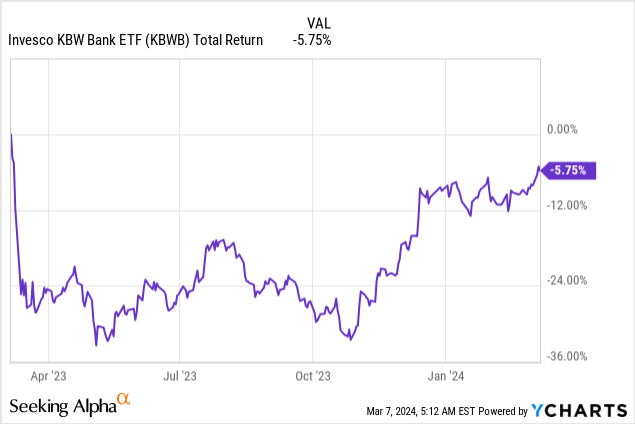
The ETF's year-on-year loss comes as no surprise, as default risk issues paired with talks of new capital adequacy rules dominated headlines. Moreover, disparity occurred within the banking industry, as retail and commercial banks faced somewhat contrasting results. However, with that being said, bank stocks have entered a new period, requiring a new outlook on their prospects.
Here are our latest findings on the banking space and the Invesco KBW Bank ETF.
The ETF KBWB tracks 90% of the KBW Nasdaq Bank Index, suggesting it has room for moderate active management to provide excess returns to its shareholders. The KBW Nasdaq Bank Index isn't as rules-based as most thematic indices; its key rules include overlooking stocks below $2 per share or an average daily trading volume of 100,000, only considering stocks listed on the NASDAQ, NYSE, and CBOE; merely investing in financial services with an emphasis on banks and quarterly rebalancing.
Although not stated in its methodology, the ETF's exposure shows that it has a large-cap value style drift. This allows for easier assessment of the ETF as its factor tilt indicates that it has very particular value drivers.
Author, Data form Invesco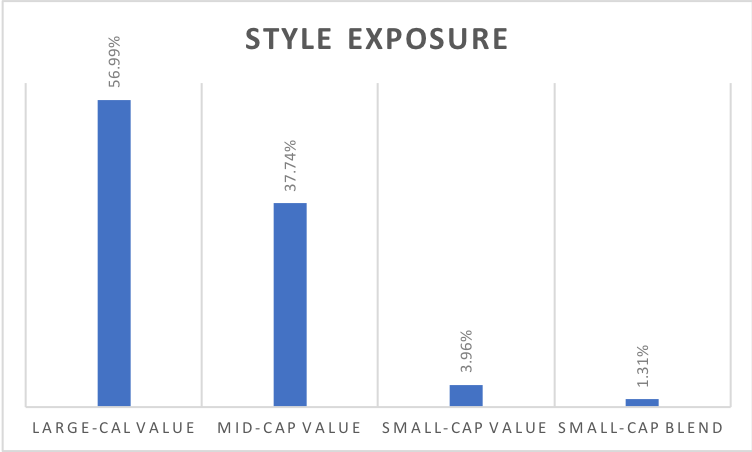
As mentioned before, the Invesco KBW Bank ETF is down year-over-year but recovered by about 3% since the turn of the year. We are unsure what caused the recovery. Our judgment tells us that most of it was due to systematic risk derived from a broad-based stock market surge. I understand that many believe sustained interest rate levels are a tailwind to banking stocks, but it's not that simple. Thus, we don't agree that sustained interest rates in the U.S. drove recent returns.
Seeking Alpha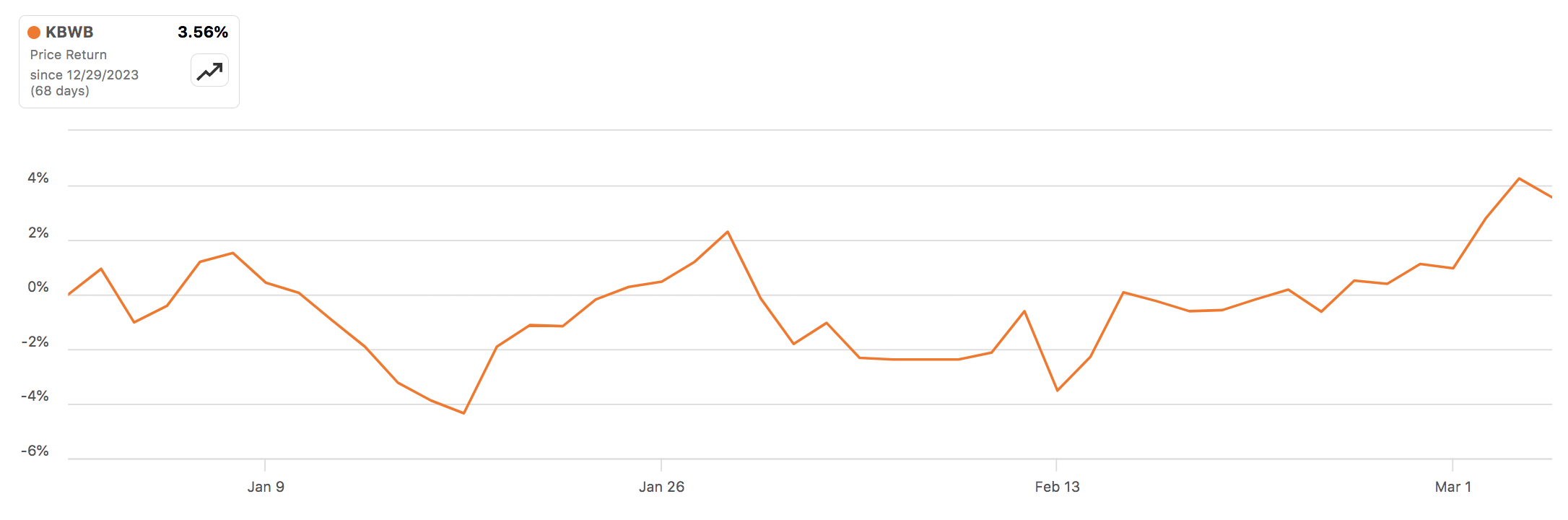
Let's shift to a forward-looking vantage point and examine what's in store for the KBWB ETF.
KBWB ETF's primary holdings include big banks such as Wells Fargo (WFC), JPMorgan Chase (JPM), Bank of America (BAC), Goldman Sachs (GS), and Morgan Stanley (MS). The ETF also holds riskier, smaller market capitalization stocks, but its primary exposure is to big banks with diversified activities and particular emphasis on sovereign debt investments, consumer lending, and commercial mortgage lending. Well, that's according to our knowledge of previously assessing some of the ETF's constituents; we encourage our readers to corroborate with their own analysis.
Seeking Alpha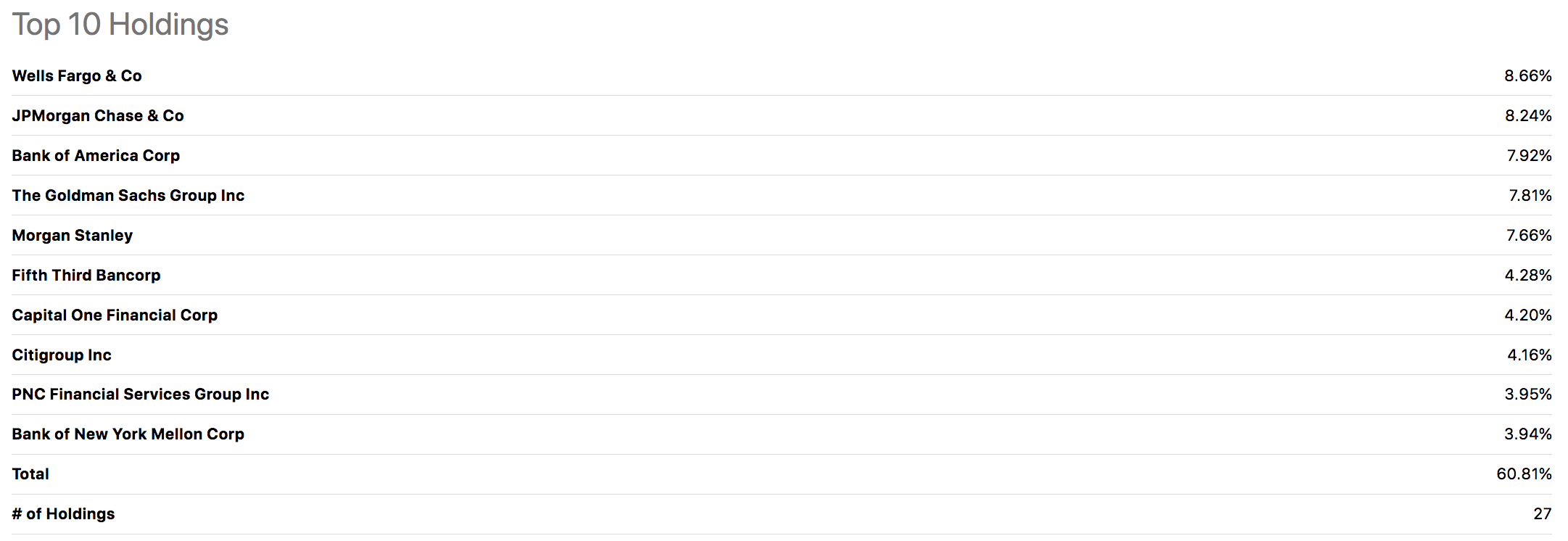
We collated data from a risk appraisal to identify KBWB ETF's value drivers. A discussion follows beneath the diagram.
Click on Image to Enlarge (Portfolio Visualizer)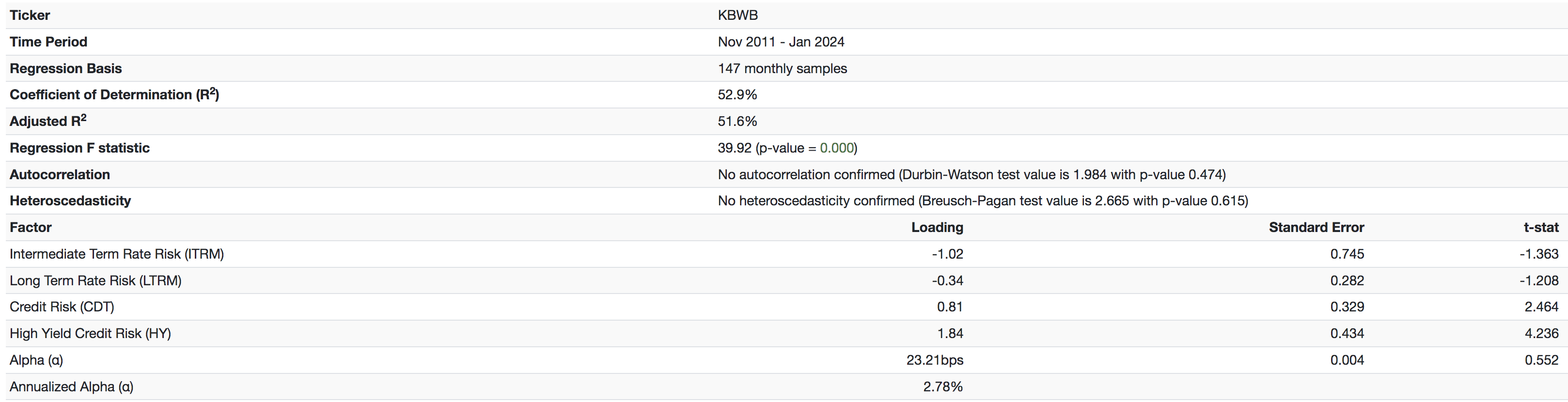
The regression's moderate adjusted R-squared suggests the combined model should be taken with a pinch of salt, but the t-stats on the individual factors are adequate, suggesting isolated analysis is warranted.
The first noteworthy factor of the regression is that KBWB generally has negative sensitivity to intermediate and long-term term risk. For those unaware, sensitivity to term risk refers to the return earned per unit of term risk, wherein the term refers to the holdings period. Intermediate would usually be a 7-10 year holdings period and long-term a 30-year.
Term risk reflects sub-categories such as interest rate risk, inflation uncertainty risk, bond supply risk, and the shape of the yield curve. We aren't too sure about bond supply, but our feeling is that inflation uncertainty will remain salient to 2024's market environment. Moreover, we think an interest rate pivot will occur in late 2024. An interest rate pivot could create a bullish steepening of the yield curve, but this would increase the term premium (due to a higher spread between long and short-dated bonds).
In essence, we think a negative term effect is set to occur for KBWB ETF if the regression is anything to go by.
The second matter to discuss regarding the regression is credit risk. The KBWB ETF has a positive sensitivity to credit risk and more than 2x the sensitivity to high-yield credit (versus low-yield credit). This means that KBWB ETF generally increases in value when credit risk rises. This can be explained by higher spreads on commercial loans and corporate bond investing. Although exorbitant credit risk premiums can derail this relationship, generally, higher credit risk seems to add value to KBWB ETF.
If we look at option-adjusted spreads, credit risk has abated in the United States in the past quarter. However, we hold the view that a drop in the yield curve will occur in late 2024, consequently sending credit spreads higher due to the general inverse relationship between the two risk premiums. As such, we think KBWB ETF will experience gains in the latter stages of the year if the regression holds true.
St. Louis Fed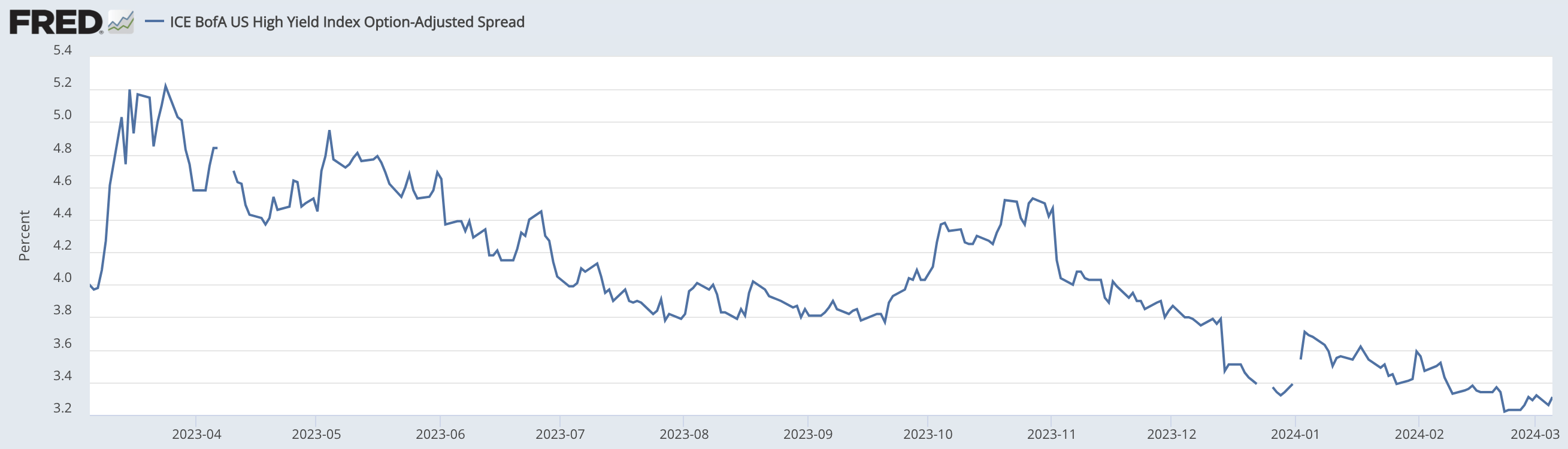
A glance at the Invesco KBW Bank ETF's valuation data shows that it is more or less fairly valued, with its price-to-book ratio exceeding the magic 1x threshold. We think bank asset values could increase later this year if interest rates fall, as their non-real estate loan books and sovereign bond holdings typically have positive durations (asset values increase with decreasing interest rates). However, we certainly don't see a pure value play here.
Invesco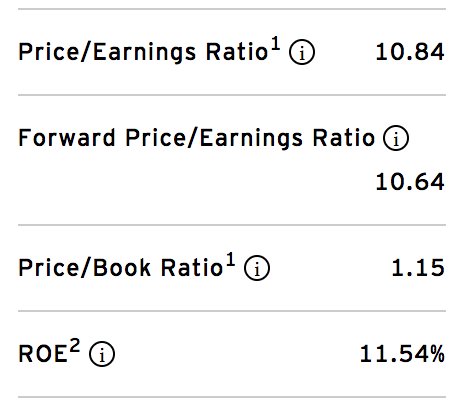
The ETF's trailing dividend yield of 3.09% shows that it adds a floor to its market price, especially considering its long-term growth rates. Moreover, reverting to the figure above illustrates a robust return-on-equity figure, adding substance to the ETF's dividend-paying abilities. Keep in mind that KBWB ETF's dividends will be cyclical due to the nature of its holdings, but a long-term view provides us with optimism.
Seeking Alpha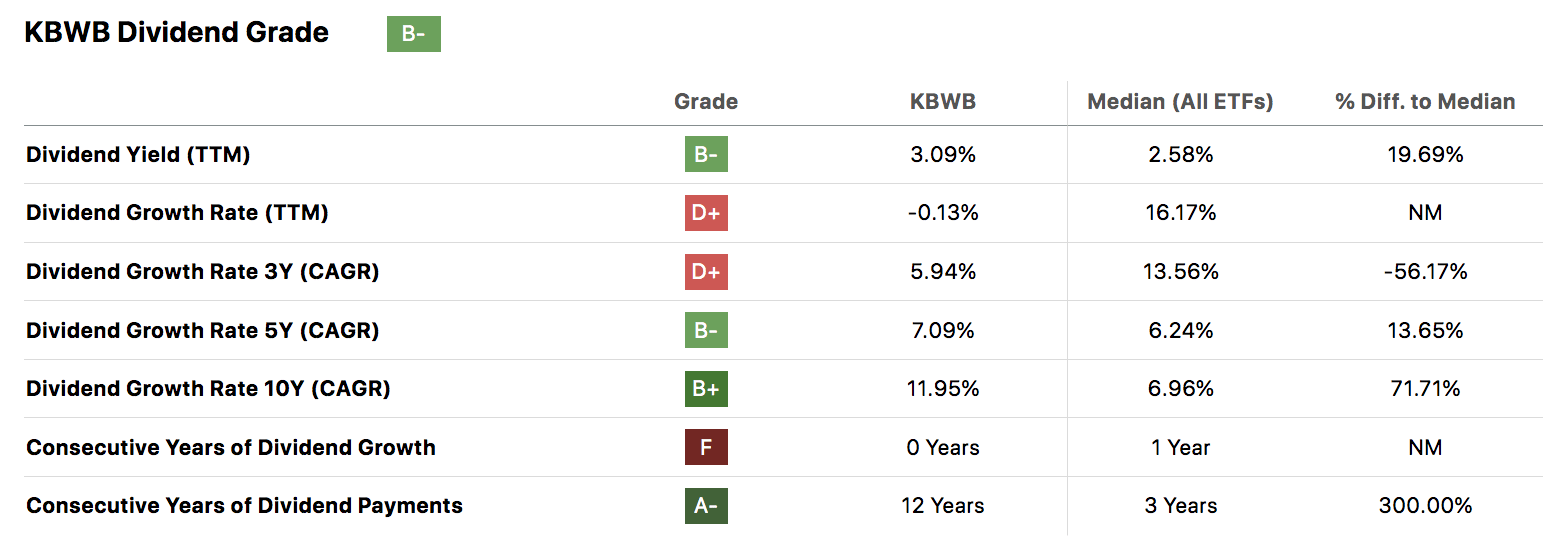
The first risk worth mentioning is the regression we performed, which acts against our fundamental knowledge. In our experience, credit risk can deplete a bank's asset base, leading to a downturn in price instead of an increase. Moreover, we've seen various banking stocks correlate to a term premium due to their tendency to fund themselves with short-term deposits and invest in longer-term assets. As such, our fundamental take and the regression form a juxtaposition.
A second risk to our analysis is that it generalizes value drivers without considering the idiosyncratic features of each bank. Considering each bank would be responsible for interested investors, but, doing so extends past the capacity of this analysis.
Lastly, the KBWB ETF has a noteworthy quantitative risk. Its monthly value-at-risk at 5% exceeds the SPDR® S&P 500 ETF Trust's, meaning its drawdowns of 2.33 standard deviations from its mean are more prevalent than those of a blended portfolio of U.S. large-cap stocks.
Seeking Alpha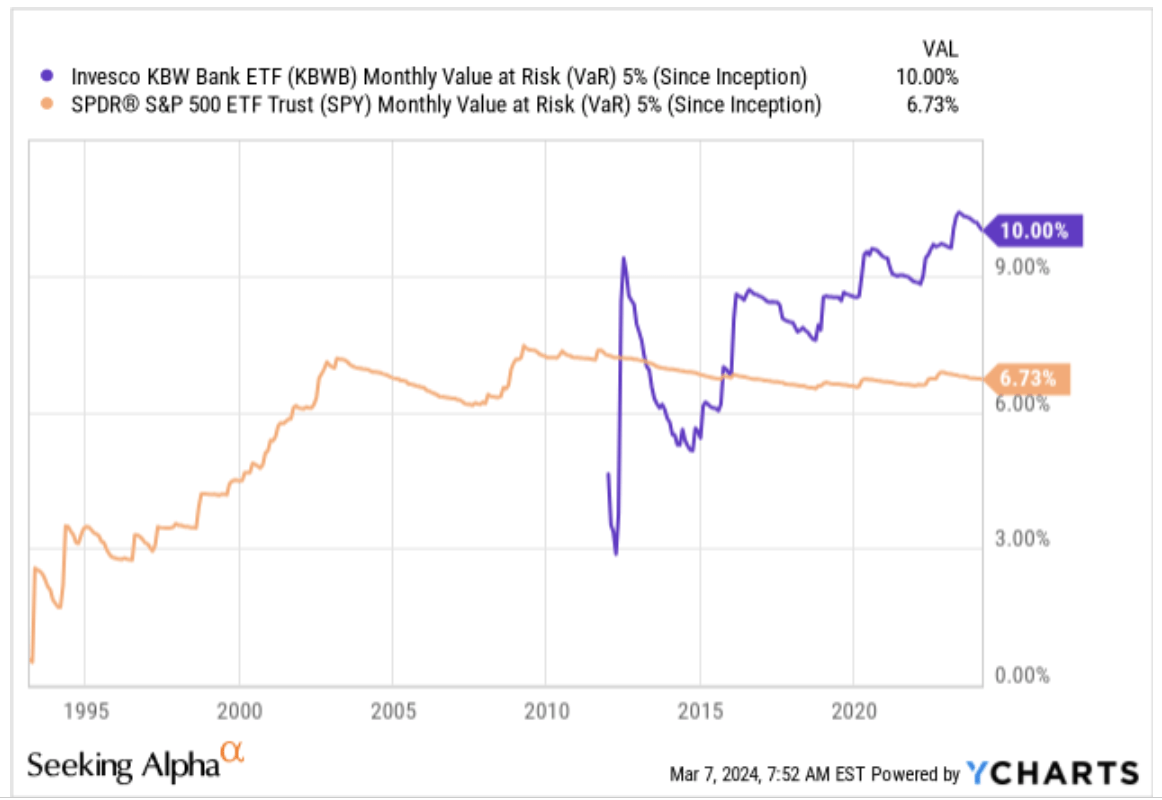
Our analysis shows that the KBWB ETF is a solid long-term investment to add to a diversified portfolio. A quantitative vantage point suggests the ETF can act as a tactical play due to its correlation to our term and credit risk outlook. However, we think long-term engagement is a better way to approach this best-in-class banking asset.
Consensus: Buy