
Eoneren/E+ via Getty Images
Eoneren/E+ via Getty Images
The S&P 500 is poised to deliver double-digit earnings per share growth this year, according to FactSet's latest estimates. Per the same report, nine out of eleven global industry classification standard (GICS) sectors are poised to see earnings per share increases, with Energy and Materials tracking negative EPS growth. The optimism as reflected in expectations of earnings increasing has driven investor capital towards funds such as the Invesco Nasdaq 100 ETF (NASDAQ:QQQM), since the technology complex of stocks saw its earnings increase higher than what was originally expected as per the same FactSet report last year. The QQQM performed much better than the broader market indices, as seen below, on the back of an expanding earnings outlook.
QQQM vs Nasdaq 100 vs S&P 500, SA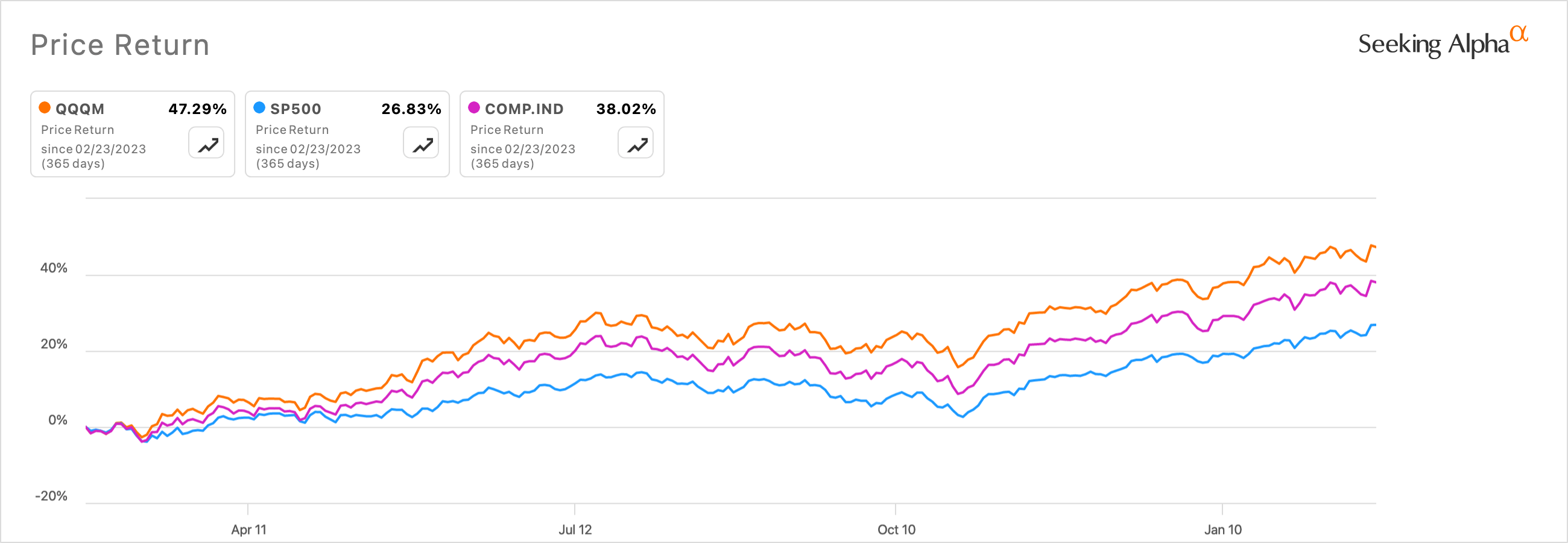
While QQQM did beat benchmarks, my research indicates investors would benefit from waiting for a pullback before deploying capital into the QQQM since valuation multiples indicate the ETF is almost priced at fair value at the moment. For reasons that I will illustrate below, I rate this ETF as a Hold.
The Invesco Nasdaq 100 ETF is issued by asset management heavyweight Invesco. The ETF is designed to track the performance of the technology-heavy Nasdaq 100 Index™ (COMP.IND). According to the fund's prospectus, the fund will deploy at least 90% of its total assets in the securities that comprise the Nasdaq100 Index. The fund is passively managed since its assets are rebalanced quarterly and reconstituted annually, in line with Nasdaq100's methodology.
I have added a chart below that shows the Top 15 Holdings vs. the Constitution of QQQM's funds by categories.
ETFdb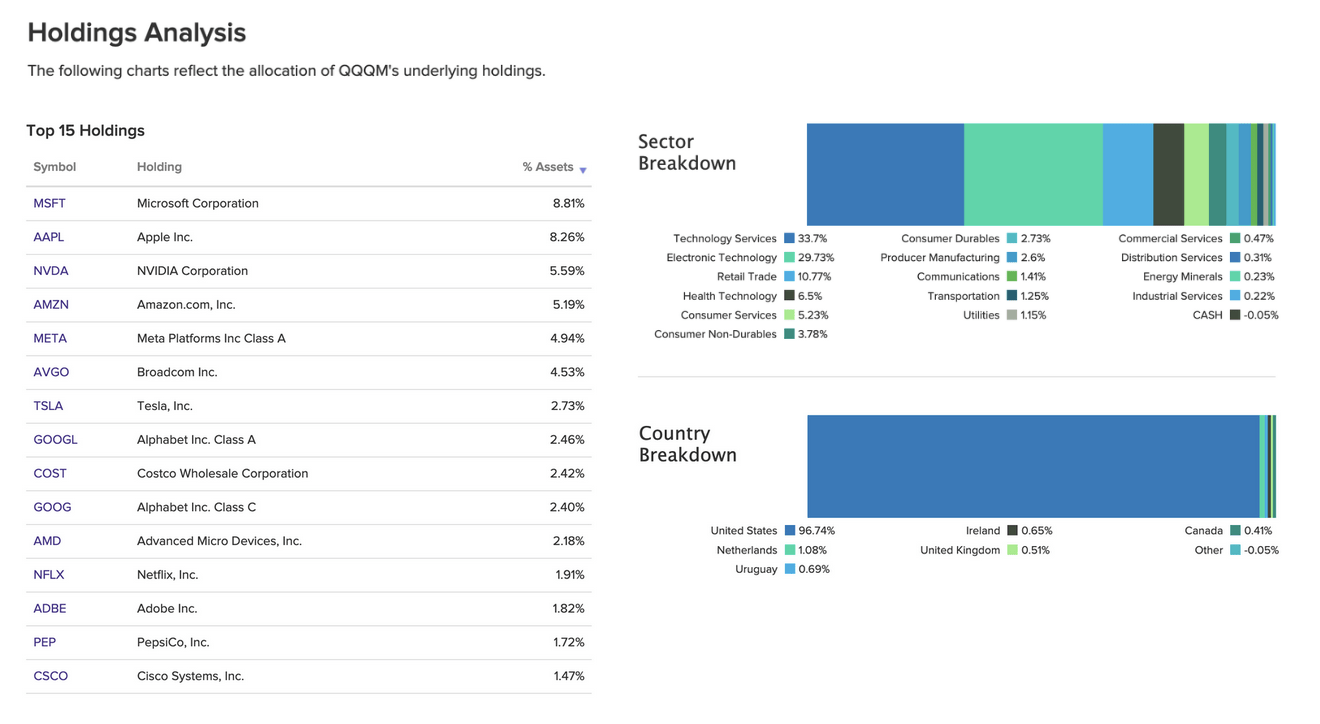
About 64% of the fund's holdings are allocated towards technology stocks and communication services stocks. This is an important point to note, and I will cover the importance of this in later sections.
Here is how QQQM compares with some of its peers. The list below is ordered by largest-to-smallest fund in terms of assets managed.
SA
The big question most investors immediately have is: why go for the QQQM when there is already the larger, more widely-traded Invesco QQQ Trust Series 1 fund (QQQ) (or the Qs) also managed by Invesco. The deeper history of why Invesco has launched QQQ-based ETFs such as QQQM is covered by this Bloomberg's research piece that investigates the business reasoning behind Invesco's QQQM offering. As can be seen from the chart above, QQQM is the youngest ETF of the lot, launched in 2020. But to quickly summarize the Bloomberg post, there is no impact on the investor, only more choices, which is great for investors.
In fact, when comparing QQQM to the Qs, there are many advantages to investing in QQQM over its parent ETF. First, an investor spends 5 basis points less in ETF fees as compared to investing in the Qs. Simultaneously, investors also earn 20 basis points in dividend yield from QQQM vs. Qs. All of this while QQQM performs at par with the Qs or, for some time periods, even better than the Qs. Granted that the Qs have been around for a long time and have benefited from the popularity and earnings potential of technology stocks over that time period, investors stand to benefit from QQQM moving forward since the earnings potential in the technology complex still remains, as I will point out below.
The only minor difference is that the Qs command a superior spread of 0%, as per its prospectus, as compared to the 0.01% spread in the QQQM. However, this will not make a major difference to retail investors who hold assets for mid-to-long-term durations.
Now that I have pointed out the major differences between QQQM and the Qs, I will review the fund's composition, which in my opinion may be a differentiating factor in QQQM's relative performance vs. State Street's Technology Select Sector SPDR Fund (XLK) and BlackRock's iShares U.S. Technology ETF (IYW).
Author's Compilation & Assessment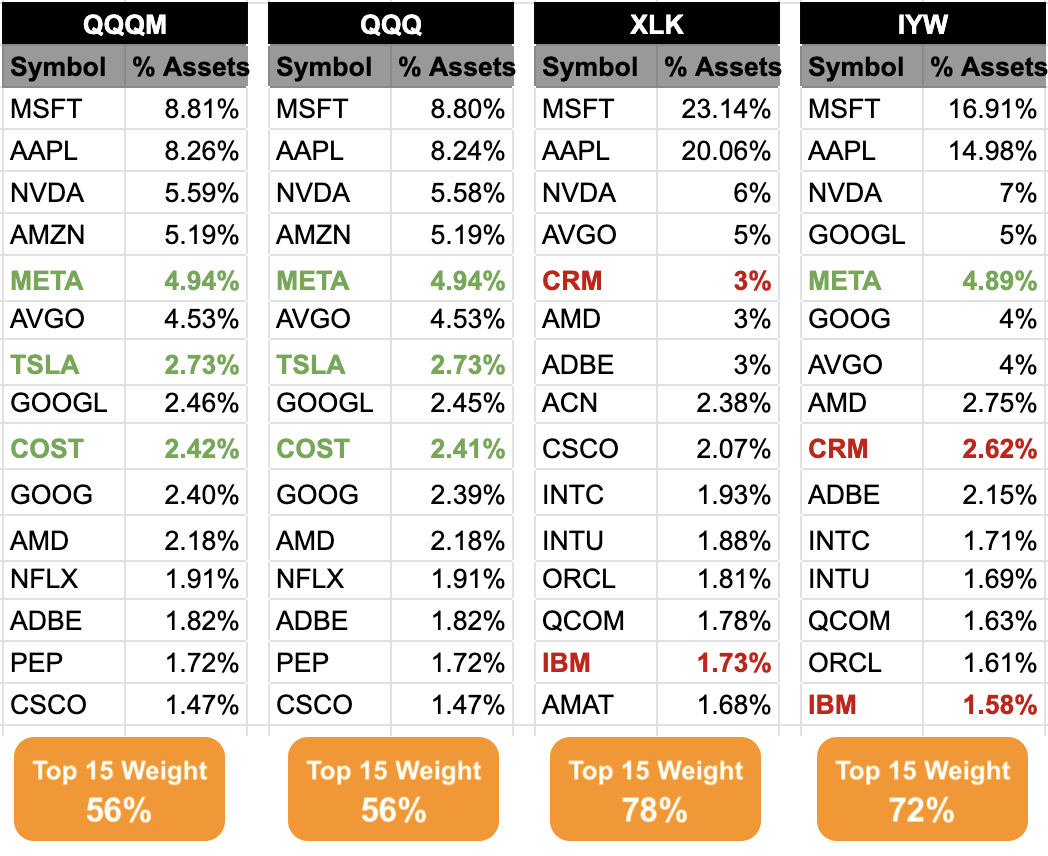
Generally, all funds have some sort of balance between Technology, Technology Services and Consumer Discretionary stocks. Moreover, while XLK and IYW tend to have a higher weightage towards Microsoft (MSFT) and Apple (AAPL), QQQM's weightage is comparatively less pronounced towards the top two names. Salesforce (CRM) and IBM (IBM) are obviously missing from QQQM simply because of the nature of tracking the Nasdaq100 index. Salesforce and IBM are listed on NYSE and therefore do not feature as part of QQQM's assets.
However, a noticeable omission in XLK is communication services stock such as Meta Platforms (META), Alphabet (GOOG), and Netflix (NFLX) that are part of QQQM. In addition, Tesla is also another omission in the XLK that is included in QQQM. The importance of Communication Services stocks is fairly important due to the earnings prospects that I will discuss in the macro section.
So far, in FY23, Communication Services and Consumer Discretionary stocks led by Meta Platforms and Amazon, respectively, have enjoyed some of the strongest gains in earnings as well as sales growth last year. While earnings for consumer discretionary stocks on average grew by +45% y/y in FY23, earnings for communication services stocks grew at around half the y/y pace by around 23.6% during the same period. In contrast to that, IT stocks earnings grew 5.8% y/y, better than the benchmark earnings growth rate of <1% y/y. These estimates are as per the latest FactSet report that I referred to at the start of this research note.
For FY24, communication services and IT stocks are expected to lead the market with EPS gains of 17.2% y/y and 16.4% y/y respectively, as compared to the 10.9% y/y EPS gains for the S&P 500 index. Given that technology and communication stocks make up about 64% of the fund's assets, the earnings growth in FY24, the long-term outlook for QQQM looks promising.
FY24 and FY25 Earnings Projections by Sector, FactSet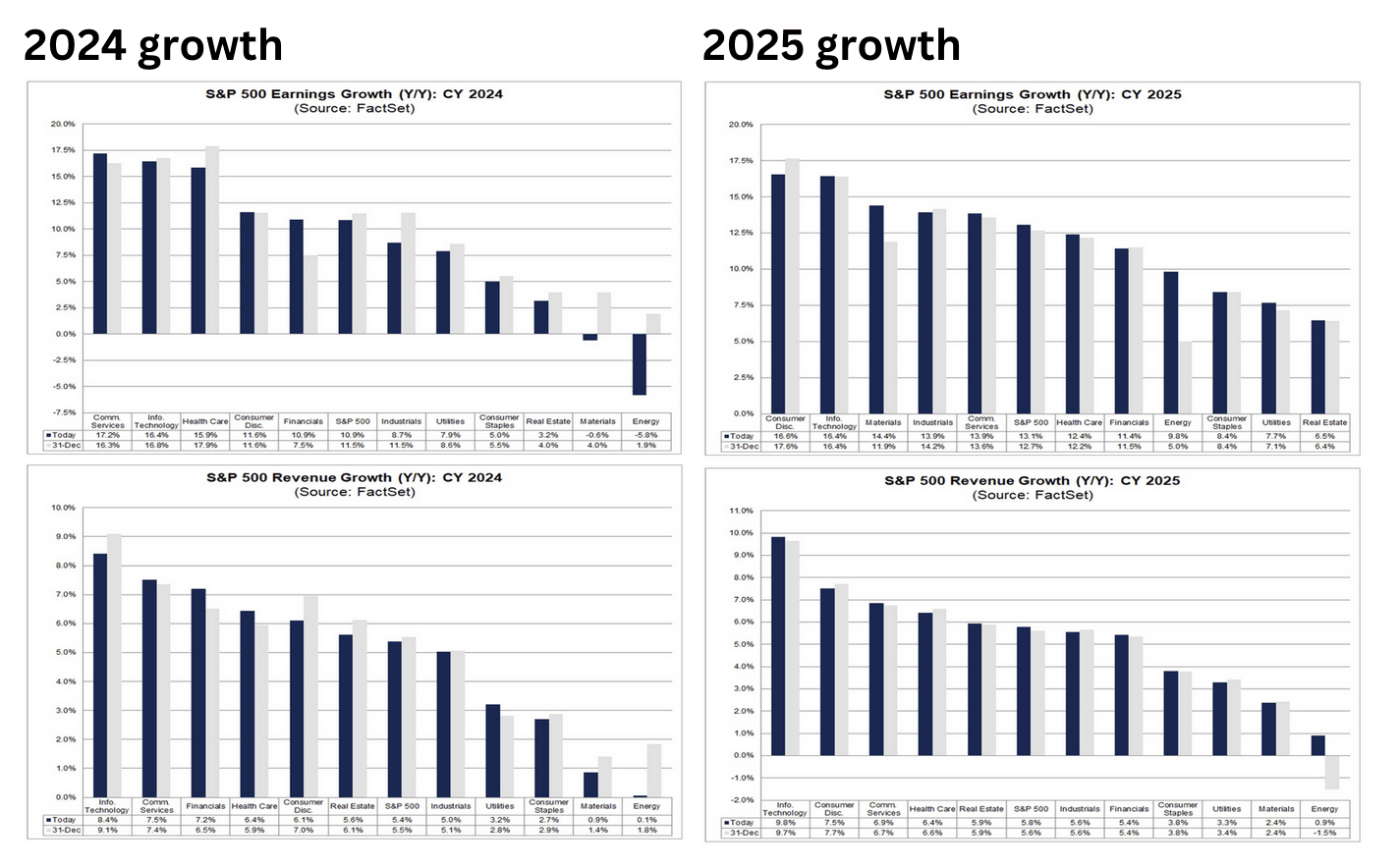
Moreover, it also appears that the strength in earnings for IT stocks and communication services stocks will continue into FY25. Given this outlook, I think a forward PE between 25 and 27 is justified. As per the fund's prospectus, QQQM's forward PE is 25. Hence, for now, it appears there is still some marginal room for valuation multiples to grow, but this ETF would be a buy on any pullback.
In addition, I had previously written about the benefits of the IYW fund and why that may be a better-suited ETF if the investor's purpose was to hold technology stocks. Investors should consider the IYW as well as compare it to QQQM.
A higher dollar would be a headwind to technology stocks held in the QQQM. So far, the dollar index (DXY) has been relatively stable, allowing most companies to project higher earnings through FY24. Part of the reason the dollar is stable is because expectations remain for interest rates to at least remain stable, if not, drop from current levels. However, if inflation starts to trend higher, the Federal Reserve will be forced to continue their rate hike program, hurting the growth prospects of technology stocks in the process.
Current growth estimates for technology, communication services, and other consumer discretionary stocks indicate there is room for multiples to slightly grow from here, but QQQM seems to be in the fair value range. Still, this ETF is buying on pullbacks given the strong growth being projected by the aforementioned sectors not only for FY24 but even into next year. However, with growth being priced in, I rate this as a Hold.