
ArtistGNDphotography
ArtistGNDphotography
The U.S. economy has come off a very strong FY23, surprising many, including me. Unemployment continued to stay low, inflation trended lower, and real wages, after accounting for inflation, proceeded on its expansion path in positive territory. This points to a sustained, healthy economy, which should keep interest rates paused at current levels at most.
These conditions that the economy saw last year incentivized consumers to spend even on discretionary products and services, as captured by the stocks of companies included in the Consumer Discretionary Select Sector SPDR Fund (NYSEARCA:XLY), which is in line with broader benchmark indices performance.
I believe long-term trends remain intact, given the progress seen so far. However, with the recent run-up over the last few months, combined with the seasonal headwinds lurking, I believe an upside in the short term remains limited. For now, a neutral view of the XLY seems justified.
The XLY fund’s assets are owned and managed by State Street’s investment management arm, State Street Global Advisors. The goal of the fund is to offer investors exposure to the consumer discretionary sector, primarily in the North American consumer market. Through the fund, investors gain broad exposure to a diversified set of companies within the discretionary sector, which includes services such as hotels, restaurants, leisure, travel, and other services, as well as products such as retail, apparel and luxury goods, household durables, automobiles, and automobile components.
The fund achieves its objective by tracking the S&P Consumer Discretionary Select Sector Index (IXY). The fund composition is based on the GICS asset classification standard, and assets are rebalanced once every quarter.
I have added a chart below that shows the Top 15 Holdings vs. the Constitution of XLY’s Funds by categories.
etfdb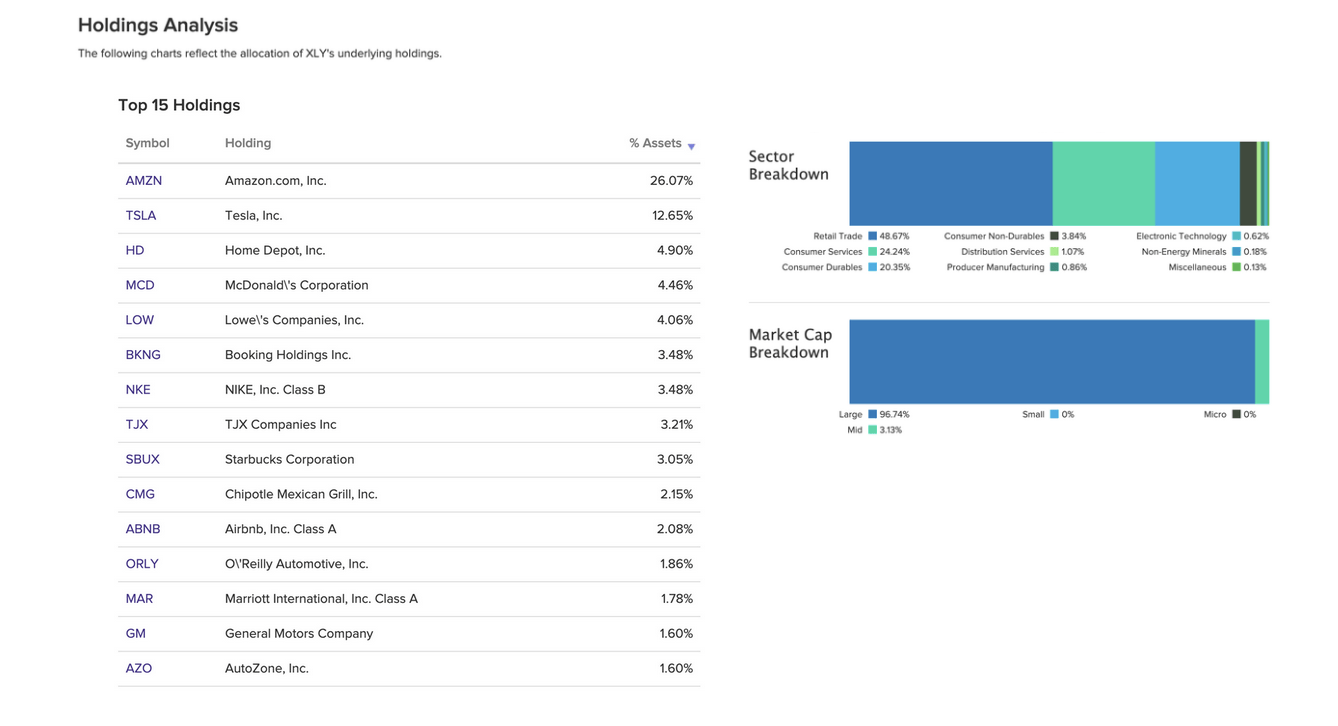
Here is how XLY compares with some of its peers. The list below is ordered by largest-to-smallest fund in terms of assets managed.
sa
As can be seen above, XLY is the largest fund that offers exposure to the consumer discretionary sector in the U.S. market, with over $20 billion in managed assets. However, due to the nature of the underlying index it tracks, a significant portion of the XLY fund’s assets are focused on a relatively smaller number of assets. As per the recent update, it holds just 54 stocks as compared to an average of 300 stocks held by its peers, such as Vanguard Consumer Discretionary Index Fund ETF (VCR) and Fidelity MSCI Consumer Discretionary Index ETF (FDIS) etfs. I have also added the iShares U.S. Consumer Discretionary ETF (IYC), which has a slightly different fund composition, which I will delve into in the next paragraph. The XLY fund also seems to be outperformed by its peers in almost all time periods, which really does not make the case for the XLY fund.
In terms of fund composition, there is not much of a difference in the assets that comprise the top stocks between XLY and its peers, such as VCR and FDIS. All three funds are top-tier, with a significant portion of the fund’s assets deployed towards Amazon (AMZN) and Tesla (TSLA).
etfdb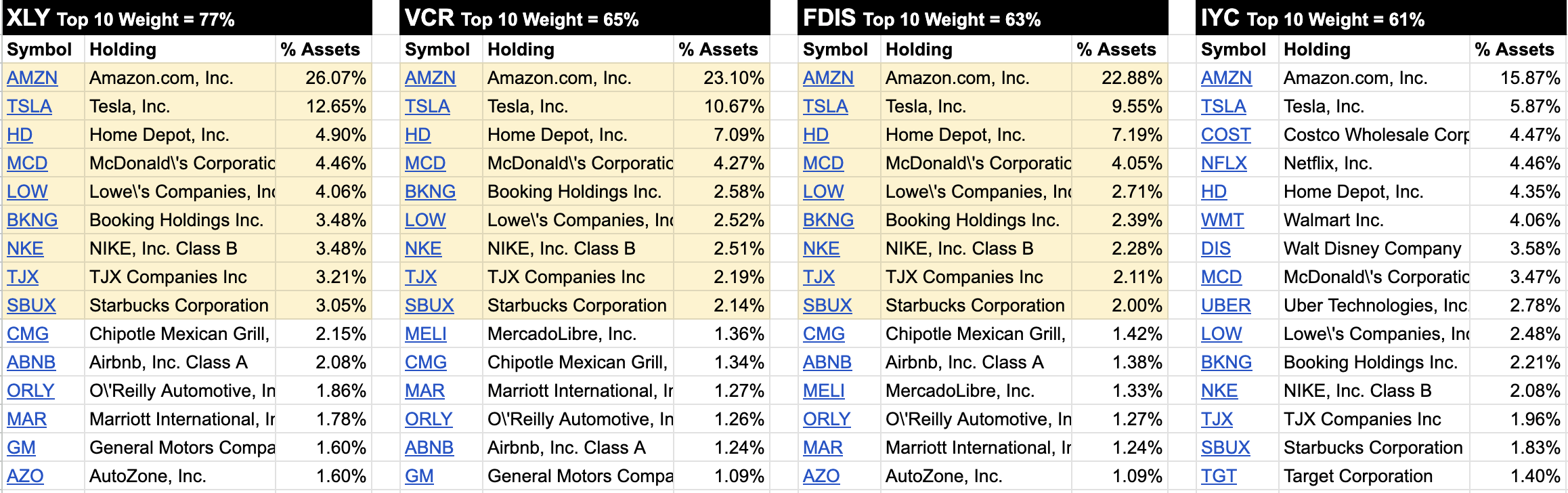
That is one of the reasons why I also added the IYC fund, which is slightly different in fund composition since some investors may not prefer the exposure to Tesla or other automobile and automobile parts stocks such as General Motors and O'Reilly Automotive, Inc. (ORLY). For example, Tesla currently trades at 56 times expected earnings this year while trading at 5 times expected sales this year. Consensus estimates project Tesla’s earnings to decline by 2.2% and sales to rise by 20% this year. Tesla’s weight in the XLY may continue to add downward pressure on a short-term basis.
In 2024, I believe that XLY will eventually benefit from macroeconomic crosscurrents that have so far been a tailwind to the U.S. economy. With inflation likely heading towards the U.S. Federal Reserve’s long-term inflation target of 2%, the Feds are likely to keep rates stable at current levels at the very least. The stability in the interest rate could provide some impetus for consumer spending to continue, especially given that real wages, after accounting for inflation, have again started growing, allowing consumers to spend more. This can also be seen in U.S. consumer sentiment, which has considerably improved since last year.
Real wages are back on a path of growth, U.S. Feds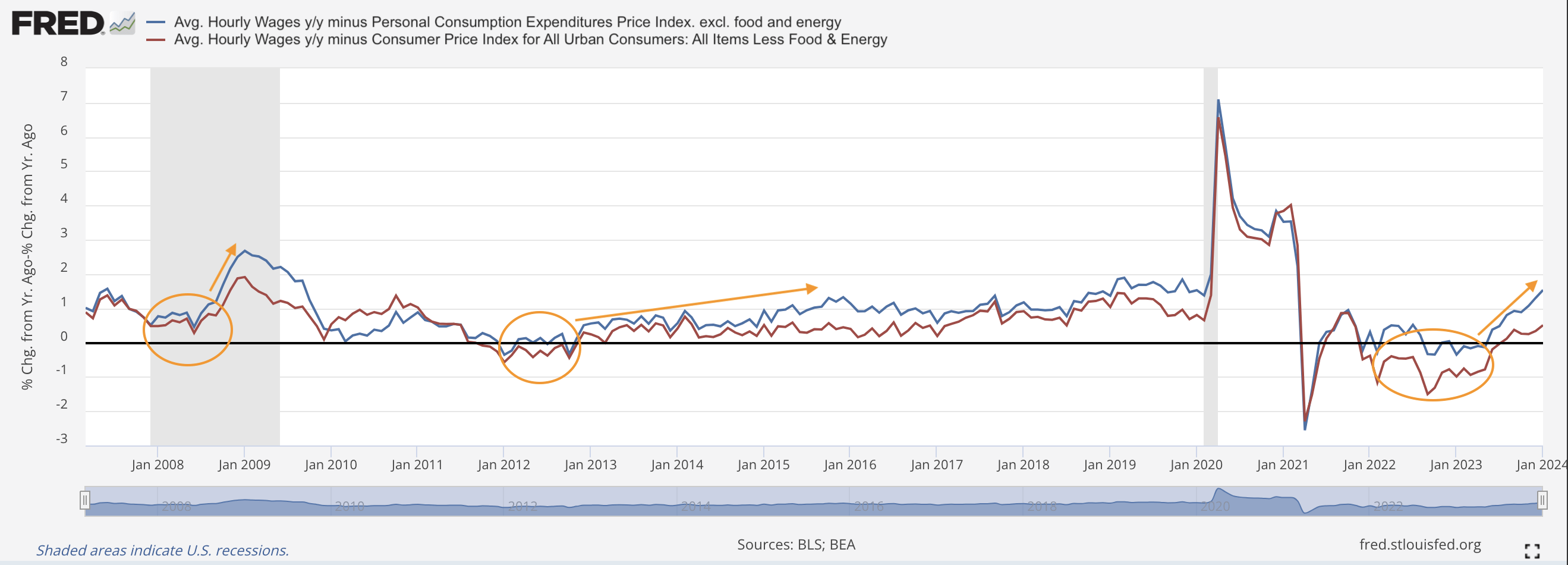
This could likely lead to strong top-line and bottom-line growth for companies in the XLY fund as the consumer spending outlook continues to improve. Over a longer period of time, the expected growth in per-share earnings of ~20%, as per its fact sheet, is superior to the long-term average growth rates of the S&P 500 of ~8%. For long-term investors, such superior earnings growth puts this fund in a position of strength and makes the long-term risk-reward appealing.
However, on a short-term basis, I believe the fund may be trading in the fair value range. First, the fund’s fact sheet shows XLY is trading at a forward PE of ~26 times forward earnings. This is higher than the S&P 500’s forward PE of 20.7, as per consensus estimates. In my view, S&P500’s forward PE also seems to be trading in the elevated range. The benchmark’s five-year forward PE usually trades ~19 times forward earnings, whereas the ten-year forward PE trades at ~17.7 times forward earnings. This implies the broader market may see a pullback of 8–10% in the short term, which allows investors to enter the XLY in this pullback due to the long-term thesis remaining intact.
Any risk to the consumer spending outlook would threaten the growth prospects of the stocks that are part of the XLY fund. If inflation makes a surprise return on the upside, it may dampen the mood among consumers, who may again switch their spending habits from discretionary to staples, causing headwinds in the XLY fund. Worse, if the U.S. Fed feels compelled to raise interest rates further, consumer spending could be severely impacted, affecting stocks in the XLY fund.
Another factor to consider is the upcoming U.S. presidential elections this year, which may have some impact on stocks. However, research from J.P. Morgan shows that elections do not impact consumer discretionary stocks generally, with average returns in election years remaining moderately higher.
To summarize, the tailwinds that have so far been helping the XLY fund will continue to drive gains for this fund, and the long term thesis continues to hold for this fund. However, on a short-term basis, there may be cause for investors to approach the XLY fund with moderate levels of caution as benchmark indices appear to have overbought. For now, I hold a neutral view on the XLY fund.