
Eoneren
Eoneren
In truth, I don't like the term "smart beta." Great marketing term, but at the end of the day, that's all it is. It's a term used to describe a style of factor investing that, like all things in markets, will have cycles where it works, and cycles where it doesn't. Despite my displeasure for the term, there are funds in the category of smart beta that are worth looking at.
One such fund that doesn't get too much coverage is the American Century U.S. Quality Growth ETF (NYSEARCA:QGRO), an exchange-traded fund, or ETF, that aims to provide investment results corresponding to the performance of the underlying Index while emphasizing high-quality, growth-oriented U.S. companies.
Originated on September 10, 2018, the American Century U.S. Quality Growth ETF uses a smart beta strategy (there's that term again), which transcends the traditional market-cap-weighted indexes to provide a more refined and strategic investment approach. The ETF had assets under management worth $888 million, making it one of the more sizable ETFs in the Style Box - All Cap Growth space.
As of May 31, 2023, the fund adopted a new index (the iSTOXX American Century USA Quality Growth Index) which further bolstered its commitment towards delivering what it hopes are differentiated returns through a focus on companies exhibiting strong growth, quality, and valuation fundamentals. The index is dynamic in how it allocates. The fund has an expense ratio of 0.29%, aligning it with the majority of peer products in the space.
The fund's portfolio is made up of various securities that exhibit higher profitability, return on assets, return on equity, leverage, and momentum. The ETF includes 202 holdings, with the top 10 holdings constituting about 25% of total assets under management. The largest holding currently is Booking Holdings Inc, with a 3.06% weighting.
americancentury.com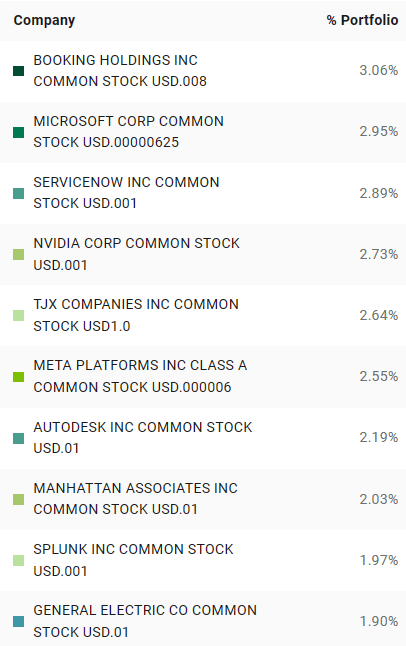
The fund's sector allocation reveals a heavy emphasis on the Information Technology sector, accounting for about 38% of the portfolio, followed by Consumer Discretionary and Industrials sectors.
americancentury.com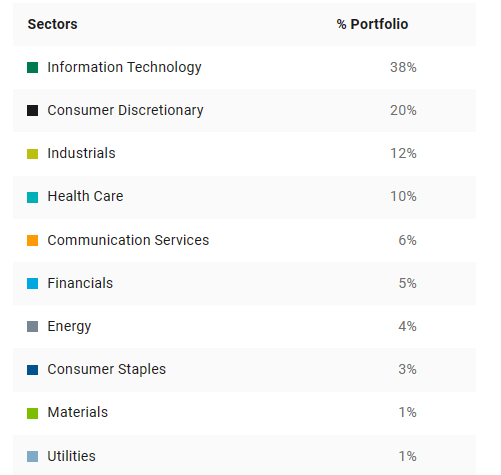
I view this personally as a bit of a red flag now. Technology is extended relative to every other major sector of the stock market, which means this fund could be vulnerable. Having said that, because the index it seeks to track is dynamic, holdings and weightings can change dramatically. Thus, it remains to be seen how impacted QGRO might be in the event of a Tech-driven downturn.
When compared to similar ETFs such as the iShares Russell 1000 Growth ETF (IWF), QGRO has underperformed as we can see in the price ratio below, but seems to have stabilized in terms of relative results in the last few months. The implication here is that the two funds over the last 4 years have largely performed in line with each other, making alpha/outperformance hard to achieve over a longer time period.
stockcharts.com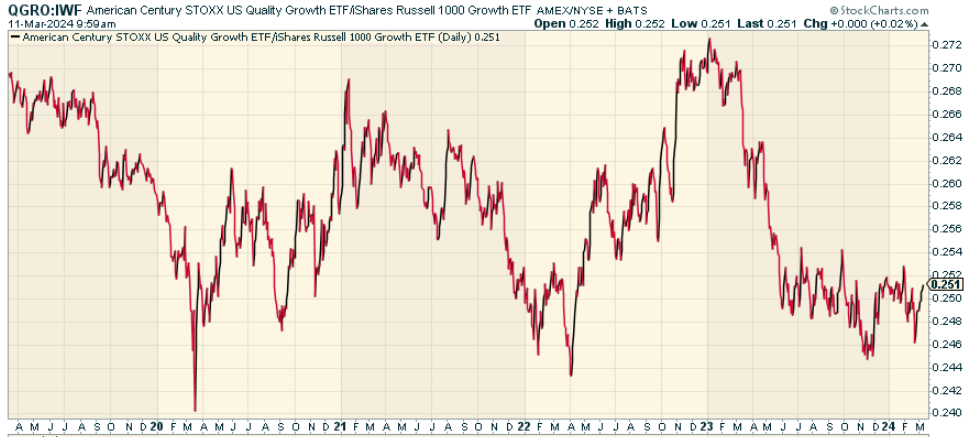
QGRO offers a dynamic, index-based, quality- and growth-centered strategy. It provides an adequate representation of the $1 trillion titans and mega caps that tilt on the growth style of investing. However, the fund's market-like performance may be insufficient for a Buy thesis, considering that the fund is active and dynamic against passive comparable funds that have similar returns. On the other hand, QGRO offers several advantages that make it a worthy contender for investors looking for growth opportunities. The problem I have with this is that it doesn't seem to be enough.
The American Century U.S. Quality Growth ETF is a good fund in that it has clearly capitalized on growth-oriented U.S. companies. That's not the issue. The issue is that the smart beta marketing term doesn't translate against passive vehicles. Maybe this will change, but to me, there are better and cheaper ways of getting similar returns without buying into this active approach. American Century U.S. Quality Growth ETF is a pass for me.