michal-rojek/iStock via Getty Images
michal-rojek/iStock via Getty Images
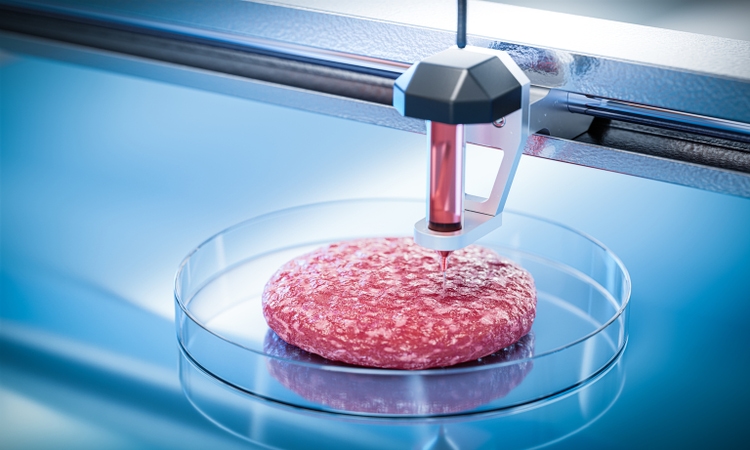
Way back in October 2021, the former UK premiere, Boris Johnson, forecast that "we" will soon be munching on "bio-engineered" burgers, rather than the more traditional cow sourced meat. I have to confess, at the time, I thought Mr Johnson was having a laugh, given his penchant for jovial repartee. As it transpires, he was serious, and furthermore, he was expressing the view of many thought leaders in the collective West.
Not too long back, I held the view that cows and other ruminants were carbon neutral. Afterall, grass converts CO2, through the miracle of photosynthesis, into sugars and amino acids. Cows take advantage of this and merrily graze on this source of nutrients, and then they convert the grass to expired CO2 and steaks. However, some bacteria in the animal's gut produce methane, a potent greenhouse gas. Over time, this methane is degraded to CO2 and H2O. Thus, one could argue that animals such as cows are carbon neutral. The problem is that methane takes around 10 years to degrade, and, so theory goes, the more cows, the higher the concentration of methane in the atmosphere.
Cows are by no means the only culprits in the methane production department. If you take a stroll over to your nearest chicken or pig farm and breathe in the aroma, you will quickly conclude that the manure produced by this livestock is also a significant source of greenhouse gases.
One of the problems with the idea that there are too many cows being raised in the collective West is that the number of ruminants has not changed sufficiently to account for the huge increase in methane in the atmosphere. For a start, some 200 years ago, there were, according to some estimates, in the order of 60 million bison roaming around the US prairies, and now, there is a fraction of that figure. Latest data for 2024 shows that the US currently has circa 87 million head of cattle, hardly enough difference to account for the massive uptick in the volume of methane in the air.
Could there be some issues with the chemistry that leads to the conversion of methane to CO2 and H2O? Well, according to research, there appears to be no drop in the levels of OH radicals that enables the destruction of methane.
How about herds of ruminants in countries outside of the collective West? According to Our World in Data, global meat production, which also includes livestock other than cows, has soared over the past 50 years. From the graphic, it can be noted that total production has more than quadrupled since 1961.
As can be seen, Asia holds the position of being the largest meat producer. Back in the 1960s, Europe and North America were the number one meat-producing regions. However, now their combined share has dropped significantly.
Meat production globally (Our World in Data)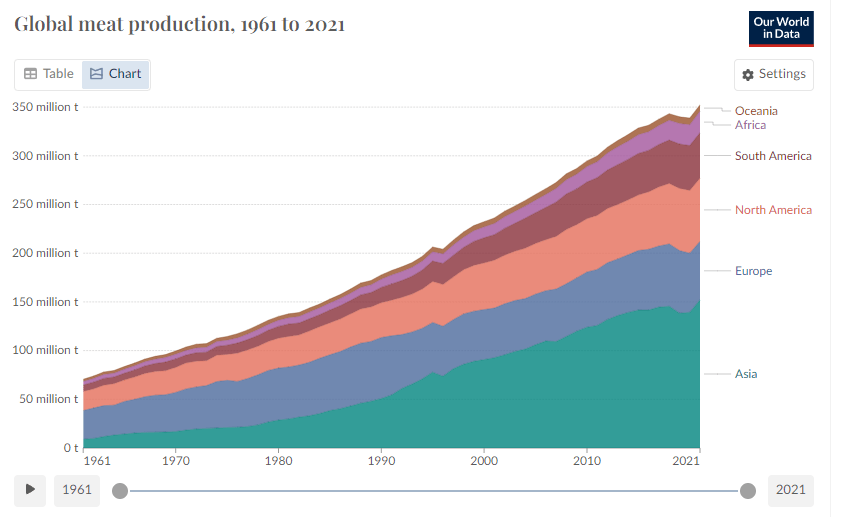
Interestingly, we can see that the amount of meat produced in Europe has hardly changed over the decades. Despite this, European leaders have taken the decision to take action to reduce methane emissions in Europe by curtailing livestock production.
At the forefront of the European drive to push down the levels of greenhouse gasses is the Dutch government. According to The Dutch Review; " the entire agriculture sector will have to shrink - quite drastically. More specifically, the Dutch livestock herd will likely have to be reduced by one-third if the Dutch want to have a chance of reaching their emissions goal."
If you follow the news, farmers all over Europe are demonstrating as their respective governments follow Holland in lockstep by introducing a wide variety of draconian measures to reduce livestock production.
What, may you wonder, will the denizens of Europe consume to maintain body and soul. For the answer to this question, I refer you to the prophecies of the mystic seer, Boris Johnson.
If the European Union follow through with their plan, meat like substances will soon be consumed in enormous quantities. Therefore, those companies supplying the compounds necessary to manufacture bio-engineered "meat" will get a significant boost to their turnover, and, one hopes, profits. I have previously penned an article pointing out Ginkgo Bioworks (DNA) as a potential beneficiary of the above trend. Of course, there are other companies which may also benefit from the move towards alternative "meat," Ingredion (NYSE:INGR) being one.
Ingredion produces various ingredients that can be used in plant-based meat alternatives. Some of the most relevant include:
All in all, Ingredion has its fair share of ingredients to enable the company to profit from the push towards meat alternatives.
Ingredion's most recent quarterly report is for the fourth quarter, which was released on February 6. From the report, as is usual, there were both positives and negatives.
Ingredion operates in the competitive specialty ingredient market, and faces competition from several bigger players, including:
While the specialty ingredient market is competitive, Ingredion possesses some potential moat attributes:
On balance, I would say a climb down by European and other Western governments would be an obvious negative for my thesis. It is clear from news reports that farmer protests are getting quite intense, so there is this possibility. As regards existing revenues from Europe, on the latest conference call, the company did not provide this data. So, in the event of a climbdown, we may surmise that revenues will remain relatively flat. Also during the conference call, the company stated; "For 2024, we expect greater volume demand and improvement in manufactured cost per ton. Our goal is to continue to grow our gross profit dollars by way of managing higher gross profit dollars per ton." It is also possible that this goal may not be achieved.
There are powerful forces behind the impetus to reduce greenhouse gases, which involves forcing the numbers of livestock downwards. Given the continuing necessity for food, it seems entirely likely that alternatives to farmed food will receive a boost in demand. Therefore, it seems to me that Ingredion has an excellent tailwind. On top of that, the company is improving profitability and pays a reasonable dividend.
Please be advised that I am long both Ingredion and Ginkgo Bioworks, so please carry out your own due diligence.