
Hispanolistic
Hispanolistic
I've been public about my belief that we are in the final phase of large-cap growth dominance. If you agree, that means you want to tilt towards value, and tilt smaller in overall market cap as part of your equity allocation. The Invesco S&P MidCap 400® Pure Value ETF (NYSEARCA:RFV) is one way to do just that. RFV is a passively managed investment fund, established to offer investors a diversified exposure to mid-cap value stocks in the U.S. market. The fund has been tracking the S&P MidCap 400 Pure Value Index since its inception in March 2006, and has an expense ratio of 0.35%.
The RFV ETF has a well-diversified portfolio, with 93 holdings currently. Top positions include
These holdings reflect the fund's strategy to invest in companies that exhibit strong value characteristics, providing a unique opportunity for investors to gain exposure to a diverse array of sectors. No position makes up more than 3.44% of the portfolio, making it well diversified. The holdings give the fund its attractive valuation metrics, with a Price/Earnings Ratio of just 11.46, and a Price/Book Ratio of 1.22.
RFV's portfolio is diverse in terms of sector representation. As of December 31, 2023, the fund's sector breakdown was as follows:
This sectoral allocation showcases the fund's broad exposure across various industry sectors, ensuring that the fund's performance is not overly dependent on the performance of a single sector. Just keep in mind that the heavy exposure to Discretionary stocks and Financials might be problematic should the economy really begin to slow down on demand concerns and lending.
When it comes to peer comparison, it's important to contrast RFV's performance and metrics with similar ETFs. For instance, RFV can be compared with the iShares S&P Mid-Cap 400 Value ETF (IJJ) and the iShares Core S&P Mid-Cap ETF (IJH).
RFV has performed considerably better than both IJJ and IJH in the last several years, making it a stronger fund than just a core mid-cap fund like IJH. It's done better than IJJ because the sector makeup is different. IJJ as a value fund has its largest weighting in Financials at 23.85%, which is hurt given the way regional banks have performed in the last year.
StockCharts.com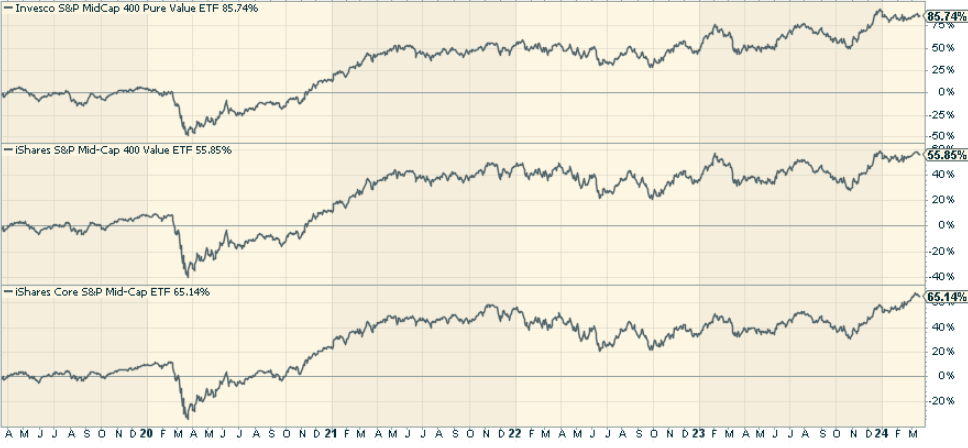
Investing in RFV comes with its own set of advantages and potential drawbacks that investors should consider.
The Pros:
The Cons:
Investing in Invesco S&P MidCap 400® Pure Value ETF may be particularly appealing to those seeking exposure to a diversified portfolio of mid-cap value stocks. The fund's historical performance and strong value characteristics make it a potentially profitable investment. I prefer this over large-cap market proxies, and think the time for value is nearer than ever.