
DNY59
DNY59
Back in the beginning of December, I wrote an article about the funds I use to park my "dry power," or cash holdings that I keep in reserve for future investment opportunities.
The two funds are the iShares 0-3 Month Treasury Bond ETF (NYSEARCA:SGOV) and the Simplify Enhanced Income ETF (NYSEARCA:HIGH).
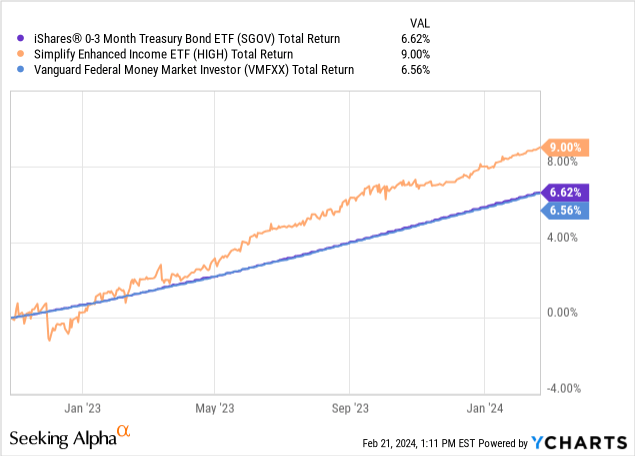
In the meantime, I want this cash to get me the best yield I can. I'm willing to withstand a bit of volatility, but I exclude funds with a standard deviation higher than 4%.
Ideally, I want 5% or higher on this cash. This has been easily doable for the past few months since the yield curve is still inverted. The Fed has signaled that it may stay like this for some time, using the phrase, "higher for longer" when describing rates.
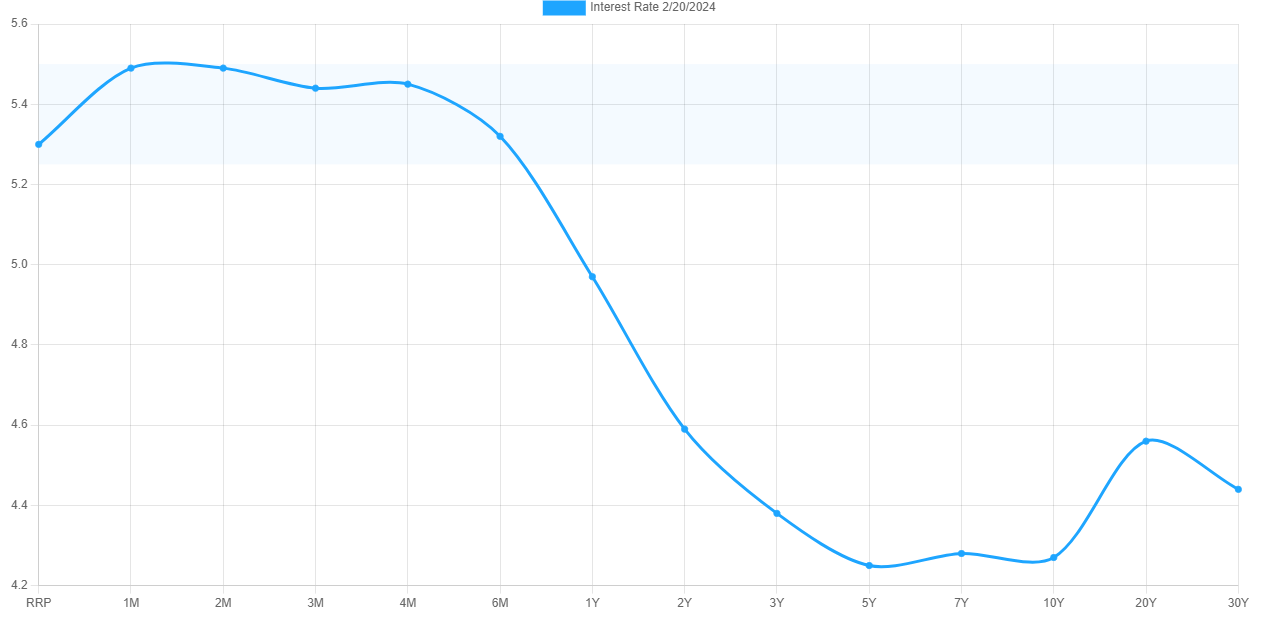
Figure 1 (US Treasury)
Note that I treat "dry powder" differently than transient cash that moves around my account between trades due to dividends being paid out, premium from option sales, etc. This I hold in the Fidelity Government Money Market Fund (SPAXX).
This inversion means that shorter-term treasuries are paying higher than longer term treasuries. While there is still some merit to long term USTs, I do not want to take on the risk that 2+yr treasuries bring, especially when you get out further along the curve to look at the 7-10yr range.
While this article is intended to be a follow-up on my cash holdings, newer readers will benefit from a quick overview of both funds. If you are already familiar with these, feel free to skip to the next bolded headline.
Both ETFs are geared toward short-term cash parking but tackle the income problem in different ways.
| SGOV | HIGH | |
| Price | $100.57 | $24.60 |
| Yield (TTM) | 4.92% | 9.59% |
| ER | 0.07% | 0.51% |
| AUM | $18.2B | $0.36B |
| Stdev** | 0.53% | 1.36% |
*Annualized standard deviation.
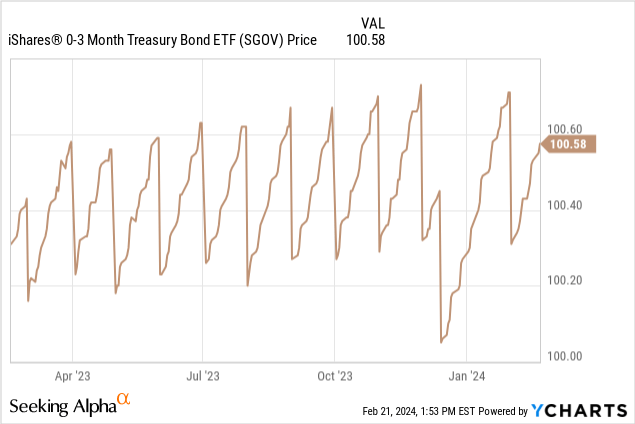
At their cores, both funds hold US Treasury bills maturing within 3 months. SGOV aims for as little duration as possible, basically zero, and has a very consistent "whipsaw" pattern where its price stays relatively stagnant, builds up toward the dividend, and pays out the dividend before going back to even.
Note the larger drop in December is from additional distributions made by the ETF. The price returned back to normal very quickly.
It is important to note that SGOV's distributions are tax advantaged at the state level. For me, a California resident, this translates into significant gains over non-government money market funds paying about the same yield.
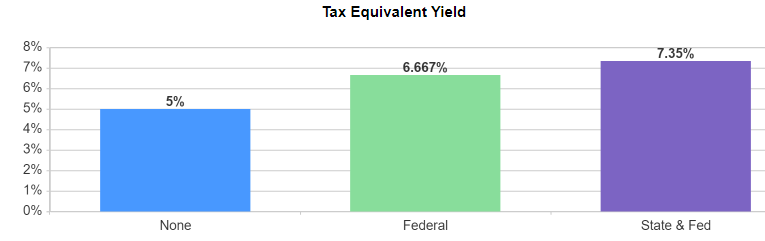
Figure 2 (Bankrate)
HIGH, on the other hand, uses their T-Bill holdings to collateralize call and put spreads on liquid indices and stocks. They use an algorithm to target inefficiencies in the market, where implied volatility is unlikely to manifest into realized volatility. While they can use their bond holdings as collateral, meaning the trade does not take any additional capital input, this does add a layer of risk in case those trades go south.
This strategy has led HIGH to currently have positions open on the S&P 500 index (SPX) and the iShares 20+ Year Treasury Bond ETF (TLT). In the past, HIGH has also sold spreads on (COP), (CVS), (CVX), and others in the past.
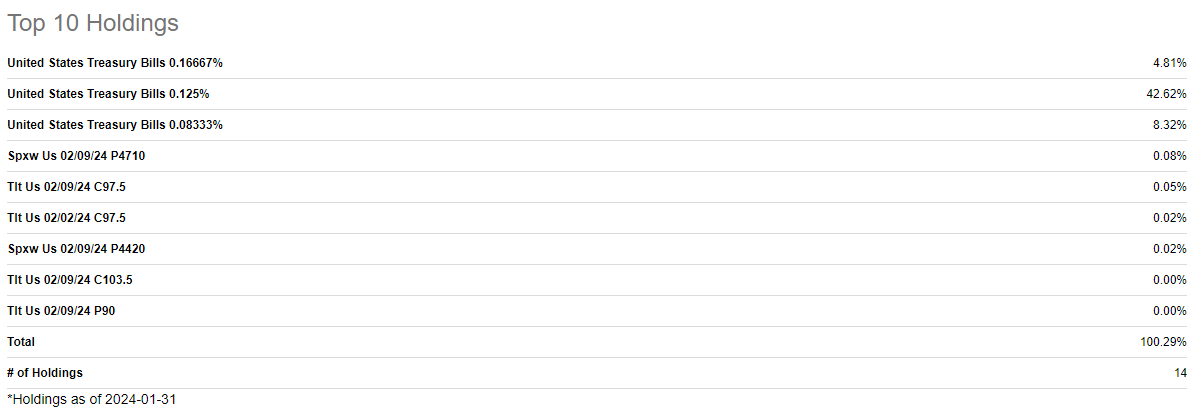
Figure 3 (Seeking Alpha)
For one, HIGH has successfully stayed within our standard deviation target and continues to put out a yield close to 10%. I do not see this train stopping anytime soon, as the T-Bills staying at 5%+ means that the options only need to generate a similar return to meet that target of 10%.
This is easier said than done but Simplify did it.
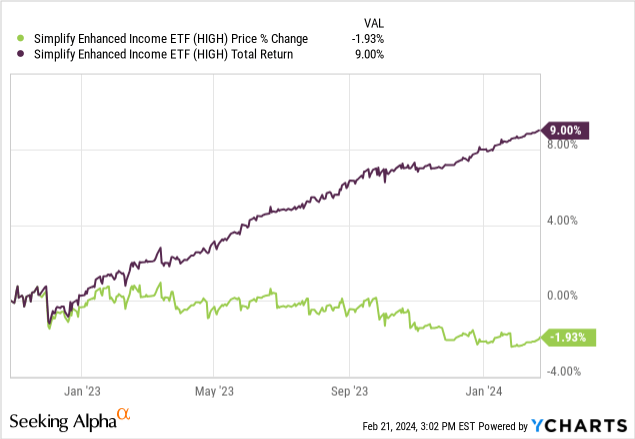
I have a slight capital loss on HIGH, but the income has more than made up for it.
The monthly distributions have been fairly consistent, with a recent spike due to capital gains distributions. We are back to the $0.20/month that investors have come to expect.
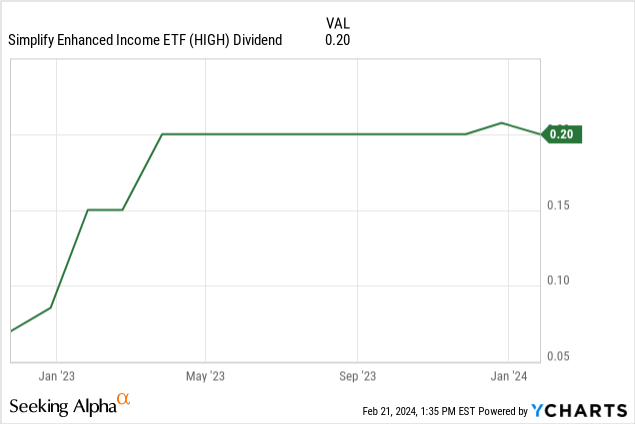
This level of consistency is rarely seen among options income funds, which may vary wildly from month to month as they rely primarily on volatility to drive income.
Because half of HIGH's income comes from T-Bills, they do not have to position aggressively with options, and have seemingly been able to generate consistent returns regardless of where the VIX is.
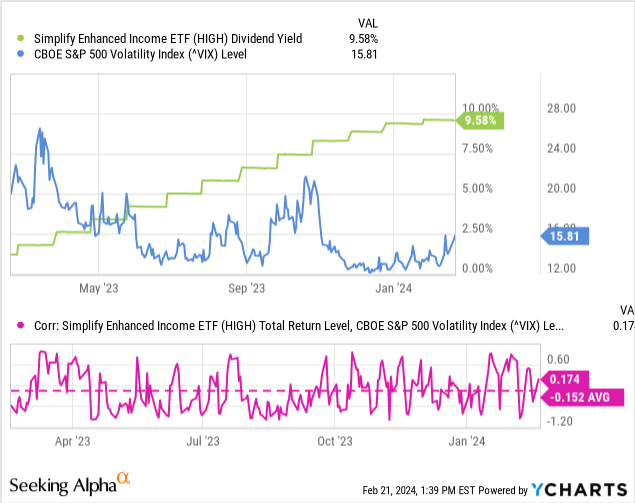
Neither HIGH's yield nor total return seems to be tied to the VIX, which shows us how little its options holdings can be affected by volatility. HIGH's total return has no correlation with the level of the VIX, meaning that we can expect a sudden spike in volatility to have little effect on HIGH, despite its income stream's connection to options spreads.
This was a major risk that I put forward in my prior article:
[HIGH's stability] could change in a rapid decline (like a crash), and with such a high negative Vega, the position could lose money very quickly. This is one of the major risks of holding funds that write options.
That being said, HIGH's algorithm does use a proprietary risk management system and would close the position before it became too detrimental to the fund. There is still the possibility and losing positions do happen.
Lo and behold! HIGH has performed exactly as expected since then and has shown little to no correlation to volatility overall. This is a huge win for Simplify, who came under pressure for the fund algorithm's opaque nature and gamble on options spreads.
I intend to keep my cash parked in these two ETFs for the foreseeable future, as I believe the Fed when they claim that they are going to wait for definitively good data before lowering rates.
This means we are likely to have several months ahead of us before meaningful rate changes take effect. These yields may stand for another quarter or more before I will need to position more aggressively.
SGOV remains the easiest core holding to recommend as a strong buy currently, as T-Bills are the best way to access the highest rates with the lowest volatility.
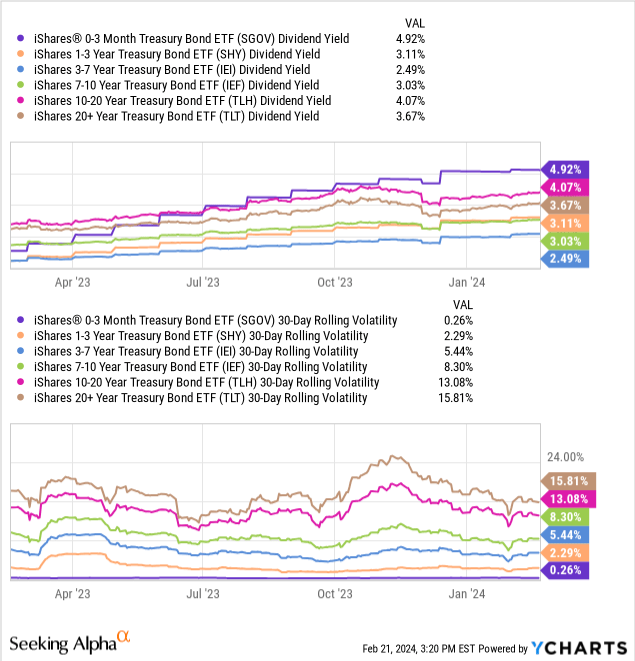
This makes them a no-brainer choice for my cash holdings currently.
I will be watching the Fed meetings, and waiting for them to say that they are happy with the economic data enough to start lowering rates. In line with typical Fed actions, we will likely be warned in advance. I expect that at the March meeting, rates will remain unchanged and the "higher for longer" narrative will continue to play out.
So long as the Fed has signaled that rates are staying here, I won't be moving my cash out of SGOV and HIGH. I've been paid handsomely for holding such low volatility instruments and am happy to continue doing so until rates fall back below 4%.
HIGH has earned an upgrade for its volatility management, to a strong buy from me. It continues to be a staple of my portfolio and I consider it a core holding of mine now. I am considering increasing my position in HIGH to include investments that are not "dry powder," as I believe it can also be used to compliment an income portfolio more generally.
SGOV maintains its strong buy and is still the best choice for risk-adverse investors in the current rate climate. T-Bills are considered one of the safest investments for Americans to make, since they are backed by the government.
For now, my cash is parked in SGOV and HIGH, and I'm better off for it. It's not moving until the Fed speaks, at least, and even then might stay put for as long as rates stay this high.
Thanks for reading.