
champpixs
champpixs
Candidly I'm surprised that Broker-Dealer and Exchange stocks have held up so well relative to other stocks in the Financial sector. I often track the space more as a signal of market activity broadly. It's not one I'd invest in however. To that end, it's worth keeping an eye on the iShares U.S. Broker-Dealers & Securities Exchanges ETF (NYSEARCA:IAI) to get a sense of market expectations for future activity and broader economic health.
IAI is an ETF that seeks to track the performance of the Dow Jones U.S. Select Investment Services Index. It primarily invests in U.S. equities in the investment services sector, with a specific focus on broker-dealers, securities exchanges, and investment banks. The fund was launched on May 1, 2006, and has a management fee of 0.40%. As of November 10, 2023, it had net assets of approximately $382 million.
Investing in the stocks of broker-dealers, securities exchanges, and investment banks can be beneficial for a few reasons. Broker-dealers earn income from trading commissions, the spread on securities, and underwriting securities, which can provide steady revenue streams during varying market conditions. Securities exchanges earn money from transaction and listing fees and selling data, providing a diversified income stream and stability. Investment banks generate revenue from advisory fees for mergers and acquisitions and capital raising, underwriting fees, and proprietary trading, allowing them to profit from high-value transactions. Investing in these financial institutions can provide exposure to the broader economy as their performance tends to correlate with economic growth.
Understanding the holdings of an ETF is crucial as it gives investors an insight into the fund's exposure and risk profile. These top five holdings, make up approximately 49% of the overall fund.
The fund's exposure is skewed towards Financial Exchanges & Data, with Investment Banking & Brokerage making up the rest.
ishares.com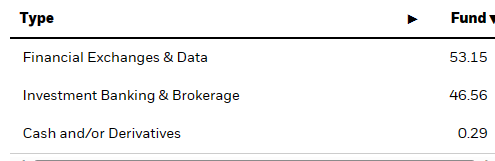
This is primarily a large-cap fund, but does have some good exposure to mid and small-cap names which I personally favor tilting towards given how poorly most stocks have done in that market cap range.
ycharts.com
One of the main competitors to IAI is the SPDR S&P Capital Markets ETF (KCE). KCE tracks the S&P Capital Markets Select Industry Index and offers exposure to the same sector as IAI. However, there are significant differences in the expense ratios, performance, and risk profiles of these two ETFs.
KCE has an expense ratio of 0.35%, slightly lower than IAI's 0.40%. In terms of performance, IAI showed a better return compared to KCE in both the one-year and three-year periods. However, IAI has a higher beta and standard deviation, indicating a higher risk compared to KCE.
When we look at the ratio of IAI to KCE, we can see IAI looks set to outperform on a relative basis.
stockcharts.com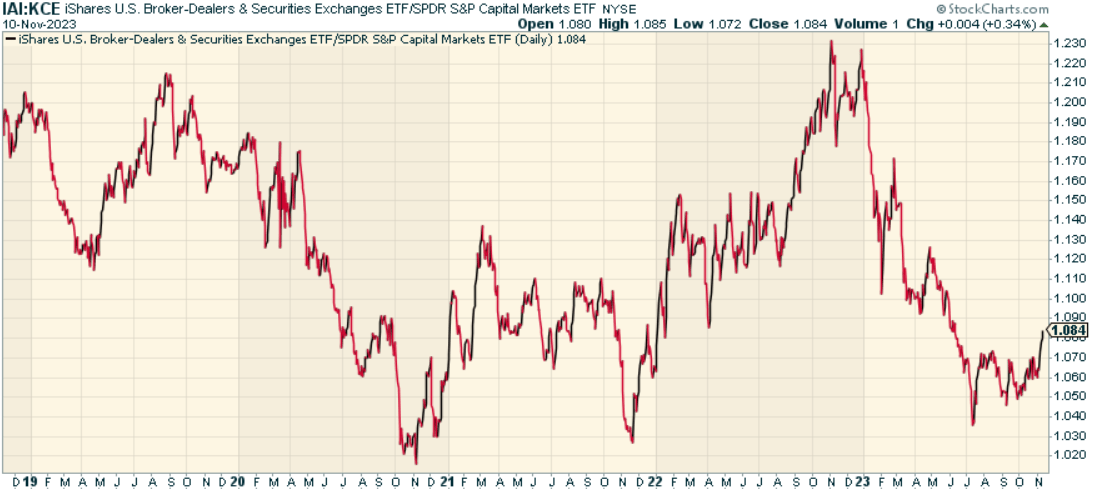
IAI can be a good choice for investors who are bullish on the sector's outlook and are willing to take on a higher level of risk. However, given a potential looming recession and corporate credit event, it's not one I'd favor here. If anything, it's one I would watch to potentially confirm if the risks I've been highlighting are starting to get priced in. The more recent sideways action may be telling in that regard.