Matteo Colombo
Matteo Colombo
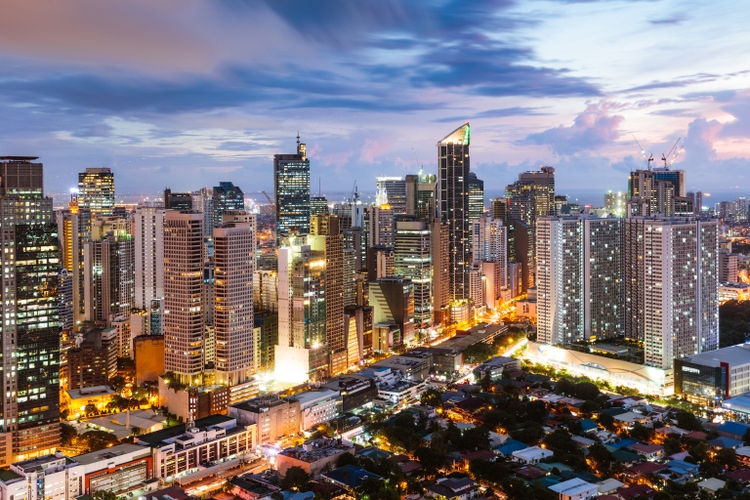
Endowed with an abundance of natural resources and convenient positioning to major Asian markets, the potential of the Philippines is enviable. The Philippines is a unique amalgam situated in the Western Pacific; the archipelago of over 100 million endured four centuries of colonial rule, first by the Spanish, then by Americans, until 1946 when it gained independence. Although the footprint of these influences remains, the Philippines has emerged as a distinct market, and something that would behoove investors to learn more about.
Today, I'll consider the iShares MSCI Philippines ETF (NYSEARCA:EPHE) as one option for investors wishing to express a single country view on the Philippines and how it is well positioned in the broader region.
One thing that surprised me in conducting research for EPHE was just how long of a track record many single country ETFs have. While EPHE was incepted in 2010, there are some Southeast Asian ETFs that data back much further. The iShares MSCI Malaysia ETF (EWM) dates back to 1996, when iShares launched their initial slew of 17 single-country ETFs. In fact, several single-country offerings predate some regional offerings; the iShares MSCI Emerging Markets ETF (EEM) did not debut until 2003. This seemed counterintuitive to me. I would have assumed demand for a broad-bucket EM category would have taken priority that of a single-country Malaysian ETF. This is a good opportunity to remind readers of how I think of single-country ETFs - It's not either-or, it's both-and.
I think of single country ETFs as complements, or enhancers. For instance, an allocation to EM that is complemented by another targeted EM country with which you have higher conviction. That could be based on an expectation on a currency movement, or even a commodity cycle that could be highly present in a country ETF. There are other lenses through which to view single country allocations, that I will continue to touch on in forthcoming articles.
Seeking Alpha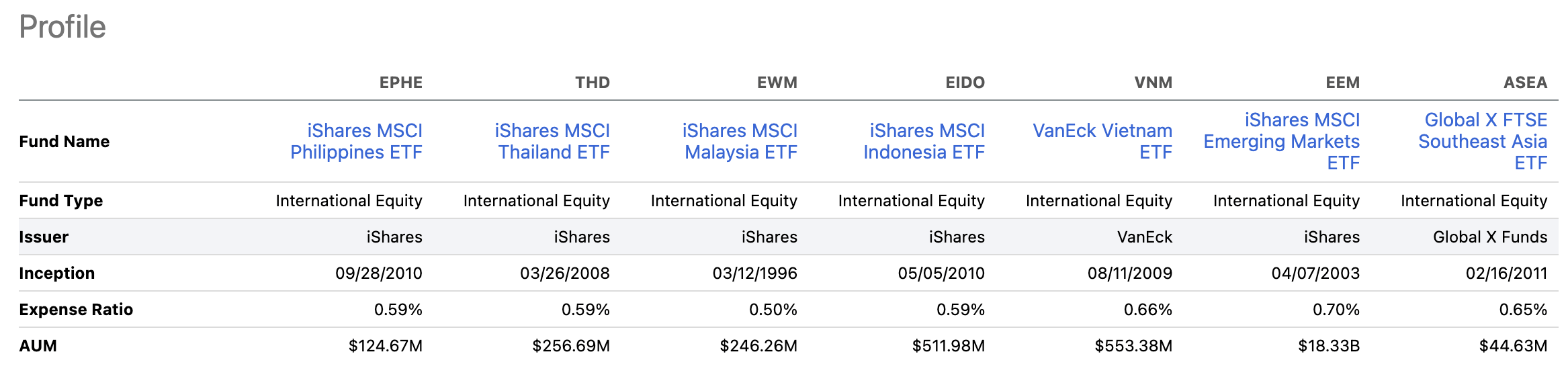
As mentioned above, the Philippines has a large population and according to the CIA World Factbook, it is young. The median age is 25.4 and young populations can contribute to future growth prospects, as runway for labor participation and consumer spending is lengthier. While GDP targets fell short in 2023, the Philippines still grew by 5.6%. The same source attributes the omnipresent global challenges of heightened inflation and corresponding interest to limiting growth in 2023. While inflation appeared to be contained by Q4 of 2023, inflation accelerated in February of 2024, owing in part to a rise in the prices of rice.
The country is also at an interesting crossroads with respect to global security. The Philippines is one of several nations that is impacted by the South China Sea territorial disputes. Tensions have recently escalated as attitudes towards the conflict have shifted since Marcos replaced Duterte as president in 2022; Duterte had previously favored stronger ties with China, while Marcos has reverted to an old alliance with the US. One incidental benefit is a recently announced $1B investment in the Philippines by the US, in an effort to enhance the diplomatic ties that will benefit US Defense posture. The investment will likely be directed toward clean tech and digitisation efforts in the country, and there is an additional emphasis on building supply chain resiliency between the two countries.
EPHE tracks the market-cap weight MSCI Philippines IMI 25/50 Index. The total AUM of the fund is roughly ~$126M in assets and priced in line with other single country ETFs with an expense ratio of 0.59%.
EPHE holds a total of 39 individual holdings, which is unsurprising given the breadth of the equity market, though still makes this a very concentrated ETF e. For a county-specific emerging markets ETF, EPHE is well diversified from a sector perspective. The three primary sectors to which the fund is allocated are Financials, Industrials, and Consumer Cyclicals, each carrying roughly 20% of the fund. Real Estate also has a decently large presence with a 17% allocation.
Seeking Alpha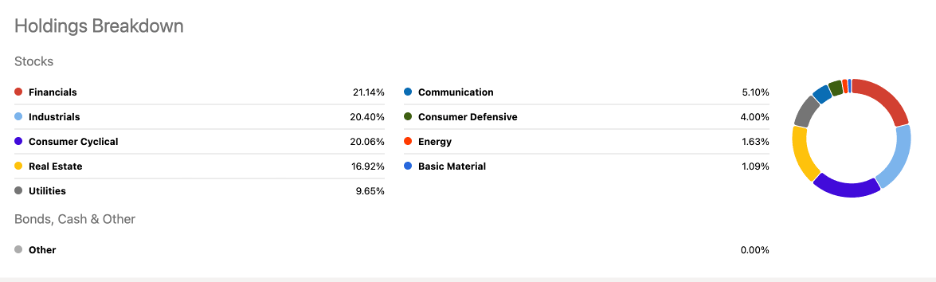
The top 10 holdings for the fund account for 61% of the total AUM. The largest stock allocation, accounting for just above 10% of total assets belongs to BDO Unibank Inc. (OTCPK:BDOUF). BDO Unibank - formerly Banco de Oro is a diversified bank operates in several divisions, including commercial banking, investment banking, as well as Insurance. It is the largest bank in the Philippines and is up ~+13% YTD. The second largest holding belongs to SM Prime Holdings Inc. (OTCPK:SPHXF) a commercial property developer. While the stock is down about -5% YTD, it's balance sheet demonstrates decent financials with strong operating cashflow.
Seeking Alpha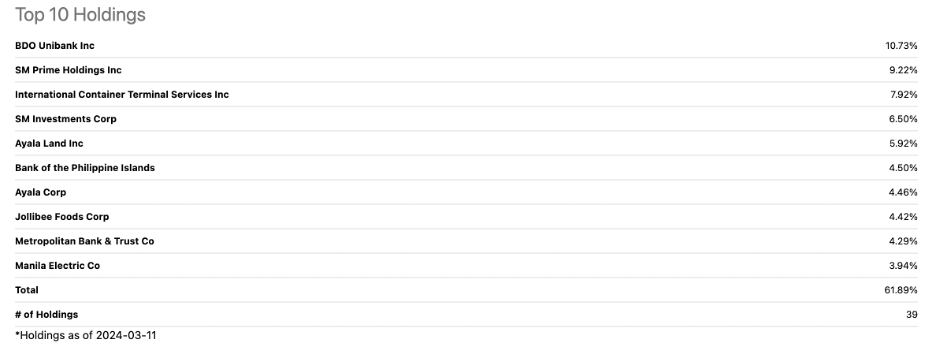
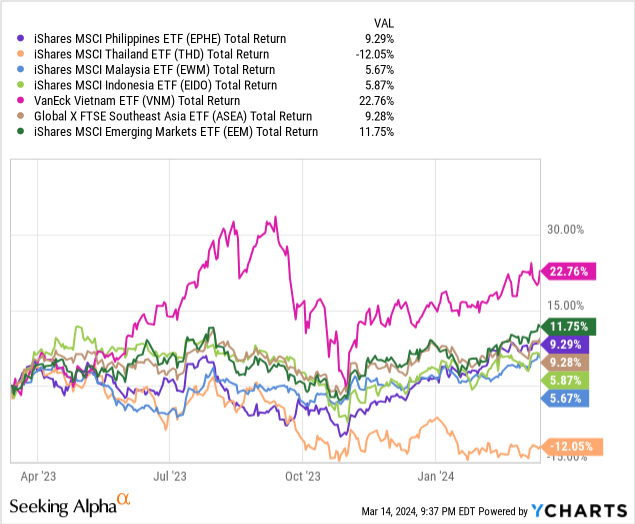
EPHE has slightly outperformed the broader regional Southeast Asian market (ASEA) on a trailing 1-year basis. It has also outperformed the majority of its single country peers in the region in the same period. The exception is the VanEck Vietnam ETF (VNM), which has had a banner year, returning +22.76% in the same period. EPHE has underperformed broader emerging markets (EEM), though not considerably.
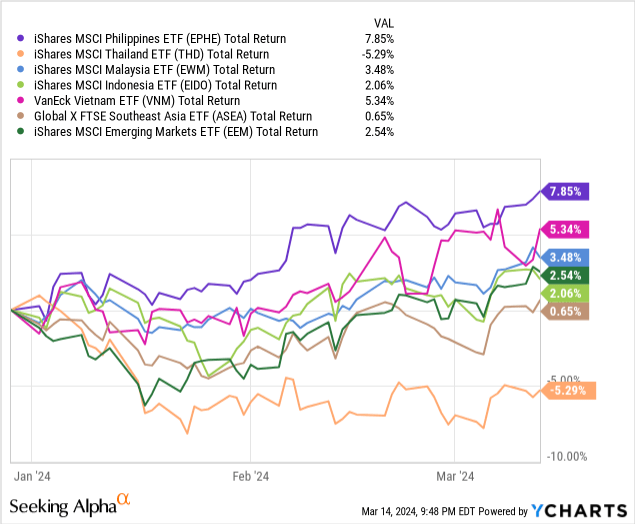
When we shorten the window to just 2024, we see EPHE has significantly outperformed broader regional market, as well as the majority of single country ETFs within Southeast Asia YTD.
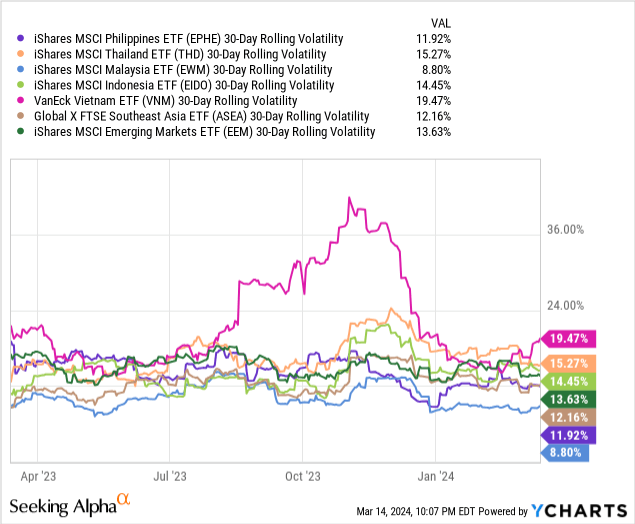
Of course, when considering any allocation, though particularly a single country emerging market allocation, risk is an important consideration. When looking at 30 day rolling volatility, we see EPHE's risk is on the lower-end of this peer universe, making its return profile more appetizing on a risk-adjusted basis.
While there are encouraging pieces to the EPHE story, there are some risks worth highlighting. Currency fluctuations could negatively impact EPHE; if the Philippine Peso depreciates vs. the USD, this could further accelerate inflation as the country would have weaker purchasing power for key import commodities such as oil and some food staples. The geopolitical risk in the region also remains elevated. Despite strong ties with the US, if China were to make a drastic move (landgrab or otherwise), this could paralyze exports in the region as maritime trade routes are compromised.
EPHE is a well-priced, concentrated ETF that provides narrow exposure to the Philippines, which is a dynamic economy that is poised for growth. Reasons for growth are both organic (young population, growing GDP), but there are exogenous factors that have the potential to springboard the economy and financial markets. There's an old adage, "the enemy of my enemy is my friend." The Philippines and the US' alliance is strengthening in response to saber rattling in the South China sea. The United States' has a vested interest in shoring up to country economically, providing direct investment, to in part cultivate favor with the country and its citizens. For investors looked for a targeted exposures in an Asian Emerging Markets, I would rate EPHE as a Buy.