
FG Trade/E+ via Getty Images
FG Trade/E+ via Getty Images
This monthly article series shows a dashboard with aggregate industry metrics in consumer staples. It is also a review of sector exchange-traded funds, or ETFs, like Consumer Staples Select Sector SPDR® Fund ETF (XLP) and iShares Global Consumer Staples ETF (NYSEARCA:KXI), whose largest holdings are used to calculate these metrics.
The next two paragraphs in italics describe the dashboard methodology. They are necessary for new readers to understand the metrics. If you are used to this series or if you are short of time, you can skip them and go to the charts.
I calculate the median value of five fundamental ratios for each industry: Earnings Yield ("EY"), Sales Yield ("SY"), Free Cash Flow Yield ("FY"), Return on Equity ("ROE"), and Gross Margin ("GM"). The reference universe includes large companies in the U.S. stock market. The five base metrics are calculated on the trailing 12 months. For all of them, higher is better. EY, SY and FY are medians of the inverse of Price/Earnings, Price/Sales and Price/Free Cash Flow. They are better for statistical studies than price-to-something ratios, which are unusable or non-available when the "something" is close to zero or negative (for example, companies with negative earnings). I also look at two momentum metrics for each group: the median monthly return (RetM) and the median annual return (RetY).
I prefer medians to averages because a median splits a set into a good half and a bad half. A capital-weighted average is skewed by extreme values and the largest companies. My metrics are designed for stock-picking rather than index investing.
I calculate historical baselines for all metrics. They are noted respectively EYh, SYh, FYh, ROEh, GMh, and they are calculated as the averages on a look-back period of 11 years. For example, the value of EYh for food in the table below is the 11-year average of the median Earnings Yield in food companies.
The Value Score ("VS") is defined as the average difference in % between the three valuation ratios ((EY, SY, FY)) and their baselines (EYh, SYh, FYh). The same way, the Quality Score ("QS") is the average difference between the two quality ratios ((ROE, GM)) and their baselines (ROEh, GMh).
The scores are in percentage points. VS may be interpreted as the percentage of undervaluation or overvaluation relative to the baseline (positive is good, negative is bad). This interpretation must be taken with caution: the baseline is an arbitrary reference, not a supposed fair value. The formula assumes that the three valuation metrics are of equal importance.
The next table shows the metrics and scores as of writing. Columns stand for all the data named and defined above.
VS | QS | EY | SY | FY | ROE | GM | EYh | SYh | FYh | ROEh | GMh | RetM | RetY | |
Staple/Food Retail | 9.09 | 8.82 | 0.0515 | 2.3142 | 0.0219 | 20.99 | 19.45 | 0.0394 | 1.8996 | 0.0293 | 16.48 | 21.54 | 2.56% | 10.06% |
Food | -3.06 | -6.39 | 0.0497 | 0.7601 | 0.0144 | 13.97 | 31.66 | 0.0450 | 0.6455 | 0.0230 | 15.24 | 33.14 | -1.46% | -10.38% |
Beverage | 8.62 | -6.45 | 0.0349 | 0.2625 | 0.0206 | 22.67 | 47.71 | 0.0344 | 0.2598 | 0.0167 | 23.56 | 52.51 | 0.10% | 0.53% |
Household prod. | 19.84 | -30.92 | 0.0232 | 1.2163 | 0.0616 | 6.37 | 41.09 | 0.0450 | 0.8767 | 0.0364 | 16.83 | 40.97 | 9.43% | 13.01% |
Personal care | -10.36 | 9.94 | 0.0333 | 0.3829 | 0.0167 | 22.84 | 60.37 | 0.0362 | 0.4257 | 0.0192 | 20.29 | 56.27 | 3.66% | 3.43% |
Tobacco | 64.80 | -37.51 | 0.1023 | 0.8987 | 0.0246 | 9.28 | 50.59 | 0.0604 | 0.5108 | 0.0165 | 33.76 | 51.89 | -3.22% | -5.93% |
The next chart plots the Value and Quality Scores by industry (higher is better).
Value and quality in consumer staples (Chart: author; data: Portfolio123)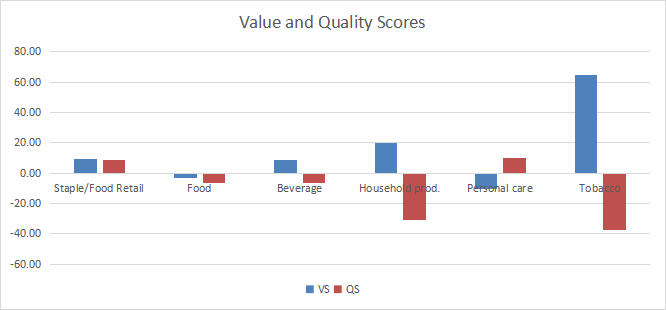
Valuation has improved in beverages and deteriorated in tobacco and household products. Quality has improved in personal care products and deteriorated in household products, too.
Value and quality variation (Chart: author; data: Portfolio123)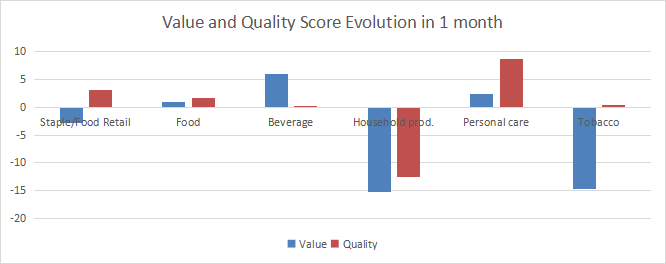
The next chart plots momentum scores based on median returns.
Momentum in consumer staples (Chart: author; data: Portfolio123)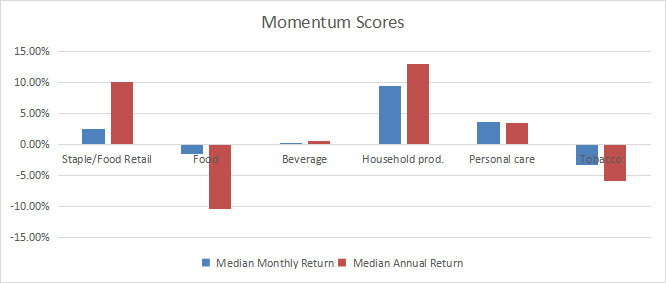
According to my S&P 500 dashboard, the consumer staples were very close to 11-year averages in valuation at the beginning of February. The tobacco industry, and to a lesser extent the household product industry, are materially undervalued. Their quality scores are below the historical baseline, though. A note of caution about sample size: there are only five tobacco companies in my reference universe, so statistics in this industry aren't the most reliable. Other subsectors are quite close to their baselines regarding both value and quality.
iShares Global Consumer Staples ETF started investing operations on 09/12/2006 and tracks the S&P Global 1200 Consumer Staples Capped Index. It has 101 holdings, a 12-month trailing yield of 2.98%, and a total expense ratio of 0.41%. It is more expensive than U.S. index ETFs in the same sector as XLP, whose fee is 0.09%. About 58% of asset value is invested in U.S. companies. Large and mega-cap companies represent 81% of assets.
The portfolio is quite concentrated: the top 10 holdings, listed in the next table, have an aggregate weight of 49.1% and the largest position weighs 9%. However, iShares Global Consumer Staples ETF is more diversified than XLP, where the top 10 weigh about 69% and the same top name, The Procter & Gamble Company (PG) is almost 15%.
Name | Weight (%) | Location | Exchange | Local Ticker |
The Procter & Gamble Company | 9.01 | United States | New York Stock Exchange Inc. | |
Nestlé S.A. | 7.24 | Switzerland | SIX Swiss Exchange | NESN |
| Costco Wholesale Corporation | 7.09 | United States | NASDAQ | |
Walmart Inc. | 4.78 | United States | New York Stock Exchange Inc. | |
The Coca-Cola Company | 4.41 | United States | New York Stock Exchange Inc. | |
PepsiCo, Inc. | 4.36 | United States | NASDAQ | |
Philip Morris International Inc. | 3.6 | United States | New York Stock Exchange Inc. | |
Unilever PLC | 3.28 | United Kingdom | London Stock Exchange | ULVR |
L'Oréal S.A. | 2.83 | France | Nyse Euronext - Euronext Paris | OR |
Mondelez International, Inc. | 2.54 | United States | NASDAQ |
Since 10/1/2006, KXI has underperformed the U.S. consumer staples benchmark XLP by 1.7 percentage points and shows a deeper maximum drawdown. However, the correlation between the two funds is high: 0.94 based on monthly returns.
Total Return | Annual Return | Max Drawdown | Sharpe | Volatility | |
KXI | 249.29% | 7.46% | -42.27% | 0.53 | 12.75% |
XLP | 358.47% | 9.16% | -32.39% | 0.67 | 12.38% |
In summary, KXI is a good instrument for investors seeking international exposure in consumer defensive stocks. It is not currency-hedged, which may be a bad point or a good one depending on your expectation about the dollar index. The portfolio is quite heavy in the top 3 holdings: Procter & Gamble, Nestle, and Costco have an aggregate weight of 23.3%. These are time-tested companies, but investors who want a more diversified portfolio may prefer Invesco S&P 500 Equal Weight Consumer Staples ETF (RSPS).
I use the first table to calculate value and quality scores. It may also be used in a stock-picking process to check how companies stand among their peers. For example, the EY column tells us that a food company with an earnings yield above 0.0497 (or price/earnings below 20.12) is in the better half of the industry regarding this metric. A Dashboard List is sent every month to Quantitative Risk & Value subscribers with the most profitable companies standing in the better half among their peers regarding the three valuation metrics at the same time. The list below was sent to subscribers several weeks ago based on data available at this time.
Energizer Holdings, Inc. | |
Conagra Brands, Inc. | |
USANA Health Sciences, Inc. | |
Medifast, Inc. | |
Edgewell Personal Care Company | |
Kimberly-Clark Corporation |
It is a rotational model with a statistical bias toward excess returns in the long term, not the result of an analysis of each stock.