
Craig Hastings/Moment via Getty Images
Craig Hastings/Moment via Getty Images
The more the dollar strengthens, the more I worry about a debt crisis sparked by foreign entities which borrows in dollars and who then must scramble for them, causing financial distress and potential global contagion. Because of this, I'd be nervous about considering funds like the VanEck Emerging Markets High Yield Bond ETF (NYSEARCA:HYEM), though I think it could be worth considering after a bout of global volatility and dislocation in credit markets.
HYEM is a fund designed to mirror, before accounting for fees and expenses, both the price and yield performance of the ICE BofA Diversified High Yield US Emerging Markets Corporate Plus Index. This index includes U.S. dollar-denominated bonds from non-sovereign issuers in emerging markets that are rated below investment grade. These bonds are issued across major domestic and Eurobond markets. The current 30-Day SEC Yield stands at 7.95%
HYEM holds a diverse portfolio of high-yield bonds from various emerging markets. The fund held 515 different bonds and had total net assets worth $366 million. No bond position makes up more than 2.27% of the fund currently, making this highly diversified. Notable examples of holdings include:
Industrial & Commercial Bank of China Ltd.: This is a major Chinese bank with a significant presence in the global banking sector.
Bank of Communications Co. Ltd.: Another well-established Chinese bank.
Teva Pharmaceutical Finance Netherlands: A subsidiary of Teva Pharmaceutical Industries Ltd., a leading global pharmaceutical company based in Israel.
Southern Gas Corridor CJSC: An energy company involved in the transportation of natural gas from Azerbaijan to Europe.
Provincia de Buenos Aires/Government Bond: A government bond issued by the Province of Buenos Aires in Argentina.
The HYEM ETF's holdings are spread across various sectors. The financial sector accounted for the largest share at 29.3%, followed by the energy sector at 19.2%, and the basic materials sector at 11.4%. Other sectors in the fund's portfolio include industrials, utilities, consumer cyclicals, technology, consumer non-cyclicals, healthcare, and government activity.
vaneck.com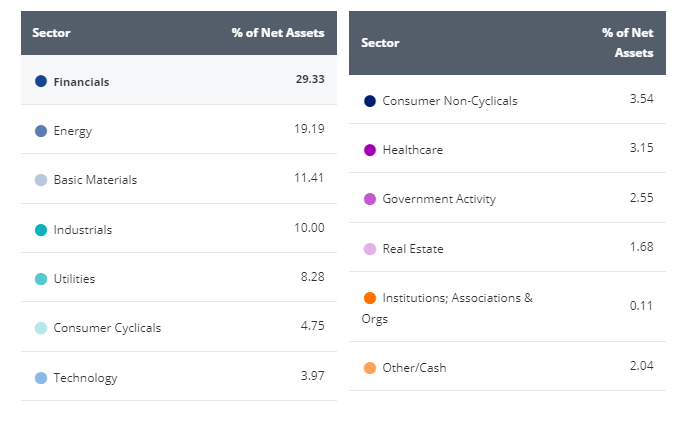
When we look at country allocation, the largest weighting goes to China, followed by Turkey and Brazil.
vaneck.com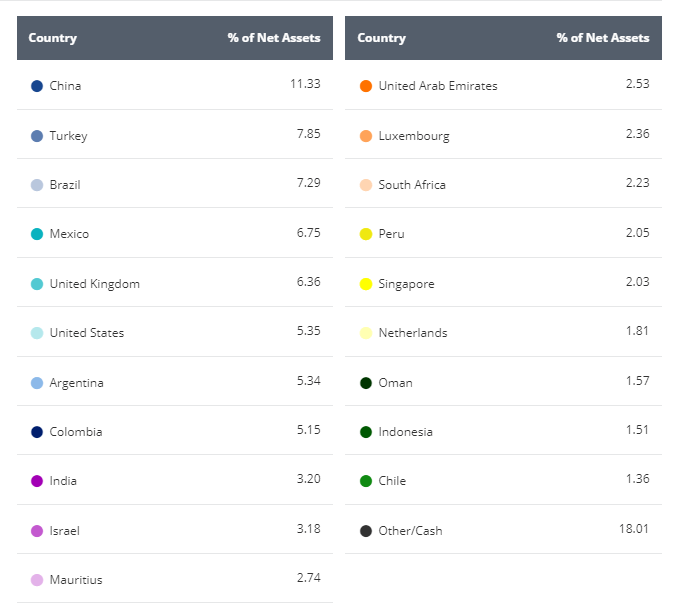
When considering investing in the HYEM ETF, it's useful to compare it to other similar funds like the VanEck Vectors J.P. Morgan EM Local Currency Bond ETF (EMLC). HYEM and EMLC are both exchange-traded funds offered by VanEck that provide exposure to emerging markets bonds, but they focus on different segments of the market. HYEM is designed to replicate the performance of the BofA Merrill Lynch Diversified High Yield US Emerging Markets Corporate Plus Index, targeting corporate bonds with high yields. On the other hand, EMLC aims to mirror the J.P. Morgan Government Bond Index Emerging Markets Global Core Index, with a focus on government bonds issued in local currencies. The cost of owning HYEM is slightly higher, with an expense ratio of 0.40%, compared to the 0.30% expense ratio for EMLC, indicating a minor increase in investment costs. The price ratio of HYEM to EMLC shows HYEM leading overall.
stockcharts.com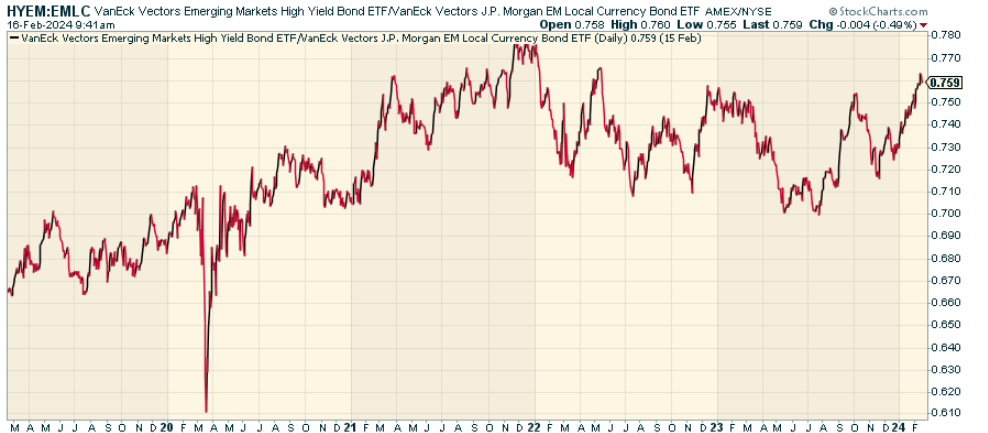
Like any investment, investing in HYEM comes with its own set of pros and cons that potential investors need to consider.
Broad Exposure: HYEM provides investors with access to an extensive selection of bonds across different emerging markets, aiding in risk distribution and possibly improving returns.
Opportunity for Enhanced Returns: Given its focus on high-yield bonds, HYEM presents an opportunity for increased returns when compared to investments in bonds with lower yields.
Expert Oversight: The fund benefits from the guidance of seasoned investment professionals, equipped with the knowledge and tools necessary to make strategic investment choices.
Risk of Default: High-yield bonds are often issued by companies or governments with lower credit ratings, which means there is a higher risk of default compared to investment-grade bonds.
Interest Rate Risk: As with all bond investments, there is a risk that changes in interest rates could negatively affect the value of the bonds in the fund's portfolio.
Emerging Market Risk: Investing in emerging markets can be more risky than investing in developed markets due to factors such as political instability, economic volatility, and less mature financial markets.
I would hold off here only because I expect there could be some credit market upheaval should the Dollar start to run away higher causing funding stress overseas, but consider this after a period of volatility in all markets. It's a good fund for what it does.