
vitapix
vitapix
Electronic Arts (NASDAQ:EA) has done a great job of innovating and expanding its reach in recent years. The company has managed to remain at the forefront of the gaming industry even as new genres have exploded in popularity. Despite the growing competitiveness in the gaming industry, EA continues to find a great deal of success with its flagship titles like FIFA, Madden NFL, and Apex Legends.
EA continues to successfully capitalize on the gaming industry's explosive growth.
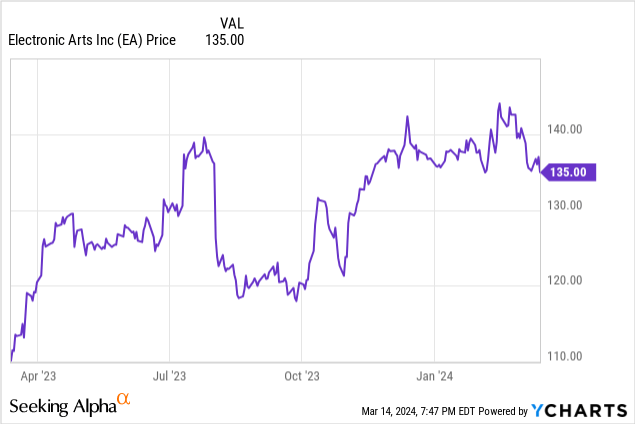
EA has managed to capture a significant share of the increasingly profitable global video game market. The company's highly diversified game lineup approach has allowed it to cater to a wide range of audiences, from sports fans to first-person shooter enthusiasts. EA's strong presence in most of the major gaming genres ensures that the company will experience steady flows of revenue and reduced volatility.
While EA may not be as innovative as other gaming companies, the company does a great job of adapting to new market trends. For instance, Apex Legends, which was largely a response to the battle royale trend, is now one of the most popular titles in all gaming. While EA was not the first to the battle royale arena, it was able to capture a significant portion of this market by producing its own quality battle royale game. By adapting rapidly to new trends, EA has continued to drive growth.
EA's partnerships and strategic acquisitions also continue to play a large role in the growth of the company. By acquiring smaller and lesser-known studios, EA has expanded its game portfolio and integrated new technologies into its gaming ecosystem. The company has also done a great job of partnering with sports organizations to secure exclusive rights for its sports titles.
The industry's transition towards digital distribution has been a major positive for EA, as it has allowed the company to bypass retail channels and reach consumers directly. Digital sales boast higher margins and have subsequently increased EA's profitability. What's more, the growth of the internet and the rise of smartphones has opened an entirely new market for EA.
EA's mobile gaming segment will likely continue to generate a large portion of the company's revenue, especially as it continues to port its popular titles onto mobile. Mobile games like FIFA Soccer or Star Wars: Galaxy of Heroes have experienced a great deal of success and have validated the company's push towards mobile.
EA continues to be one of the more financially stable gaming companies. While the company reported mixed Q3 results, with bookings of $2.37 billion missing expectations by $30 million, the company still managed to grow YoY. EA also beat Q3 GAAP EPS estimate by $0.19 at $1.07. EA still remains one of the more profitable video game companies despite a weaker quarter.
Other major pure plays like Take-Two Interactive (TTWO) and CD Projekt RED (OTCPK:OTGLY) are far more dependent upon their flagship franchises. This is reflected in the fact that their financials are heavily dependent upon the success of singular franchises. EA has avoided this problem by having a far more diversified lineup.
EA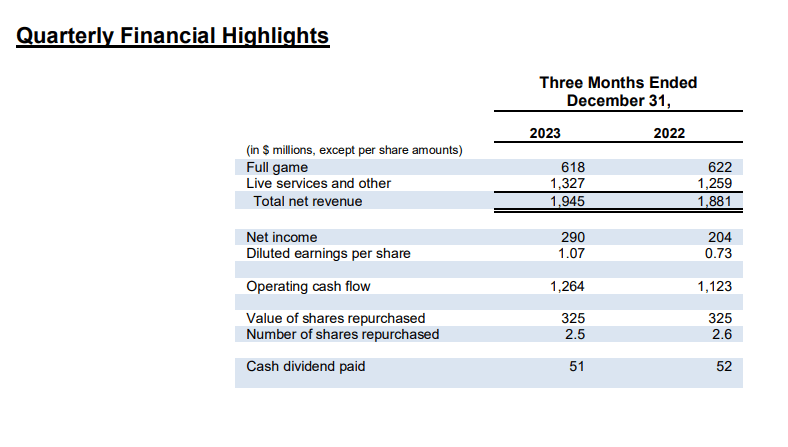
Most of EA's top franchises face intense competition in their respective genres. Battlefield and Apex Legends, which are some of their best-performing titles, are second in their genres to Call of Duty and Fortnite respectively. Now that Activision Blizzard has been acquired by Microsoft (MSFT), EA will have an even harder time competing against Call of Duty given Microsoft's sheer resources. On the other hand, Epic Games is heavily focused on Fortnite as it is their biggest title by far, which means that EA will have to continuously pour a great deal of resources into Apex Legends to remain competitive in the battle royal genre.
EA's sports titles are also highly dependent upon the popularity of the sports they emulate. If sports like American football were to wane in popularity, their popular franchises like Madden franchises would likely suffer as well. EA also needs to maintain good relationships with sports leagues in order to continue making games for them. What's more, EA faces stiff competition for licensing rights given how popular FIFA, the NFL, and the NBA are. The company has already lost its FIFA rights after negotiations fell through, showcasing the risks involved in building a brand around sports leagues.
EA is well-positioned in the booming video game industry. The company has a relatively low P/E ratio of 19 compared to other video game pure plays like Take-Two Interactive and Capcom (OTCPK:CCOEY), which have P/E ratios of 52 and 25 respectively. EA still has more room to grow at its current market capitalization of $38 billion.