
ArtistGNDphotography/E+ via Getty Images
ArtistGNDphotography/E+ via Getty Images
Last year was the first since 2017 where International stocks outperformed the US stock market. Hedging is continuing its superior results of 2022 into 2023 against US stocks also. Compared to unhedged International stocks, hedging these stocks has been the better investment 8 of the last 10 years, including the last three.
The purpose here isn’t to convince readers that hedging International stocks is the best asset class, but that over the past decade, the X-trackers MSCI EAFE Hedged Equity ETF (NYSEARCA:DBEF) provided better results compared to the iShares MSCI EAFE ETF (EFA), an unhedged ETF that invests in the same set of stocks. Whether an investor wants direct investment in non-US stocks is a topic another article.
Results show that the DBEF ETF gets a Buy rating for its long history of outperforming the EFA ETF, the unhedged alternative.

Seeking Alpha describes this ETF as:
The fund invests in public equity markets of global ex-US/Canada region. The investment seeks investment results that correspond generally to the performance, before fees and expenses, of the MSCI EAFE US Dollar Hedged Index. The fund, using a "passive" or indexing investment approach, seeks investment results that correspond generally to the performance, before fees and expenses, of the underlying index, which is designed to track developed market performance while mitigating exposure to fluctuations between the value of the U.S. dollar and the currencies of the countries included in the underlying index. The ETF launched in 2011. Benchmark: MSCI EAFE 100% Hedged NR USD
Source: seekingalpha.com DBEF
DBEF has $4.46b in AUM and investors incur 36bps in fees. Ignoring the current TTM Yield due to special payment, the ETF’s normal yield is between 2-3%. The 30-day SEC Yield is 3.1%.
Understanding the index methodology informs the ETF investors what to expect in holdings, allocations, and strategy.
The MSCI EAFE 100% Hedged to USD Index represents a close estimation of the performance that can be achieved by hedging the currency exposures of its parent index, the MSCI EAFE Index, to the USD, the "home" currency for the hedged index. The index is 100% hedged to the USD by selling each foreign currency forward at the one-month Forward weight. The parent index is composed of large and mid cap stocks across 21 Developed Markets countries and its local performance is calculated in 13 different currencies, including the Euro.
Source: msci.com indices
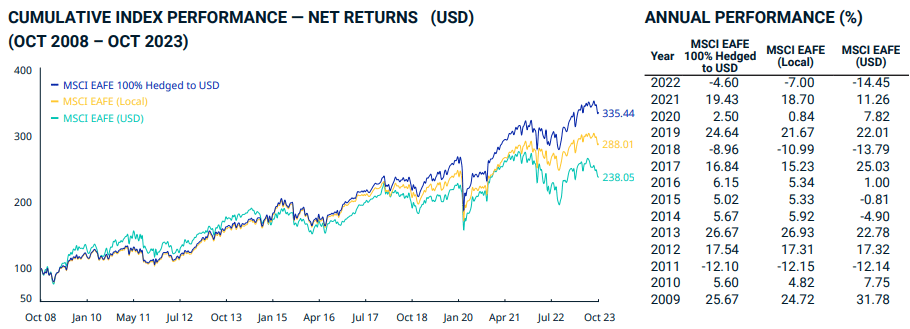
The next charts show how the three indices (hedged, Local, USD) have done since 2008.
msci.com/documents
Hedging beat the USD index 10 of the 14 years; against the Local index, 11 times.
seekingalpha.com holdings
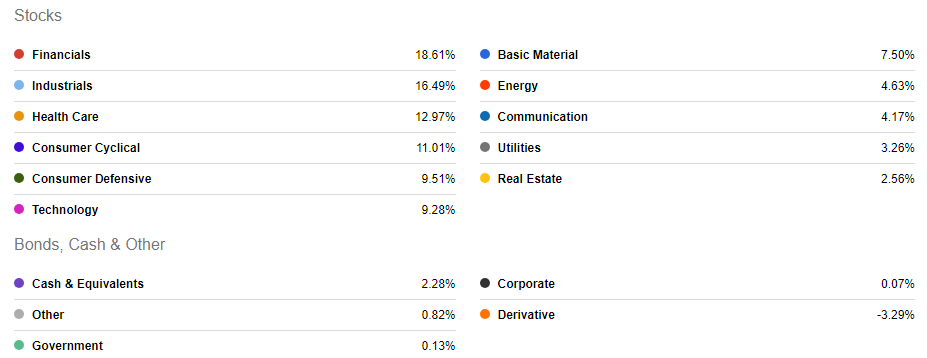
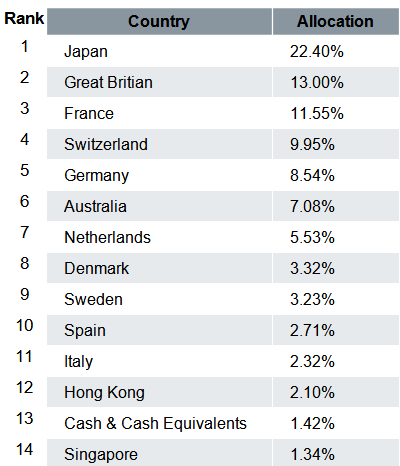
As with most International funds, it is not dominated by Technology stocks, unlike Large-Cap US funds. About 50% of the weight is in the top three sectors. As important with such a fund, is country allocations, which then drives the hedging required. There are 25 countries represented with just over 2% exposure to Emerging Markets via Hong Kong.
etf.dws.com countries
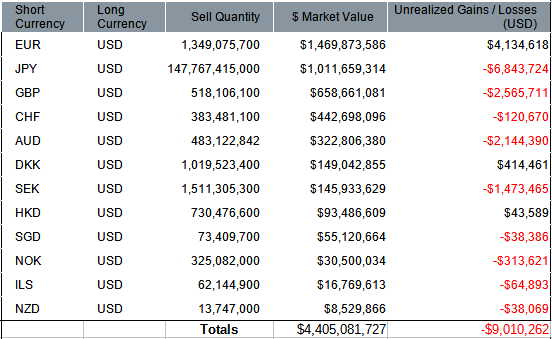
By region, 64% is in Europe, 34% in Asia, with the rest in North America or other assets. DEBF holds 848 stocks, with Novo Nordisk A/S Class B (NVO) being the largest position at 2.1%. Overall, the top ten account for under 16% of the ETF's weight. The hedging assets are as follows. The USD strength (or lack thereof) recently shows in the gain/loss column.
etf.dws.com/; compiled by Author
Great timing must account for the Euro hedging position being positive, as the Euro has been rising against the USD also. Reviewing past reports, today's unrealized gain/losses are at a low level.
Besides individual stocks and the currency hedges, DBEF has consistently owned 11-13 stock index futures to help maintain full exposure despite holding some cash.
I chose not to list the top stocks, as I believe the sector and country allocations are what really matters in a hedge or not analysis. That list is available on Seeking Alpha or the ETF's website.
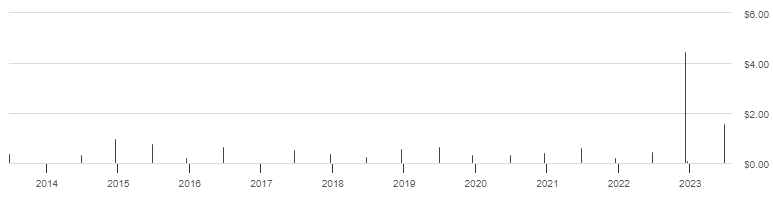
seekingalpha.com DBEF DVDs
When the hedging strategy "pays off", the ETF adds that income to the regular semi-annual distribution. The large extra payment last December came from Short/Long Capital gains, and the DBEF’s website shows no ROC has ever been used.
Seeking Alpha describes the comparison ETF, the iShares MSCI EAFE ETF as:
The investment seeks to track the investment results of the MSCI EAFE Index composed of large- and mid-capitalization developed market equities, excluding the U.S. and Canada. The index is a free float-adjusted, market capitalization-weighted. EFA started in 2001.
Source: seekingalpha.com EFA
When I compared the holdings of DBEF against EFA, I saw DBEF held 99% of the stocks held by the unhedged EFA. Only one sector had a measurable allocation difference, that being Health Care due to DEBF’s 2% overweight in Novo Nordisk A/S; only one other stock differed by .4%. This makes these two ETFs a good pair to gauge what a properly executed hedging strategy can achieve.
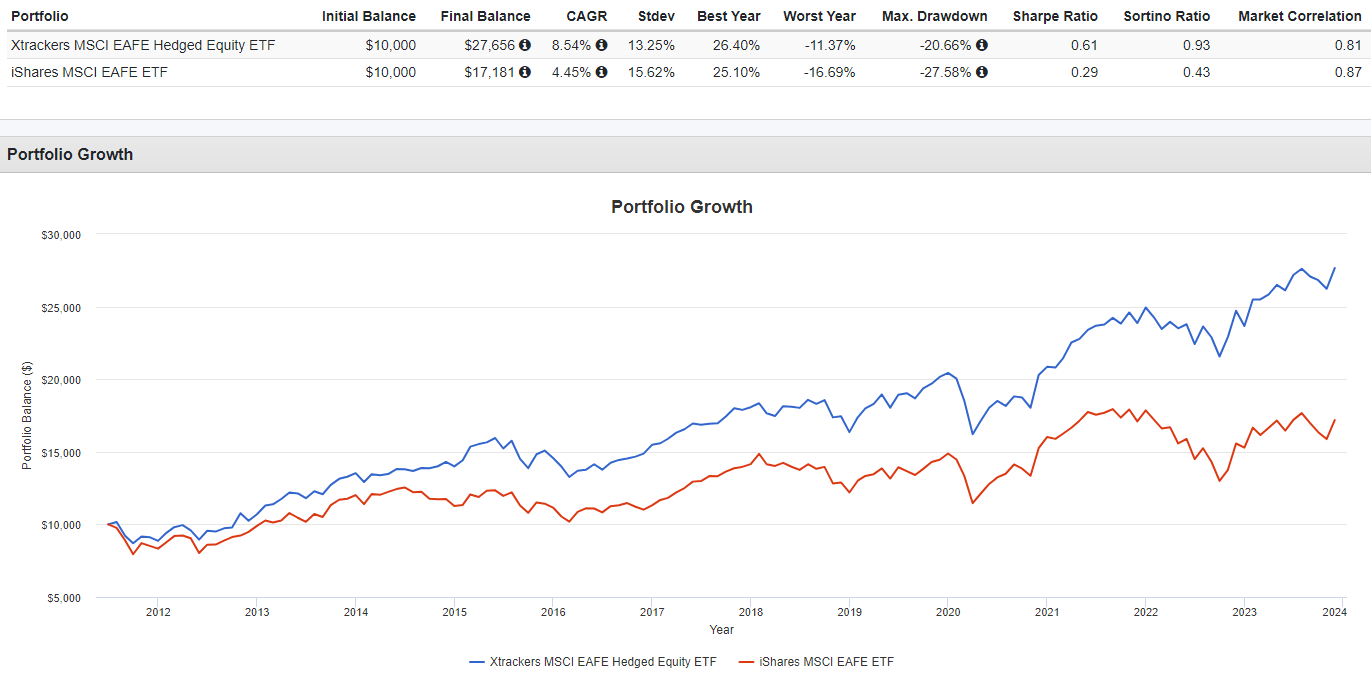
The above chart showed index history, the next one showed how the DBEF ETF and EFA ETF compared since DEF started in 2011.
PortfolioVisualizer.com
Long-term and within all the shorter time frames (1,3,5,10 years), DBEF treated investors better. While DBEF had the better monthly result only 55% of the time, the +29bps average over the months it trailed allowed DBEF to show a +409bps annual advantage over EFA since it launched.
As shown by the number of currency contracts, unlike regional ETFs, DBEF has to hedge many more currencies; about one dozen. As one might expect, the USD doesn’t move in lockstep to each currency, meaning that a hedging strategy is not always the best place to be.
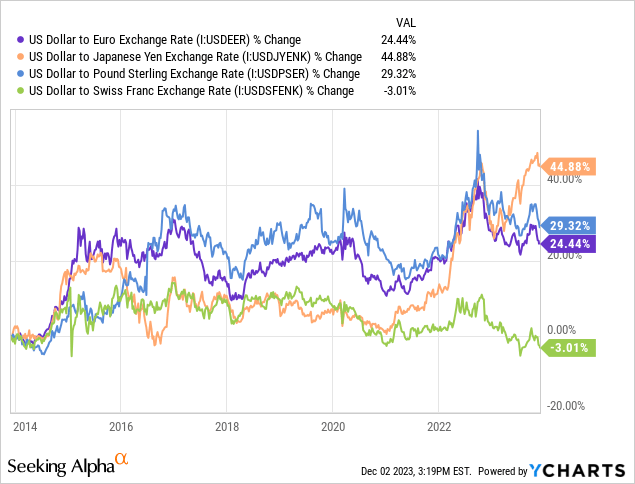
The dollar recently posted a 3% loss, its worst monthly showing in a year, as measured against a basket of six major currencies. For investors who want to use an active strategy between hedging or not their International equity exposure, factors that drive currency rates include currency reserve status, inflation, political stability, interest rates, speculation, trade deficits/surpluses, and public debt. I achieve that goal by owning both types of international equity funds.
For those of us following a more passive approach, results show that the DBEF ETF gets a Buy rating for its long history of outperforming the EFA ETF. New investors might wait to see if the recent USD weakness continues before establishing a position.
I previously reviewed other hedged ETFs that were outperforming their equivalent unhedged ETF.