
benedek
benedek
Late winter can be bleak. In addition to dirty snow, and long stretches without public holidays (if you’re an American at least), the optimism that begins with the New Year is tempered by practical realities. Given the German dual ethos of being both practical and realistic, it would be inconsiderate to paint a rosy picture of Deutschland at the moment. Attitudes around the industrial titan, and flagship economy of Europe, are bleak indeed. But how that translates to financial markets and potential utility in an investment portfolio is not a total 1:1. I like the underlying contents of DAX and their demonstrable resilience to a weakening macro environment in Germany. Today, we will look at the country that gave us (modern) beer, schnitzel, and Mercedes and one representative ETF – the Global X DAX ETF (NASDAQ:DAX).
The German economy was challenged in 2023, experiencing a contraction of 0.3%. The government recently downwardly revised its growth expectations in 2024 from 1.3% to 0.2%, and the downward revisions extend into 2025 per the Financial Times.
The Financial Times also pointed to Germany's constitutionally codified "debt brake", which limits budget deficits by law. This has hampered the government’s ability to invest in critical infrastructure such as railways and bridges for which Northern Europe is typically lauded, which in turn has also negatively impacted growth that that is factored into GDP forecasts.
According to the Financial Times, the political environment – like much of the industrialized world – is fractious. The Chancellor, Olaf Scholz, has seen weakened support for the three parties that make up his coalition, with the combined vote dipping from 50% in 2021 to around 30% currently. Continued protests over energy prices have garnered the attention of the press and are a demonstration of the displeasure of the German electorate.
The Global X DAX ETF tracks the DAX (Deutscher Aktienindex) index, which comprises roughly 43 premier German large-cap companies that trade on the Frankfurt Stock Exchange. The 10-year-old fund has roughly $53M in AUM. When compared to a peer universe, we see the fund has managed to gather the largest amount of assets, with a comparably low expense ratio (except for Franklin’s FLGR) relative to other Germany-focused ETFs.
Seeking Alpha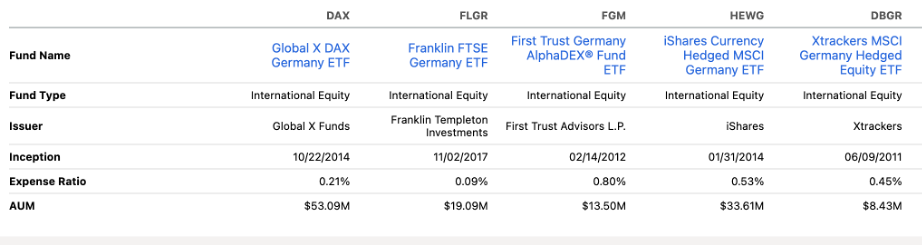
Roughly a quarter of the fund is allocated to Industrials, while 19% is allocated to Financials, with still roughly 15% to tech. This makes DAX fairly concentrated from a sector perspective, with approximately 60% of its holdings confined to these three sectors.
Seeking Alpha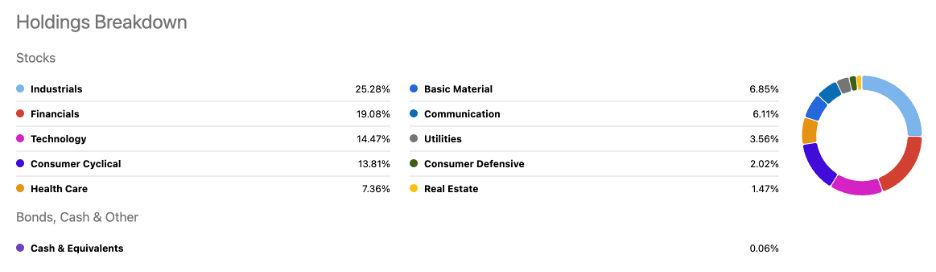
In terms of individual holdings, I like where DAX is allocated. The largest allocation to SAP SE (SAP) (11.15%), a multinational software company specializing in enterprise solutions. SAP has experienced several quarters of revenue growth, largely driven by its latest cloud offering. Year-to-date, SAP has returned 21.53%. An announcement in January that the company would restructure to emphasize integration of AI into its business pushed stock prices to new heights in Q1 2024. The fund’s largest financials holding, Allianz SE (OTCPK:ALIZF) (7.63%) has also experienced positive performance YTD. Allianz is a global insurer, with a diversified customer base that allows to it to maintain a level of resilience despite the local macro backdrop. Some other notable holdings include Airbus (OTCPK:EADSF)(6.84%), which for the fifth year in a row has bested Boeing in terms of plane deliveries and securing future orders. Boeing’s recent PR crises around the safety of their aircraft has also tallied points for Airbus in the global large aircraft duopoly. The fund sees about 60% of its AUM in its top 10 holdings, but given that the fund only holds 43 stocks total, it is not terribly concentrated in any one stock.
Seeking Alpha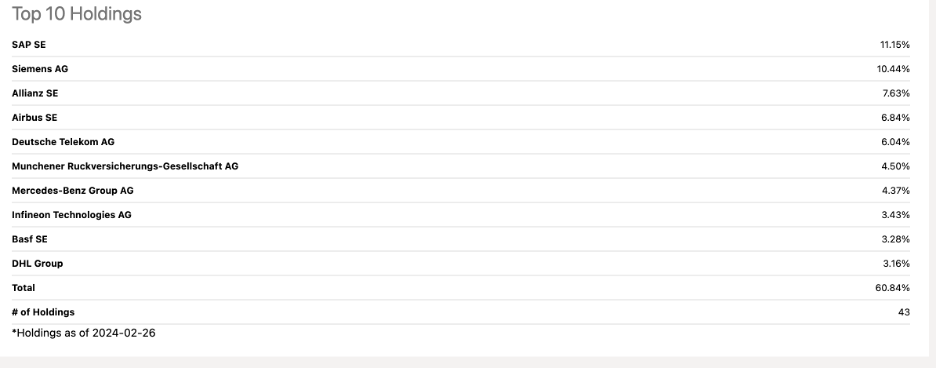
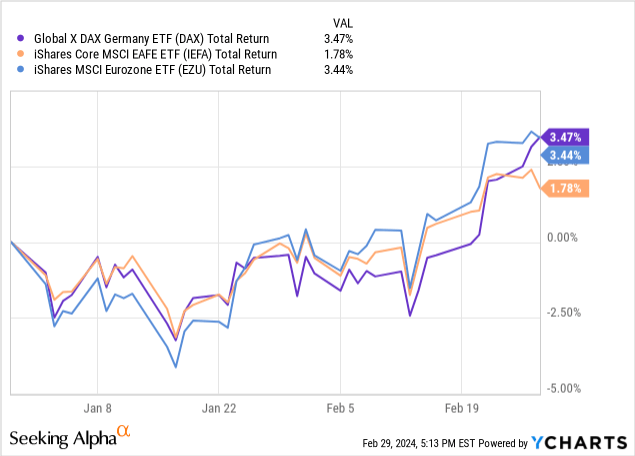
Year-to-date, DAX has outperformed both the broad developed ex-US market (IEFA) and marginally outperformed the Eurozone (EZU). EZU comprises roughly 25% of German securities, with a similar sector breakdown to DAX. When extending the look back period to 1 year, we see the fund has outperformed both IEFA and EZU more soundly.
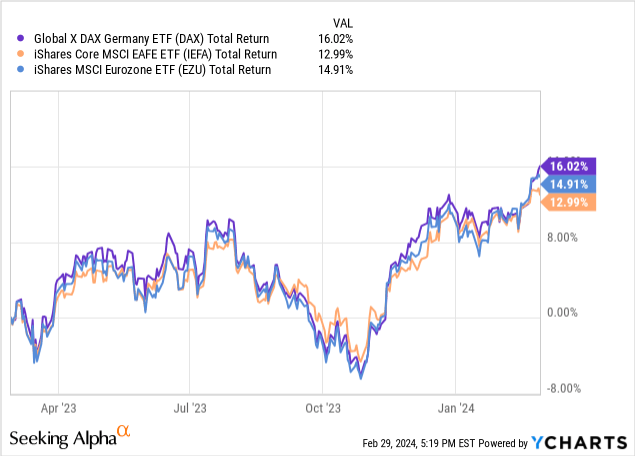
When comparing these three products in terms of risk, DAX remains more volatile than globally developed ex-us markets, while still less volatile than for the entire Europe region, despite delivering higher returns in the same period. On both an absolute and risk-adjusted basis, DAX outperforms EZU.
Currently, DAX has a weighted average PE ratio of 12.7, with a price to book of 1.5. This is in line with what we're seeing in terms of the broader Eurozone (13.8 and 1.7 respectively), so DAX isn't necessarily a steal in terms of value compared with all of Europe. The fund offers a somewhat modest yield of 2.40%, again which is slightly lower than both EZU and IEFA.
While the weakening macro environment hasn't necessarily impeded DAX thus far in 2024, there are looming future opportunities where the former could impact the latter. Nationwide strikes have occurred throughout Germany for the first two months of 2024; an expression of discontent for union workers who, among other things, want to negotiate higher wages to combat the effects of inflation. These strikes have occurred across different industries, notably travel, truck drivers, and agricultural workers. To the extent that these disruptions can eventually impact supply chains, DAX could suffer as a result. Given the pace of strikes and 2024, and long-term trend of increasing strikes in Germany, this could begin to impact investor confidence in the country.
Reutuers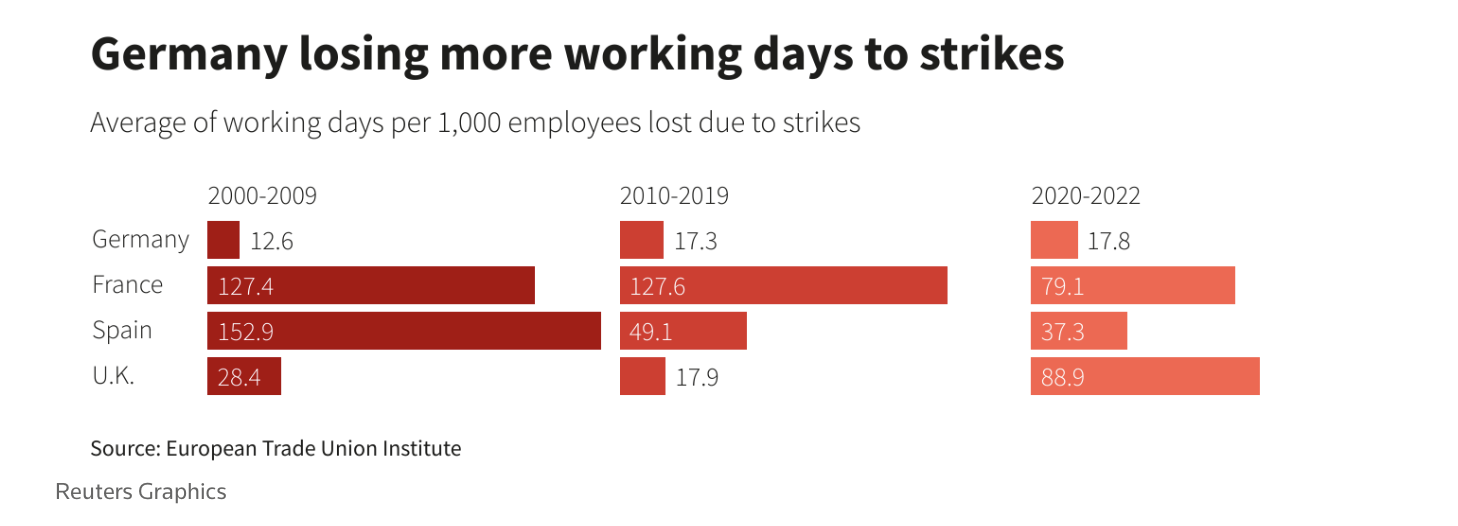
I said at the start that Germany often holds a special place in the imagination as a titan of industry, lauded for what it manufactures and for what it constructs within its borders (who doesn't love the autobahn?). The government builds roads, bridges, and energy pipelines. Structural impediments to Germany's near-term growth may threaten the construction of the latter, but for the time being, German-owned companies seem to be pressing on with their culture of innovation. Of course, with any investment carries risk. DAX remains concentrated, and the underperformance of single companies will directly impact DAX's performance. For the time being, DAX can offer blue-chip caliber exposure to investors who want to diversify outside of US markets, across several established companies for a fair price. I rate DAX as a BUY.
Editor's Note: This article discusses one or more securities that do not trade on a major U.S. exchange. Please be aware of the risks associated with these stocks.