
pingingz
pingingz
My followers know I'm extremely bullish on the future of the technology sector in the 21st Century. Indeed, the technology sector continues to see strong demand across a variety of tech sub-sector like semiconductors, software, high-speed networking, ML/AI, and data centers - just to name a few. I'm also bullish on the future of cloud computing, but today I'll explain why I would sell the First Trust Cloud Computing ETF (NASDAQ:SKYY) and, instead, offer some excellent alternatives.
Despite my reference to the old Rolling Stones song in the title, cloud computing is still a relatively new and rapidly-growing field. As you're aware, the emergence of AI will likely only accelerate the transition to cloud computing because it will be necessary for companies to utilize the cloud for low-latency high-bandwidth access to mega-data sets and LLMs in order to run the AI algorithms specific to their businesses on high-performance computers ("HPCs") like Nvidia's (NVDA) recently-released H200 Tensor Core GPU.
Indeed, research by Mordor Intelligence estimates that the cloud computing market is likely to grow at CAGR of 16%-plus over the next five years:
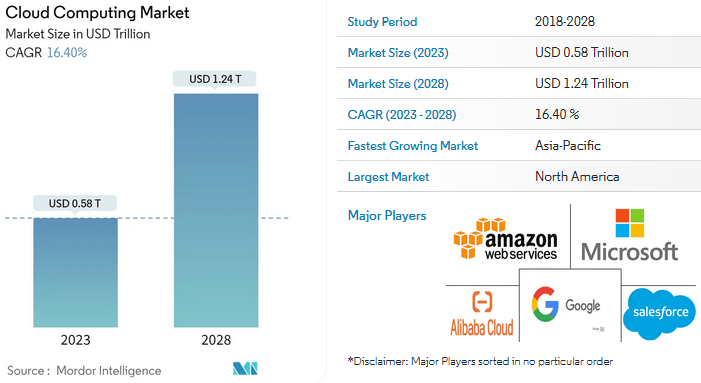
Mordor Intelligence
With that as background, let's take a closer look at the SKYY ETF to see how it has positioned investors for success going forward.
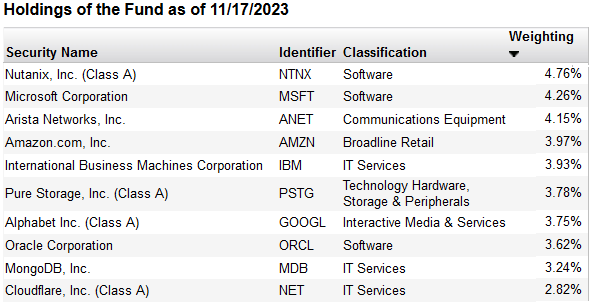
The top 10 holdings in the SKYY ETF are shown below and were taken directly from the First Trust SKYY ETF webpage where investors can find more detailed information on the fund:
First Trust
The top 10 holdings equate to what I consider to be a moderately well diversified 38.3% of the entire 66 company portfolio.
The No. 1 holding with a 4.8% weight is Nutanix (NTNX). Nutanix operates a global enterprise-scale cloud platform that specializes in a turnkey integrated virtualization, storage, and networking solution. NTNX is arguably richly valued with a forward P/E=47x in comparison to its FY24 estimated revenue growth (13%), yet the stock is up 40.8% over the past year.
Microsoft (MSFT) is the No. 2 holding with a 4.3% weight. Microsoft is well covered on Seeking Alpha so I won't go into details other than to mention the company's fast growing Azure cloud segment (No. 2 in cloud to Amazon's AWS) and recent news that legendary AI pioneer Sam Altman (and some peers ...) appears to be leaving OpenAI to make a new home a Microsoft. This development will likely enable MSFT to accelerate integration of AI across its platform (from Cloud to Office to individual consumers).
The No. 4 holding is Amazon (AMZN) with a 4.0% weight. According to Statista, Amazon's AWS is still the cloud-computing leader with a commanding 32% market share and a near 10 percentage point lead on No. 2 Microsoft:
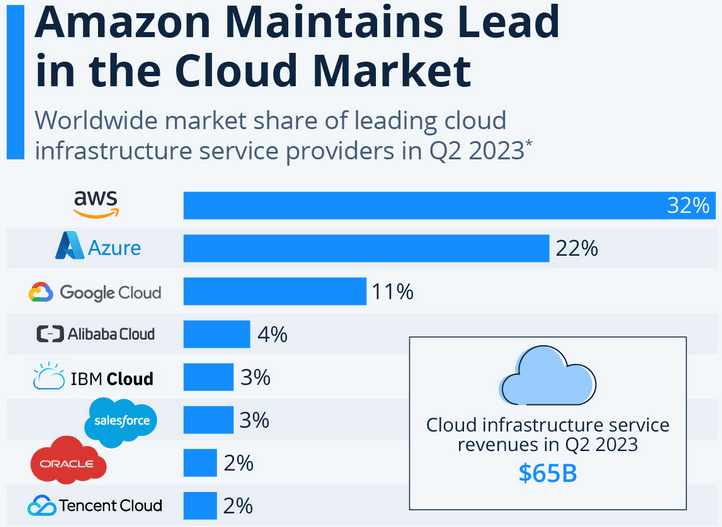
Statista
The No. 3 cloud provider, Google (GOOG)(GOOGL), is the No. 7 holding in the SKYY ETF with a 3.8% weight. As I have been reporting, Google has turned into a free-cash-flow generating machine (see Q2 Surprise: Google Generated $2 Billion More Free-Cash-Flow Than Microsoft). Google ended the most recent Q3 with $119.9 billion in cash. Assuming the company is earning 5% on that cash, that's potential net income of ~$6 billion annually just on what the company is earning on its cash-hoard.
MongoDB (MDB) is the No. 9 holding with a 3.2% weight. Mongo operates a general purpose multi-cloud database platform and can be considered as somewhat of a competitor to data analytics companies like Datadog (DDOG). Mongo stock is up 178% over the past year and currently trades with a forward P/E = 167x. FY24 revenue is expected to come in at $1.61 billion (+26% yoy).
As you can see from the top-10 graphic above, the majority of the portfolio is invested in Software and IT Services companies - in aggregate, 72% of the entire portfolio. The next highest sub-sector allocation is in Technology Hardware, Storage & Peripherals (~10%).
The average annual short and long-term total returns of the SKYY ETF are shown below:

First Trust
As you can see, the 10-year average total returns is a relatively attractive 11.8%.
The graphic below compares the five-year total returns of the SKYY ETF with a couple of its direct competitors: The Global X Cloud Computing ETF (CLOU), the WisdomTree Cloud Computing ETF (WCLD). For some relevant perspective, I also added the broad market indexes as represented by the Vanguard S&P 500 ETF (VOO), the SPDR DJIA ETF (DIA), and the Invesco Nasdaq-100 Trust (QQQ) to the comparison:
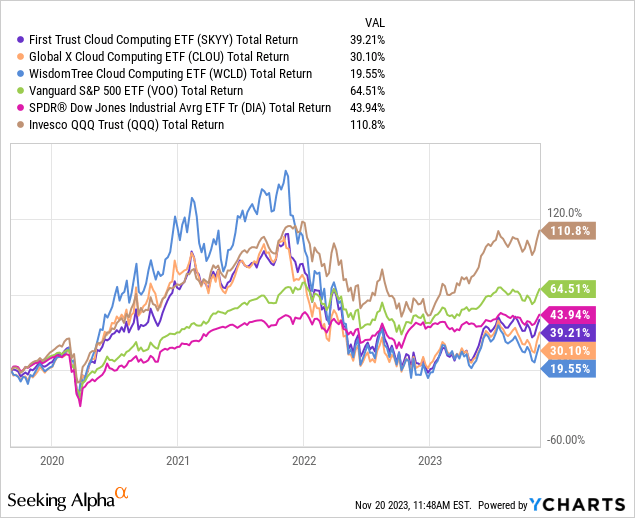
As you can see from the chart, and not surprisingly, the QQQ ETF has been the far-n-away winner, while the SKYY ETF failed to even match the returns of the S&P 500 and DJIA over the past five years, although it was the best of the three cloud computing ETFs.
The primary risks of investing in the SKYY ETF are threefold:
On point No. 3, I suppose one could argue that some of the smaller growth companies could well turn into acquisition targets for some of the leading and larger companies in the space. On the other hand, I would argue that the large companies - with the size-and-scale and the capital to invest heavily in the space (and can therefore more fully leverage AI across their platforms) - are at an advantage.
Meantime, and as I have opined in some of my other related Seeking Alpha articles, the larger software oriented companies - in general - will likely be the big winners in AI. That's because they all operate SaaS-based platforms that can be relatively easily scaled-up as they add new customers. And that, of course, leads to margin expansion. As a result, I continue to recommend funds like the iShares Expanded Tech-Software Sector ETF (IGV) and the Fidelity MSIC ETF (FTEC), and individual stocks like Google and Amazon. All of these funds and stocks have significantly outperformed the SKYY ETF over the past five years:
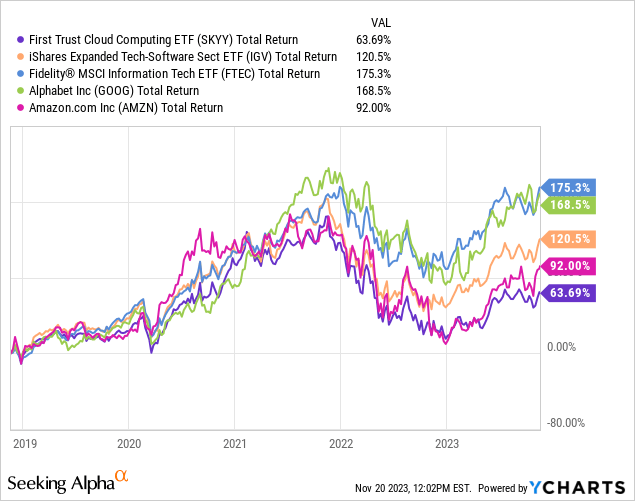
On the face of it, with an average 10-year average returns of 11.8%, the SKYY ETF appears to be a strong performer. That is, until you compare it to some of the alternative opportunities as shown in the previous graphic. I advise investors to Sell the SKYY ETF and its annual 0.60% expense fee and move the proceeds into one of the following: IGV, FTEC, GOOG, AMZN.