da-kuk
da-kuk
FormFactor (NASDAQ:FORM), a supplier of test and measuring solutions for the semiconductor industry, has been able to hitch a ride on the artificial intelligence or AI train. The stock has risen by benefiting from the consequences in the wake of outstanding results from the leading AI play, Nvidia (NVDA), as an ancillary player. This is set to continue with NVDA continuing to keep the AI factor in play by posting outstanding quarterly results in recent days. However, there is still reason to ponder whether the AI train stands a chance of being derailed. Why, will be covered next.
A previous article from last November rated FORM a hold after comparing the pros and cons of the stock. For instance, on the one hand, growth has come to a halt after an extended expansion due to a downturn in semiconductor demand. On the other hand, FORM stuck with its existing financial model, suggesting the current slump is seen as a temporary hurdle that will pass on its own.
Source: Thinkorswim app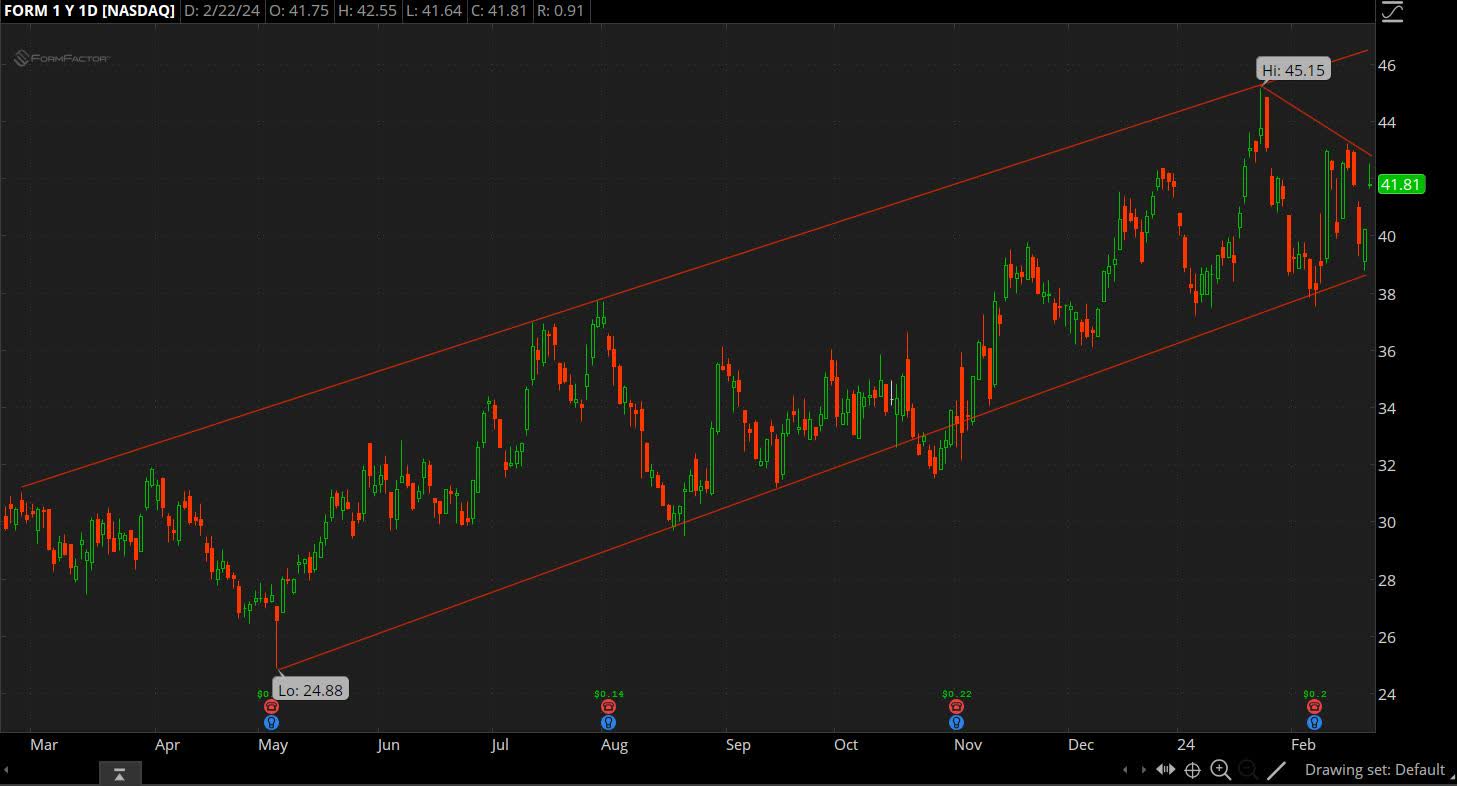
The chart above shows how the stock has kept on rolling, following the 52-week low of $24.88, set in May 2023. However, it's worth noting how the stock seems to have gone into consolidation mode after hitting a 52-week high of $45.15 in January 2024, following an extended move higher after the May 2023 low. In recent weeks, the lows are moving higher, yet the highs are moving lower. The rally seems to have paused, at least for now.
Still, the overall trend is pointing higher. The stock has been in consolidation before during the current uptrend. For instance, the Summer of 2023 shows similar price action with higher lows and lower highs and the stock continued higher following a period of consolidation. This could happen again with the current bout of consolidation. Trends can change, but if one were to place bets, the trend says they should be on the side of being long.
However, it's worth being mindful of the fact that while the stock has soared higher, earnings itself have not, at least not to the extent like the stock, unlike other AI plays like NVDA in particular. A look at the February report shows as much. FORM posted non-GAAP EPS of $0.20, in line with expectations, on revenue of $168.2M. The latter is up just 1.3% YoY, but the former represents an increase of 300% YoY.
It's therefore worth mentioning that Q4 benefited from favorable comps, which skewed the YoY comparisons. Q4 FY2022 was weighed down by restructuring charges of $8.4M, which lowered margins and earnings. In addition, Q4 FY2023 benefited from an income tax benefit, whereas Q4 FY2022 saw the opposite. Strip out these distortions and the change in EPS becomes flattish.
In terms of GAAP, FORM posted net income of $75.8M or $0.97 a share. This huge increase was mostly the result of the sale of FRT to Camtek (CAMT) for $100M, which resulted in a gain of $73M. If this one-time gain was excluded, GAAP EPS would be more like $0.03-0.04 and not $0.97. The table below shows the numbers for Q4 FY2023.
(Unit: $1000, except EPS) | |||||
(GAAP) | Q4 FY2023 | Q3 FY2023 | Q4 FY2022 | QoQ | YoY |
Revenue | 168,163 | 171,575 | 165,987 | (1.99%) | 1.31% |
Gross margin | 40.4% | 40.4% | 27.2% | - | 1320bps |
Operating income | 81,270 | 2,707 | (15,945) | 2902.22% | - |
Net income | 75,846 | 4,371 | (13,727) | 1635.21% | - |
EPS | 0.97 | 0.06 | (0.18) | 1516.67% | - |
(Non-GAAP) | |||||
Revenue | 168,163 | 171,575 | 165,987 | (1.99%) | 1.31% |
Gross margin | 42.1% | 41.8% | 31.7% | 30bps | 1040bps |
Operating income | 19,142 | 17,269 | 4,780 | 10.85% | 300.46% |
Net income | 15,744 | 17,316 | 4,148 | (9.08%) | 279.56% |
EPS | 0.20 | 0.22 | 0.05 | (9.09%) | 300.00% |
Source: FORM Form 8-K
FORM has seen its stock soar in the past year, but sales and profits went down during this time. The annual results are reflective of this. FY2023 revenue declined by 11.3% YoY to $663.1M. Non-GAAP EPS declined by 41.6% YoY to $0.73 and GAAP EPS increased by 61.5% YoY to $1.05, but it would have shrunk if not for the one-time gain mentioned earlier.
FORM finished with cash, cash equivalents and marketable securities totaling $328.3M, an increase of $83.9M QoQ, mostly as a result of the FRT sale and partially offset by a $14M term loan on the balance sheet. Note that most of the additional cash is slated to be used to buy back shares with a new $75M stock buyback program approved for the next two years.
(Unit: $1000, except EPS) | |||
(GAAP) | FY2023 | FY2022 | YoY |
Revenue | 663,102 | 747,937 | (11.34%) |
Gross margin | 39.0% | 39.6% | (60bps) |
Operating income | 82,756 | 54,912 | 50.71% |
Net income | 82,387 | 50,738 | 62.38% |
EPS | 1.05 | 0.65 | 61.54% |
(Non-GAAP) | |||
Revenue | 663,102 | 747,937 | (11.34%) |
Gross margin | 40.7% | 42.3% | (160bps) |
Operating income | 60,783 | 112,780 | (46.10%) |
Net income | 56,790 | 97,943 | (42.02%) |
EPS | 0.73 | 1.25 | (41.60%) |
Source: FORM Form 10-K
Guidance sees a sequential decline in the top and the bottom line. Guidance calls for Q1 FY2024 revenue of $160-170M, a decrease of 1.4% YoY at the midpoint. The forecast sees non-GAAP EPS of $0.15-0.23, an increase of 18.8% YoY at the midpoint, but also less than the preceding quarter.
(GAAP) | Q1 FY2024 (guidance) | Q1 FY2023 | YoY (midpoint) |
Revenue | $160-170M | $167.4M | (1.43%) |
Gross margin | 38.5-41.5% | 36.5% | 350bps |
EPS | $0.03-0.11 | $0.02 | 250.00% |
(Non-GAAP) | |||
Revenue | $160-170M | $167.4M | (1.43%) |
Gross margin | 39.5-42.5% | 38.4% | 260bps |
EPS | $0.15-0.23 | $0.16 | 18.75% |
Source: FORM Form 8-K
At first, the quarterly/fiscal results look rather lackluster at best, certainly not the kind of results one would expect considering the massive gains in the stock. Fortunately for FORM, the overall results were overshadowed by the potential payoff FORM could derive from the rising use of AI in the industry.
FORM is a provider of test probes, including for high bandwidth memory or HBM memory, from the three leading DRAM manufacturers. This includes SK Hynix, the leader in HBM memory. This HBM memory is used in close conjunction with GPUs, supplied by the likes of NVDA because HBM comes with much greater bandwidth than conventional DRAM, which results in faster and more efficient processing of data in AI applications, while also reducing latency, power consumption and the overall size of the module.
HBM memory is currently in great demand. In fact, the HBM market is growing by leaps and bounds, far faster than the DRAM market as a whole or the semiconductor market for that matter. For instance, while reports can differ in their numbers, a recent report predicts the HBM market will grow by an impressive 156% YoY from $5.5B in 2023 to $14.1B in 2024 in terms of value, one year after it doubled from $2.7B in 2022 to $5.5B in 2023. In comparison, the DRAM market is forecast to grow by 42% YoY in 2024 after contracting by 36% in 2023. The HBM market is expected to grow at a slower pace afterward to reach $38B in 2029, which implies a CAGR of 22% in 2024-2029.
This hypercharged growth is expected to trickle down to FORM, and the latest earnings call suggests FORM is reaping the benefits. FORM sees growth in Q1 DRAM revenue offsetting contraction elsewhere. This is similar to Q4, where a 31% QoQ increase in DRAM revenue offset a 13.3% decrease in foundry and logic revenue. From the Q4 earnings call:
Turning to the first quarter non-GAAP outlook. We expect Q1 revenues of $165 million, plus or minus $5 million. At the midpoint of our outlook range, Q1 revenues is expected to be approximately $3 million lower than in Q4. The expected decrease relates to lower systems segment revenues, mainly due to the sale of FRT in Q4. And in the probe card segment, we expect flat Foundry and Logic and lower Flash revenues in the first quarter, partially offset by the increase in DRAM revenues.
The sale of our Chinese subsidiaries that we announced today is expected to close in the first half of 2024, and it is not expected to have a significant impact on our financial results."
Source: FORM earnings call
More importantly, it is HBM that is doing the heavy lifting for the DRAM segment.
The second factor behind our strong DRAM outlook is the continuing acceleration in demand from multiple customers for probe cards to test high bandwidth memory or HBM. Together with the headline grabbing GPUs, HBM is a key enabler for generative AI, and we are forecasting nearly 50% sequential growth in our HBM probe card business in the first quarter."
The HBM segment is expected to grow by about 50% QoQ according to FORM. It is this kind of AI-related growth that has overshadowed all else to hog the spotlight.
The DRAM market, and the HBM market in particular, are expected to drive growth at FORM. In addition, the logic and foundry market is expected to grow in 2024. A recent forecast from TSMC (TSM) calls for the foundry market to grow by about 20% YoY in 2024. All this bodes well for FORM.
As shown earlier, FORM earned $0.73 on revenue of $663.1M. The stock closed at $41.81 on February 22, which translates to a trailing non-GAAP P/E ratio of 57.3x. In comparison, the median in the sector is 22.5x and FORM has traded at an average of 27.4x in the last five years. One could argue FORM is unappealing on this front, but FORM looks better on a forward basis.
Assuming the HBM market grows as fast as predicted and growth in the logic and foundry market returns, FORM is estimated to achieve sales of $710M by growing 6-8% YoY, which would result in non-GAAP EPS of about $1.05, recouping a big chunk of ground lost in FY2023 versus FY2022. This implies a forward non-GAAP P/E ratio of 39.8x with a stock price of $41.81 and EPS of $1.05. In comparison, the median is 26.5x and the average P/E ratio for FORM is 28.4x. Somewhat better than on a trailing basis, but not by all that much.
There are a couple of strong arguments to be made in favor of long FORM. The AI boom shows no sign of abating, and recent stellar results from NVDA show this as much. Demand for HBM should rise as well since they are used together with GPUs. FORM is seen as an AI play, not without reason due to its exposure to the AI boom.
The stock has moved higher after bottoming in May 2023 following stellar results from NVDA, which revealed just how fast the use of AI was taking off and which set off the hunt for AI plays like FORM. Its true trends can and do change at some point, but at the moment, the trend is on the side of higher stock prices for FORM.
Earnings fell by 41.6% YoY to $0.73 in FY2023, in contrast to where the stock headed in the past year, but they are expected to rebound in FY2024. This growth is expected to be driven by a rebound in semiconductor demand and spectacular growth in the market for HBM memory in particular, which is forecast to grow by 150+% this year according to some industry forecasts.
However, 2024 may be peak growth for the HBM market, with demand growth likely to slow in the following years. It's also not impossible the AI market may not grow as forecasted. While many companies are investing heavily in AI-related infrastructure, most have yet to show how to earn a profit from AI. If companies can't profit from AI, then it will be difficult to sustain AI spending.
Less spending on AI would ultimately make its way back to downstream players like FORM. Datacenter spending can also be lumpy in nature, and recent spending may not be representative of spending levels in the coming years. The HBM market is not likely to continue to drive growth at FORM like it is expected to in 2024. FORM will need other end markets to step it up to sustain growth over the long run. The problem is that there are currently no substitutes as far as the eye can see for what AI brings to the table.
It's a tough call to make since long FORM looks tempting, but I am going with neutral on FORM, mostly because of where multiples are and the arguably excessive reliance on AI. The AI growth has been priced in for the most part, but no provisions have been made for a possible slowdown in AI spending, whether due to AI not yielding a sufficient return on investment or some other reason that could cause companies to spend less on AI. The heavy dependence on AI may make FORM a risky bet in the long run.
While AI has done well, other segments of the market have been much less so. FORM has been driven by AI for almost a year, and this is likely to continue in the near term, assuming AI plays like NVDA keep posting stellar results like they did recently. But should AI somehow come up short down the road, AI plays like FORM are headed for the cleaners.