Juanmonino
Juanmonino
It has been four months since my last article on Bridgford Foods (NASDAQ:BRID) was published and not too much has happened since then, other than a release of their fourth quarter earnings, a tentative date of March 27th for their next Annual Shareholder's Meeting and a flattering article by Seeking Alpha author William Walsh. In addition, a new advertising campaign was revealed, featuring Mario Lopez.
Regarding this year's annual meeting. I'm looking for more color and update relating to the points that were emphasized by Michael Bridgford and Baron Bridgford II during last October's Annual Meeting. Michael, who runs the frozen food division claimed they were making big progress in their school food service channel (serving four of the largest school districts in the nation).
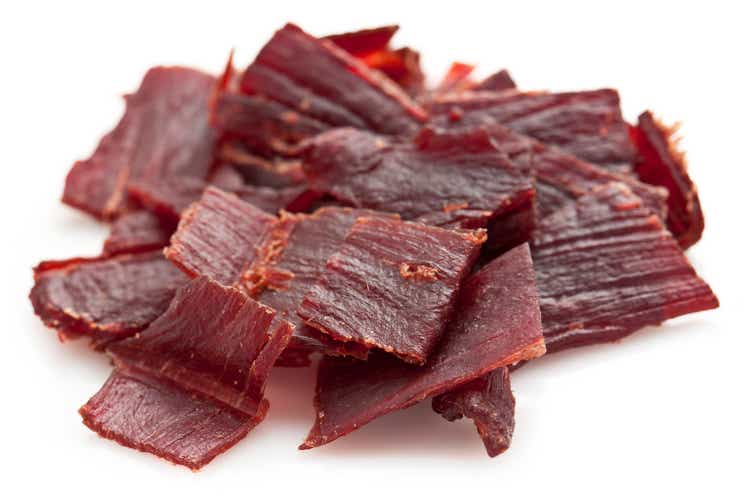
Baron emphasized improvement in the Chicago meat division. Baron claimed BRID is only scratching the surface with their newly acquired Target Stores (TGT) business as well and their penetration of the convenience store space in a very meaningful way (they are now the fourth largest beef jerky seller in that segment). Baron also highlighted their success in obtaining shelf space in 19 of Kroger's 20 divisions.
In addition, the meat division is test marketing food service items, for the very first time. In the past, the company didn't have the plant capacity to produce the larger sizes necessary, for that niche.
Fourth quarter earnings improved: Although sales fell 2.40% from $82,307,000 to $80,315,000, the enterprise was still able to increase its operating earnings significantly from $1,859,000 to $2,404,000 (a whopping 29.30% jump). SG&A costs were essentially unchanged at $20,175,000 while long term debt fell 27% from $3,824,000 to $2,786,000
The operating performance gain was attributable to a 138 basis point enhancement in its gross profit margin from 26.68% to 28.06%. Net cash increased 3.30% from $12,509,000 to $12,922,000 while shareholder's equity rose 2.54% from $126,325,000 to $129,535,000. The frozen food division made substantial improvement in its fourth quarter, producing a profit nearly offsetting all the losses they had sustained the first three quarters of their fiscal year.
First quarter results are right around the bend, slated to be issued during the early part of March. Expectations are mild on the top line, but solid on the bottom line. Look for earnings to jump 50% from 10 cents eps to 15 cents on sales of $60 million vs $61.60 million (a 2.60% erosion). This will be attributable to a 50 basis point increase in GPM from 28.06% to 28.56% and a corresponding 50 basis point drop in SG&A costs from 25.11% to 24.61%.
Here are my views, and these are my observations after listening and participating in last September's annual shareholders meeting (1) consumers are buying less because their disposable income has fallen (2) high fuel costs have hampered the company's 225 Direct Store Delivery route salesman. Equipping those delivery vans with expensive fuel every day is taxing (3) input prices such as flour, beef and pork have jumped (4) wage inflation has increased payroll costs (5) More automated checkout lines have reduced available space to sell impulse items (6) the company's lack of innovation such as ability to hedge the commodity markets is backwards thinking (7) not implementing buyback of their own shares in the open market (they are authorized to still purchase 120,000 shares) is disheartening (8) not willing to issue quarterly press releases is problematic (9) failure to update their IT functions (such as utilizing AI in DSD ordering or upgrading their antiquated website) (10) they have no interest in sharing their vision with the investing community by presenting at an annual small cap investment conference (11) their openness of going private and saving $500,000 to $1,000,000 per year on accounting, filing and regulation fees seems severely confined (12) potential for family nepotism
Although I am disappointed with some of these developments, I still hold out hope for improvement. As a matter of fact, I have submitted my own shareholder proposal for vote at next month's annual meeting. We will have to wait and see if they even accept my proposal. If so, will the Board of Directors support it or oppose it?
In the meantime, the stock price continues to languish: Since my last article, the share price has fallen about 2% (trading at just 5% above its 52 week low) despite the S&P 500 index increasing more than 18% to an all-time high, closing above the 5,000 milestone for the very first time. There is no denying the stock is exhibiting poor relative strength.
Bridgford's largest outside shareholders are still hanging in there and keeping their share counts relatively unchanged. This is good news because it implies, they still believe that the boat's rudder has been straightened and a clear path of improved profitability is imminent. The largest institutions holding BRID shares are the following:
(1) Dimensional Fund Advisors: 179,819 shares (2) Nuveen Asset Management LLC: 70,834 shares (3) Neuberger Berman Group LLC: 66,175 shares (4) Vanguard Group: 47,964 shares (5) Bridgeway Capital Management LLC: 23,100 shares (6) Northern Trust Corp: 18,581 shares (7) Geode Capital Management LLC: 17,038 shares (8) BlackRock Inc.: 4,489
Bottom line: By the way, I'm somewhere on that above list too, as I'm never afraid to put my money where my mouth is. I still think patience is a virtue when it comes to investing in value stocks and this one takes the cake in that department. That being said, the possibility of meaningful enhancement in shareholder value is real, powerful and compelling.
Editor's Note: This article covers one or more microcap stocks. Please be aware of the risks associated with these stocks.