
Funtap
Funtap
I recently saw that Vanguard expanded their offerings by launching the Vanguard Core Bond ETF (NASDAQ:VCRB). If I read correctly, this would be the fifth Vanguard ETF covering the total US bond market, with funds ranging in duration from short to long. VCRB is classified as an intermediate-term duration ETF, of which Vanguard has another, which is mentioned later and whose features are compared to VCRB. The Vanguard Core Bond ETF is too new to rate above a Hold, but I like the ability to have an actively-managed bond ETF in one’s fixed income allocation.
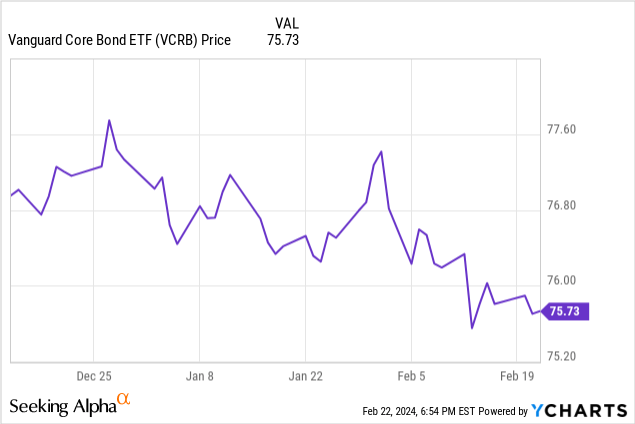
Vanguard describes their ETF as:
This actively managed fund seeks to provide broadly diversified exposure predominantly to the U.S. investment-grade bond market. The low-cost fund invests in U.S. Treasury, mortgage-backed, and corporate securities of varying yields and maturities (short-, intermediate-, and long-term issues). Using a disciplined, risk-controlled approach, the fund seeks to outperform the broad investment-grade market through security selection, sector allocation, and, to a lesser extent, duration decisions.
The Core Bond ETF is a stand alone product and is separate and distinct from the Vanguard Core Bond Fund (VCOBX and VCORX).
Source: investor.vanguard.com VCRB
VCRB started on 12/12/23 and is classified as an Intermediate-Term Bond. The ETF has $106m in AUM and despite being actively managed, the fees are just 10bps. Assuming the latest dividend is reflective of the future, the yield would be 3.7%.
Not sure why, but I failed to find the option of downloading the complete holdings for this ETF.
investor.vanguard.com holdings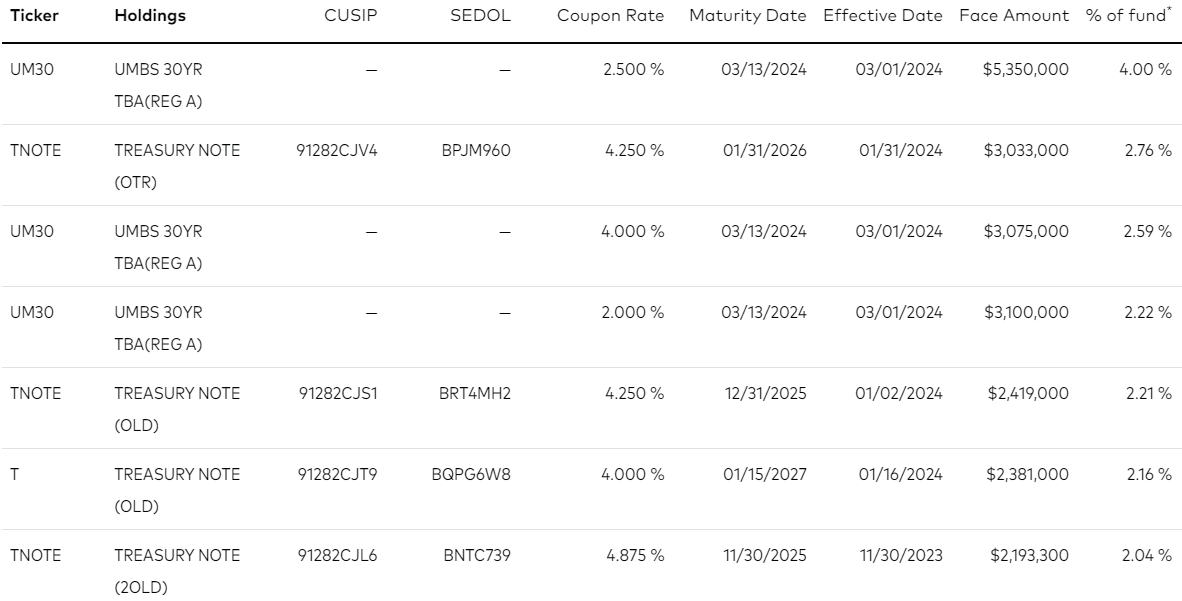
The top holdings show none of the non-government bonds they hold. There are only three corporate bonds in the Top 40 holdings, with the MILEAGE PLUS HOLDINGS LLC 144A at 1.27% weight being the largest.
This ETF has made only one full monthly payment, which being $.2315. Annualized, that comes to a 3.7% yield, a respectable amount.
Vanguard has another total market intermediate-term bond ETF, the Vanguard Intermediate-Term Bond Index Fund ETF (BIV). Vanguard describes this ETF as:
The Vanguard Intermediate-Term Bond ETF invests in the fixed income markets of the United States. It invests in investment-grade debt securities including government, corporate, and international dollar-denominated bonds with maturities between 5 and 10 years that are rated BBB- or above by S&P. It seeks to replicate the performance of the Bloomberg U.S. 5–10 Year Government/Credit Float Adjusted Index, by employing representative sampling methodology. Vanguard Bond Index Funds - Vanguard Intermediate-Term Bond ETF was formed on March 1, 1994.
Source: seekingalpha.com BIV
BIV has $38b in assets and charges just 4bps in fees. The TTM yield is 3.2%, the Forward yield is higher at 3.6%.
I found this description of the underlying index used by BIV:
The Bloomberg Barclays US Government/Credit Float-Adjusted 5-10 Year Bond Index is a Float-Adjusted version of the US Government/Credit Index, which tracks the market for investment grade, US dollar denominated, fixed-rate treasuries, government-related and corporate securities. Both the flagship US Government/Credit Index and the Float-Adjusted version exclude holdings of US Treasuries, but the Float Adjusted version also excludes US agency debentures held in the Federal Reserve SOMA account. To be included in the US Government/Credit Float-Adjusted 5-10 Year Index, securities must have at least five and up to, but not including, ten years to maturity. The Bloomberg Barclays Float-Adjusted index family was launched in July 2009 with an inception date of July 1, 2009.
Source: assets.bwbx.io/documents
Key features listed about the index included:
The newness of VCRB means some important data points aren’t yet provided, but sectors are, and the two ETFs do not invest the same. All data is sourced from the Vanguard site. The analysis starts with ratings.
| RATING | VCRB | BIV |
|---|---|---|
| AAA | 67.5% | 57.77% |
| AA | 0.4% | 2.39% |
| A | 9.9% | 18.32% |
| BBB | 20.6% | 21.56% |
| BB or lower | 2.3% | 0.0% |
Differences are small, so I wouldn’t see ratings as a deciding factor. That said, VCRB overall quality is slightly higher.
| Asset Sector | VCRB | BIV |
| Agency Mortgage Backed | 16.30% | — |
| Asset Backed | 0.73% | 0.06% |
| Bank Loan | — | — |
| Cash & Equivalents | 15.74% | 0.09% |
| Commercial Mortgage Backed | — | — |
| Convertible | — | 0.06% |
| Corporate Bond | 25.18% | 39.09% |
| Covered Bond | — | — |
| Future/Forward | — | — |
| Government | 41.68% | 56.44% |
| Government Related | 0.36% | 3.77% |
Along with sector differences, VCRB has slightly more overseas bonds, with a 4% exposure to EM bonds; BIV has under half that exposure. Based on the index description, there should be limited currency risk in either ETF. I did see VCRB held some currency futures for Euros and Japanese Yen.
| PRODUCT | U.S. MARKETS | NON-U.S. MARKETS | EMERGING MARKETS |
|---|---|---|---|
| Vanguard Core Bond ETF (VCRB) (As of 12/31/2023) | 91.12% | 3.93% | 4.02% |
| Vanguard Intermediate-Term Bond ETF (BIV) (As of 1/31/2024) | 89.46% | 8.52% | 1.75% |
Some important factors were available, and they show little differences between the ETFs, the biggest is the number of assets held. While maturities differ, effective duration is more important in how interest movements affect the portfolio.
| Factor | VCRB | BIV |
| Effective duration | 6.3 | 6.2 |
| Effective maturity | 10.1 | 7.2 |
| Est yield | 3.6% | 3.2% |
| Average coupon | 3.7% | 3.4% |
| Fees | 10bps | 4bps |
| Assets held | 185 | 2122 |
The low cost, okay yield for an ETF with a 6.2-year effective duration earns BIV a Buy rating for those wanting that exposure and preference for an ETF with a track record. The Vanguard Core Bond ETF is too new to rate above a Hold, but I like the ability to have an actively-managed bond ETF in one’s fixed income allocation. For those investors with faith that Vanguard can execute an active bond strategy, probably something new to them, then VCRB gets a Buy rating.
Intermediate-term bond funds allow investors to take the middle road on where interest rates are going. Those durations provide extra income over funds investing in short-duration bonds and will have less price damage compared to long-duration bond funds if rates climb and possibly with little loss in income. While it wasn’t the case in 2022, such funds should reduce portfolio volatility, which can become an important investment goal for investors as they age.